
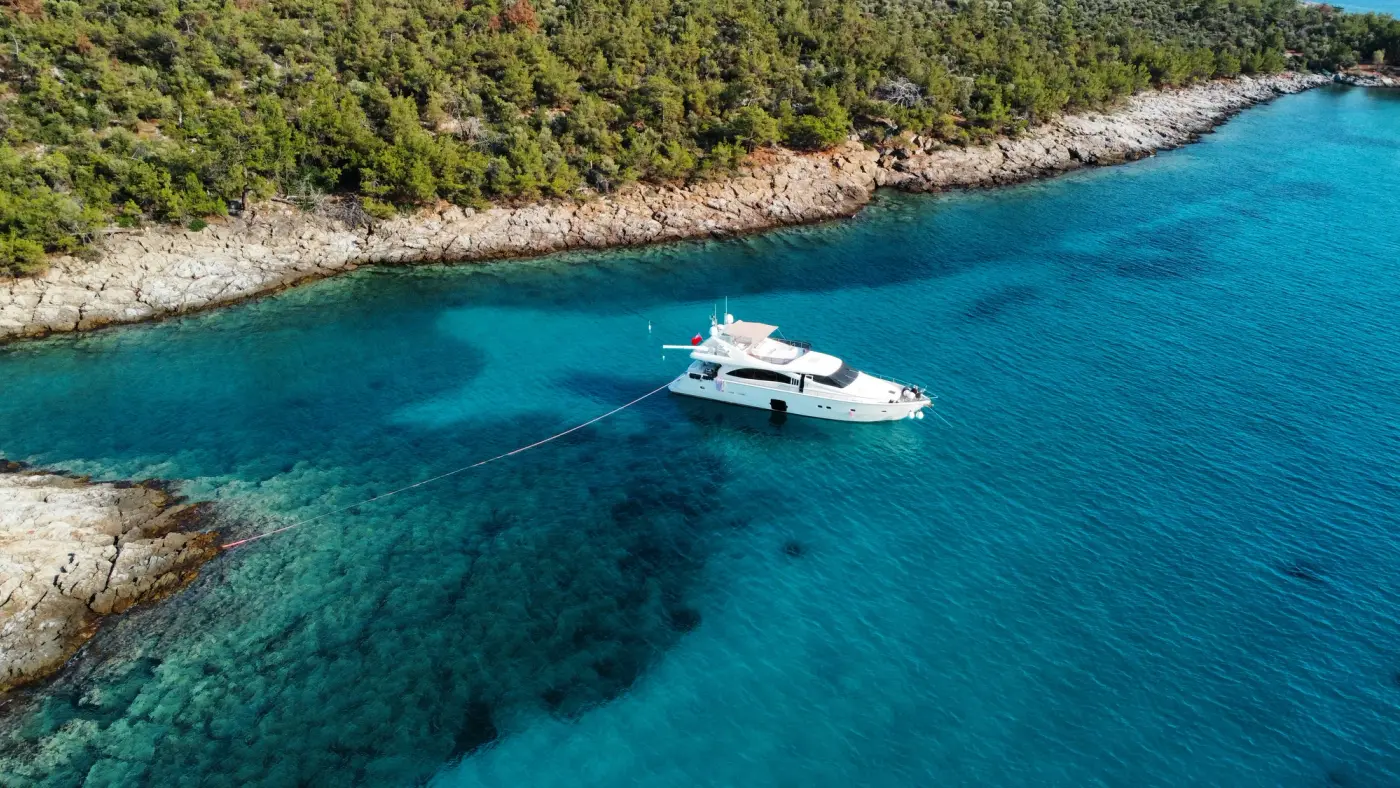
There is a word in the 2026 luxury travel reports that is everywhere at once. Hilton put it in their annual trend brief. Classic Vacations built a section of their Luxury Travel Trends Report around it. Travel Monitor ran it as a headline in March. Pinterest recorded a 530 percent year-on-year spike in searches for quiet travel destinations. The word is hushpitality - a new name for an old idea: the luxury of silence.
The industry reports describe it as a movement away from spectacle and toward restoration. Away from crowded resorts and toward intentional environments. Away from digital noise and toward presence. Classic Vacations frames it as low-stimulus escape; Hilton calls it the rise of silence as a status symbol; USTOA writes that the most powerful luxury experiences in 2026 are defined by subtlety, not spectacle.
They are all describing - in language from branding agencies - something the Aegean has been doing for three thousand years.
This is a working broker's account of hushpitality by sea. Where it already lives. Why Greek waters are uniquely suited to it. What changes when you book a charter with silence as the goal rather than status. And why the families who try this once rarely go back to the louder version of luxury.
What Hushpitality Actually Is - And Why It Broke Out in 2026
Hushpitality is not a brochure invention. It emerged in early 2026 from a convergence of independent data points across the luxury hospitality industry. Hilton's 2026 Trends Report identified it as one of four defining movements of the year, alongside whycation travel and intergenerational reconnection. Classic Vacations, the US luxury advisor network, coined the specific term in their Luxury Travel Trends Report published in February. Slojourn Studio, a boutique resort management group, described it as a shift toward environments that encourage guests to pause, reflect and reconnect with their surroundings.
The numbers behind the trend are real. Pinterest reported a 530 percent year-on-year increase in searches for quiet travel destinations in 2026. Hilton's survey data found that 73 percent of luxury travellers now prioritise digital check-in specifically for the privacy it affords; nearly half say they will carve out solo time even within family trips. Luxury villa specialists report a clear shift toward extended stays in fully private compounds, with multi-week retreats replacing the traditional one-week itinerary.
What the UHNW traveller is buying in 2026 is no longer excess. It is - in the phrasing of the USTOA's 2026 analysis - service that is intuitive, privacy that is protected, and a sense of place that replaces the need for display.
That is the market context. What follows is why Greek waters answer this trend more completely than any land-based product in the Mediterranean.
Why a Crewed Greek Yacht Charter Is the Purest Form of Hushpitality
The problem with hushpitality on land is that land is finite. A quiet resort borders another resort. A secluded villa shares roads, neighbours and flight paths. The silence is engineered rather than found, and it ends the moment you step past the property line.
A crewed yacht charter in Greek waters solves the problem structurally. The following are not marketing claims - they are operational facts that change the nature of the experience:
- Privacy is absolute. A vessel in a Greek anchorage answers to no lobby, no neighbours, no reception desk. There is no possibility of another guest. There is no requirement to leave.
- The destination changes with the day. Quiet on Wednesday. Different quiet on Thursday. A yacht can move to find silence; a resort cannot.
- The Greek archipelago contains more than 6,000 islands and islets. Fewer than 230 are inhabited. The arithmetic of silence is on your side.
- The crew is yours. A five-star hotel staffs three hundred people to serve three hundred guests; a crewed yacht staffs six to ten people to serve up to twelve. The ratio is the experience.
- Nature replaces architecture. The acoustic texture of a charter is wind, rope, water against hull, distant bells from the church on the next headland. No air-conditioning hum. No lobby music. No corridor footsteps.
None of this is new. What is new is that the global UHNW market has finally given it a name.
Seven Islands Where Silence Still Lives
Mykonos is not hushpitality. Santorini in August is not hushpitality. If you are reading about hushpitality, you are reading about a specific kind of Greek island that the charter industry - and most travel advisors - rarely surface, because they are difficult to reach without a yacht.
Seven that matter, in a working broker's order:
1. Sikinos
Population roughly 270. One main village perched on a ridge above the sea, two tavernas, a monastery built into a classical temple. No airport. No cruise port. The western Aegean's most complete silence.
2. Donoussa
The northernmost of the Lesser Cyclades. Population under 200. Three beaches reachable only by yacht or a long walk. The September anchorages at Kedros and Livadi are the sort of places guests ask to stay for a second night.
3. Iraklia
The smallest inhabited island of the Lesser Cyclades. 150 year-round residents. A cave system that rivals any in Greece. The bay at Livadi is clear to the anchor chain.
4. Amorgos
Larger than the others on this list, but most of the coast belongs to no-one. The Monastery of Hozoviotissa - clinging to a vertical cliff for nine centuries - is one of the few places in modern Europe where a crewed yacht guest can arrive by tender, hike up, and be genuinely alone with the view.
5. Anafi
Two hours southeast of Santorini by yacht. Population under 300. The second-largest monolithic rock in the Mediterranean rises from the eastern end. The south-facing bays are empty on any Tuesday in September.
6. Kimolos
A kilometre north of Milos, geologically related to Santorini, socially its opposite. Volcanic beaches the colour of ash and snow. Prassa bay's turquoise water is best reached by tender. Local population 900.
7. Kythira
Technically part of the Ionian but geographically Aegean-facing, off the southern tip of the Peloponnese. Largely undiscovered by international yacht traffic. The Kaladi beach anchorage is famously silent even in peak season.
None of these islands can be reached comfortably without a yacht. That is precisely why they remain quiet in 2026 when everything else has been found.
The Starlink Paradox - Hushpitality as Choice, Not Sacrifice
One of the quieter changes in the Greek charter fleet is that high-bandwidth satellite internet is now standard on virtually every serious charter vessel. Starlink Maritime covers the entire Greek cruising area with speeds that support video calls, cloud work, streaming and real-time markets access from any anchorage.
This sounds like the opposite of hushpitality. It is in fact its precondition.
Land-based digital detox destinations force disconnection. You are in a remote Bhutanese monastery because there is no signal, not because you chose the monastery. On a Greek charter with Starlink, the principal can take the one call that actually matters on Monday morning, then ask the captain to move to a bay with no phone reception for the next three days. The connectivity is there when required. The silence is there when chosen.
That is hushpitality as the 2026 UHNW traveller actually wants it - not off-grid by necessity, but selectively off-grid by choice. A hotel cannot offer this. A villa cannot offer it. A yacht does it by default.
The Multigenerational Case - Why Hushpitality Is the Only Family Trip That Works in 2026
Hilton's 2026 data includes a figure that most hospitality brands are still digesting: 84 percent of travelling families say they will prioritise play and shared experience over screens on their next trip. Skift's 2026 luxury hospitality analysis names multigenerational travel as one of the five defining themes of the year.
For a three-generation family - grandparents, parents, children - there is no land-based hushpitality destination that works. A boutique silent resort cannot accommodate a six-year-old. A secluded cliffside villa cannot simultaneously serve a 72-year-old with mobility limitations and a 28-year-old who wants wakeboarding before breakfast. A forest retreat cannot produce a dinner that the fussy middle child will eat.
A crewed yacht can. The same vessel, on the same day, delivers a silent morning swim for the grandparents, a water-sports hour for the teenagers, a private-tutor Greek cooking lesson for the aunt, and a nap in the shaded aft deck for the child who did not sleep. The structure forces three generations into the same physical space for eight hours a day - which is the entire point - while the crew absorbs the logistical load that would otherwise break a family holiday before the second evening.
This is hushpitality as family architecture, not as solo retreat. It is, in practical terms, the only version of hushpitality that can genuinely hold three generations at once.
What Changes When You Book for Silence Instead of Status
The decision to book a charter around silence - rather than around visibility, energy, or signalling - changes almost every variable in the brief. An experienced broker is trained to spot these differences during the initial call:
- Itinerary. Lesser Cyclades, Dodecanese south of Patmos, or the Ionian off-season, instead of Mykonos-Paros-Santorini.
- Timing. Mid-June, late-September or early-October instead of the 1-20 August block.
- Vessel profile. A displacement motor yacht with a soft generator signature, or a well-insulated large catamaran, rather than the noisiest planing yacht in the fleet.
- Crew brief. Anchorages chosen for acoustic isolation, not for visibility. Lunch in a deserted bay rather than at a beach-club restaurant. The captain's weather window optimised for glass water, not for fastest passage.
- Food. Local ingredients sourced island by island. Breakfast delivered whenever each of you chooses, not at a single hotel hour. A single long dinner instead of four competing restaurant bookings.
- Protocol. No public announcement of the vessel, the itinerary or the arrival. AIS transponder quiet-tracking requested where permitted. No crew social-media posts from the vessel.
Every one of these is a specific broker choice, made in advance, not a default. A charter booked through a broker who understands hushpitality looks materially different from a charter booked through a broker who does not.
A Morning I Remember
A guest I worked with last September - a partner at a New York fund, the kind of man whose phone is the second thing in his hand most mornings - anchored on the second night of the charter in a bay off the southern coast of Amorgos. Nothing organised. The captain simply chose a sheltered cove the family had not been to the day before.
He came up onto the foredeck at six the next morning before anyone else was awake. He sent a short message a few hours later: for the first time in eleven years, he had sat for forty minutes and heard nothing. No cars. No conversation. No device. No music. Only a halyard tapping the mast and a single shepherd's bell from the slope above the anchorage.
He said, I had forgotten silence was a texture.
That sentence - more than any search data, any Hilton report, any Pinterest trend line - is what hushpitality actually is. And it is what we sell, in the specific sense that we book the bay, the vessel, the morning, the captain, the absence of other guests. The silence is not an accident. It is the product.
Frequently Asked Questions
What is hushpitality and why is it the defining luxury travel trend of 2026?
Hushpitality is a luxury travel movement, formally identified in 2026 by Hilton's Trends Report and Classic Vacations' Luxury Travel Trends Report, that describes the shift away from spectacle and toward silence, privacy and restoration as the new status markers in UHNW travel. Pinterest recorded a 530 percent year-on-year increase in searches for quiet travel destinations. Hilton's data shows 73 percent of luxury travellers now prioritise digital check-in for the privacy it affords. It is the single most cited trend in the 2026 luxury hospitality reports.
Why is a Greek yacht charter considered an ideal hushpitality experience?
A crewed yacht charter in Greek waters offers structural privacy no land-based destination can match. The Greek archipelago contains over 6,000 islands and islets, fewer than 230 of them inhabited, with thousands of uninhabited anchorages. A vessel answers to no lobby and no neighbouring guests. The destination can change with the day, allowing the captain to select anchorages for acoustic isolation rather than visibility. And the crew-to-guest ratio - typically six to ten crew for up to twelve guests - is structurally incompatible with the ambient noise of any hotel, however high-end.
Which Greek islands are best for a quiet, hushpitality-focused yacht charter?
The most silent cruising grounds in Greece are accessed almost exclusively by yacht: Sikinos, Donoussa, Iraklia, Amorgos, Anafi, Kimolos and Kythira. These islands have populations between 150 and 2,000, no airports or cruise ports, and remain largely unseen by mainstream luxury travel because they cannot be reached comfortably without a private vessel. They are the natural choice for a hushpitality itinerary and can be combined with more well-known islands for balance.
Can you be digitally connected during a hushpitality yacht charter in Greece?
Yes. Starlink Maritime now covers the entire Greek cruising area on virtually every serious charter yacht, delivering speeds that support video calls, cloud work and market access from any anchorage. This is what separates modern hushpitality from earlier digital-detox trends. On a Greek charter, disconnection is a choice rather than a forced sacrifice - the connectivity is there for the one email that matters on Monday morning and absent for the three days that follow, at the guest's request.
Is a yacht charter the right hushpitality choice for a three-generation family?
It is the rare hushpitality environment that works for multigenerational travel. Hilton's 2026 data shows 84 percent of travelling families prioritising shared experience over screens. A crewed yacht delivers different paces for different generations in the same location on the same day: silent swims for grandparents, water sports for teenagers, private-tutor experiences for adults, and a crew that removes all logistical load. Land-based hushpitality destinations - silent resorts, remote retreats - typically cannot accommodate young children or mobility-limited older guests simultaneously.
When should a hushpitality charter in Greece be booked for best results?
The quietest Greek windows for a hushpitality charter are mid-to-late June and mid-September through early October, when crowds have thinned and the Meltemi wind has softened. These shoulder weeks also carry 15 to 25 percent lower charter fees than peak August rates. Premium vessels book from February through May for these weeks, not last minute. A broker conversation in the first quarter of the year for that year's shoulder season is the correct timeline.
How to Decide - Next Steps
Hushpitality is not the right frame for every charter. If you want the peak-August energy of Mykonos, if the trip is organised around a named beach club, or if the itinerary is driven by visibility, then this is not your brief. There is nothing wrong with that - it is a different product, and any honest broker will say so.
But if you are reading this because the idea of a genuinely silent morning - earned, chosen, specifically arranged - resonates, then the work of building the right charter begins before you look at any yacht. It begins with a conversation.
I offer a 30-minute consultation at no cost to walk through the brief with you. You can book the call directly here, or reach me on WhatsApp at +1 786 798 8798.
Explore More
- August or September in Greece? The honest 15-25% shoulder-season breakdown
- What actually happens on a crewed yacht charter in Greece - hour by hour
- Private yacht charter vs. 5-star hotel in Greece for a family of eight
- Browse available yachts for 2026
Sources and References
- Hilton 2026 Trends Report - annual global luxury travel trends analysis
- Classic Vacations 2026 Luxury Travel Trends Report - hushpitality coinage and industry framing
- Pinterest Trends 2026 - 530 percent YoY growth in searches for quiet travel destinations
- USTOA - 5 Ways Luxury Travel Is Being Redefined in 2026
- Skift - 5 Luxury Hotel Themes for 2026 (multigenerational travel, restraint, place-based design)
- Slojourn Studio commentary on hushpitality as environmental and design principle
- MYBA (Mediterranean Yacht Brokers Association), Standard Charter Party Contract, APA provisions
- IYBA (International Yacht Brokers Association), broker standards and ethics
- Hellenic Statistical Authority - Greek archipelago census data (6,000+ islands and islets, 230 inhabited)
- Working broker experience - crewed charters delivered in Greek waters
Written by George P. Biniaris, Managing Broker at George Yachts and IYBA Charter Active Member. Licensed skipper with hands-on experience across Greek waters. BSc in Shipping Management & Operations. Based in Athens. This article reflects working broker knowledge and current 2026 luxury travel market data.
P.S. The formalised version of this idea, the boat retreat, now has its own page: wellness weeks and executive off-sites on a private crewed yacht, with the real formats and figures.


