
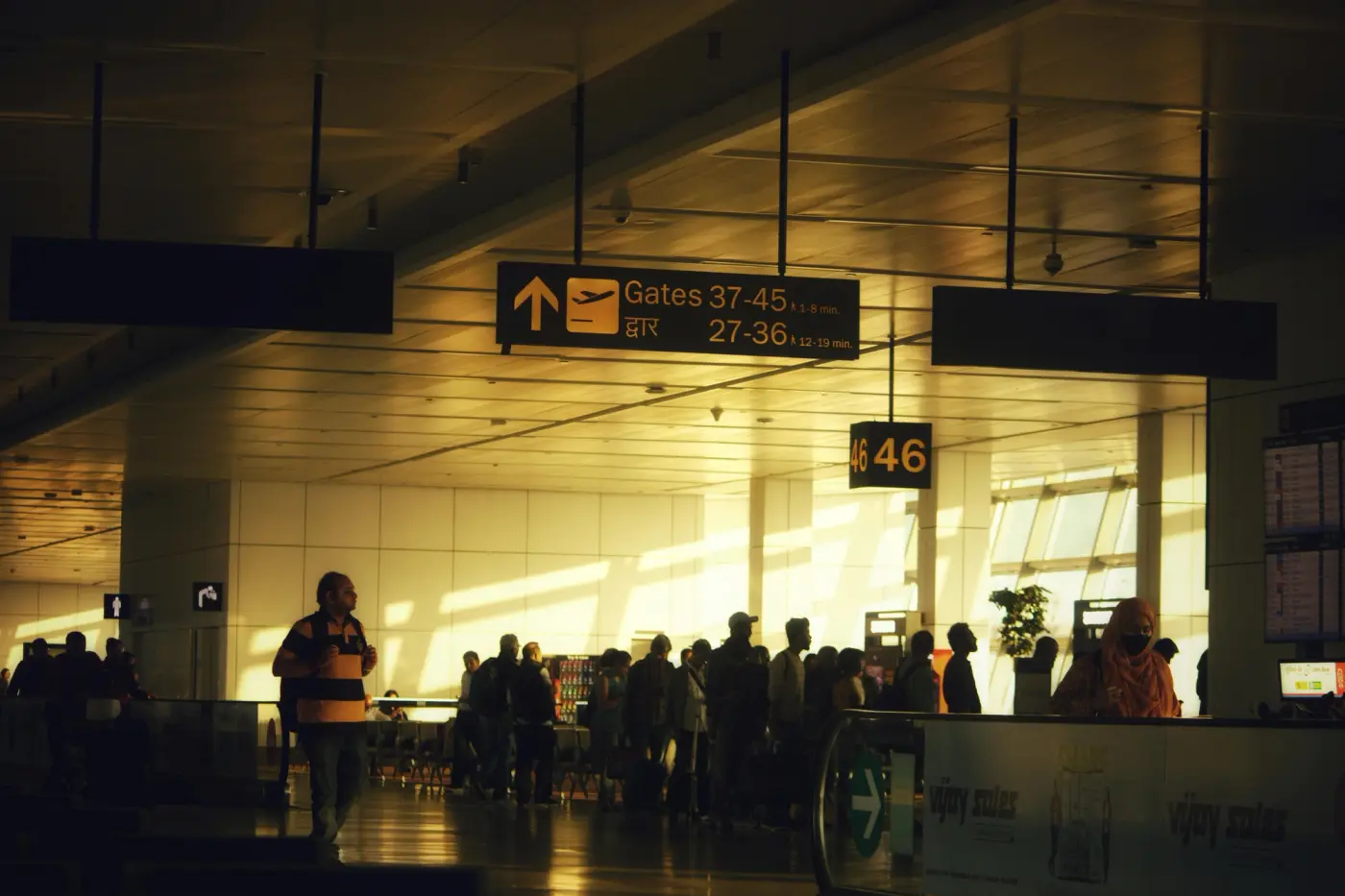
The smartest way to reach the Greek islands in summer 2026 is to never set foot in an airport terminal at all. A crewed yacht charter in Greece - boarded directly at Marina Zeas in Piraeus or the Port of Corfu - eliminates every point of failure that is currently breaking American air travel, from three-hour TSA queues to cancelled flights, while delivering a private, fully crewed voyage through the Aegean or Ionian Sea with zero dependency on the commercial aviation system.
Why Have American Airports Become a Liability for Luxury Travelers?
The US Department of Homeland Security entered a partial government shutdown on 14 February 2026. Five weeks later, the consequences for air travellers are no longer theoretical - they are systemic.
As of this week, 366 TSA officers have resigned since funding lapsed. At Houston Hobby International Airport, the single-day callout rate among security staff reached 55% on 14 March. Nationwide, the TSA callout rate has surged from a baseline of 2% to over 10%, with spikes above 30% in Atlanta, New Orleans, and Houston on peak travel days. Acting Deputy TSA Administrator Adam Stahl told Fox News that the agency has "fully depleted" its national deployment reserves and warned that smaller airports may be forced to shut down entirely if the funding impasse continues.
For the 171 million passengers expected to fly between March and April - the busiest spring break travel period in US aviation history - this means security lines stretching to three hours at major hubs, flights held at the gate because passengers are stuck in screening queues, and a cascading system of delays that no amount of PreCheck status can reliably circumvent.
The CEOs of American Airlines, Delta, United, Southwest, JetBlue, Alaska Air, FedEx, and UPS issued a joint open letter to Congress on 15 March demanding an end to the shutdown. Delta CEO Ed Bastian called the situation "inexcusable," telling CNBC that frontline TSA agents are "being used as political chips." The industry projects 2.8 million passengers per day through April. The infrastructure serving those passengers is, by every operational metric, failing.
Is the U.S. Airport Crisis a Temporary Disruption or a Structural Collapse?
What makes the 2026 airport crisis categorically different from a weather delay or a single airline's operational failure is that it is structural, recurring, and accelerating.
This is the third government shutdown to hit TSA workers in less than twelve months. During the full government shutdown of autumn 2025, more than 1,100 TSA officers resigned in October and November alone. Each replacement officer requires four to six months of training and certification. The workforce has not recovered from the last shutdown - and it is now haemorrhaging again.
Global Entry - the programme that allowed 13 million pre-vetted travellers to bypass standard passport control - was suspended entirely on 22 February. While it was reinstated on 11 March after 17 days of closure, the episode confirmed what every frequent traveller already suspected: the infrastructure that UHNW Americans once relied upon to insulate themselves from the mass-market airport experience is no longer reliable.
TSA PreCheck came within hours of being shut down on the same day. The decision was reversed only after direct intervention from the White House. Officers at airports including Denver and Seattle have organised public donation drives - asking passengers to contribute grocery and gas gift cards so that the people screening their luggage can afford to eat.
For a principal flying private from Teterboro to Athens on a Gulfstream or Global, much of this is irrelevant. But the moment that aircraft lands at Athens International, the client re-enters the same system: passport control queues, customs, ground transfers. And for anyone connecting through a US commercial hub - JFK, Atlanta, Miami - the exposure is total.
What Is the Zero-Airport Alternative for UHNW Travelers?
There is a category of summer travel that bypasses every node of this broken system. A crewed yacht charter in the Greek islands requires no airport security screening, no check-in counter, no gate change, no customs queue, and no baggage carousel.
Here is how it works in operational terms:
A client arrives in Greece by whatever means suits them - private aviation, a first-class commercial routing that avoids US hub connections, or in many cases, because they are already in Europe. At Marina Zeas in Piraeus - twelve kilometres from the centre of Athens - or at Marina Alimos, or at the Port of Corfu, or at Mandraki harbour in Rhodes, they step aboard their vessel. The captain, chef, and crew are already on board. Provisioning is complete. The itinerary is loaded. There is nothing between the client and the Saronic Gulf - or the Cyclades, or the Ionian Sea - except the gangway.
No terminal. No queue. No one asking you to remove your shoes.
For the next seven, ten, or fourteen days, the vessel is simultaneously transport, accommodation, dining, and privacy. Every island - Hydra, Spetses, Poros, Mykonos, Paros, Milos, Santorini, Corfu, Paxos, Kefalonia - is a destination accessible without a single interaction with any aviation or ground transport system. When the charter ends, the client disembarks at the marina of their choice. If that marina happens to be a short transfer from a private aviation facility, the return journey mirrors the outbound: seamless, private, airport-free.
Why Are Ultra-Wealthy Travelers Choosing Yacht Charters Over Flights in 2026?
The convergence of three simultaneous disruptions has made the crewed yacht charter model not merely attractive but structurally superior for UHNW summer travel in 2026:
The Airport Crisis
The TSA shutdown, the recurring government funding failures, and the degradation of trusted-traveller programmes have made commercial aviation exposure a genuine operational risk for high-value travel. It is not a question of comfort - it is a question of whether you arrive. DFW alone expects 4.7 million spring break passengers. The system is at capacity with a depleted workforce. Peak summer will be worse.
The Geopolitical Pivot
The ongoing Iran conflict has closed the Strait of Hormuz, removed Dubai and the Gulf from the luxury travel map, elevated Cyprus to a Level 3 travel advisory, and driven an unprecedented reallocation of UHNW summer demand toward the Eastern Mediterranean. Greece - a NATO member operating under EU maritime law, with the Hellenic Coast Guard maintaining robust patrols from the Saronic Gulf to the Dodecanese - is the beneficiary. The pivot is already visible in summer 2026 charter availability in Greece, where premium vessels for July and August are filling weeks ahead of any previous season.
The Value Proposition of Fixed-Price Travel
A crewed yacht charter operates under a MYBA (Mediterranean Yacht Brokers Association) contract. The base charter rate is fixed at signing. It does not reprice when oil crosses $120 a barrel. It does not carry a fuel surcharge that appears on checkout. The Advance Provisioning Allowance (APA), typically 25-35% of the base fee, covering fuel, provisioning, berthing, and crew gratuity - is calculated transparently before departure based on the planned itinerary and current fuel pricing. Any unused APA is refunded.
Compare this to the financial unpredictability of commercial aviation in March 2026: dynamic pricing, war-risk insurance surcharges on certain routes, cancellation and rebooking fees when flights are delayed by TSA staffing failures, and lost hotel nights when connections break. The charter is, paradoxically, the more financially predictable option. For a detailed breakdown, see our guide to MYBA charter contract and APA budgeting.
What Does a Week Without Airports Actually Look Like?
Consider a ten-day crewed charter departing Marina Zeas in Piraeus, heading south into the Cyclades.
Day one: you board at the marina in the late afternoon. The crew has already stocked the galley based on your provisioning preferences - submitted two weeks prior. Dinner is served at anchor off Aegina, with the Temple of Aphaia lit on the hillside above.
By day three, you are anchored in the volcanic caldera off Milos, at Kleftiko - a formation of white rock arches and sea caves accessible only by water. Your captain has timed the arrival to avoid the midday excursion boats. You have the anchorage to yourself until mid-morning.
Day five: Paros. You tender ashore at Naousa for lunch at a harbourside taverna your chef has been coordinating with since last week. The children swim off the stern platform while you walk the backstreets. No one asked for your boarding pass.
Day eight: Santorini. Not the cruise-ship dock at Fira - your captain anchors off Oia, and you tender to a private beach transfer arranged in advance. You watch the sunset from the caldera rim, then return to the yacht for a dinner prepared with ingredients sourced that morning from the Santorini cooperative.
Day ten: you disembark at Mykonos town quay, or back at Marina Zeas, or wherever the itinerary concludes. Your luggage is carried to your ground transfer. You have spent ten days moving between five islands, dined twenty times, slept in the same bed every night, and interacted with zero airport systems.
This is not a hypothetical. This is what a standard crewed yacht charter in the Greek islands delivers, every week, from April through October.
George's Inside Info: This season, I am seeing a specific pattern I have not observed before: US-based clients who hold both private aviation accounts and commercial first-class memberships are requesting charters that begin and end at the same marina - specifically to avoid the need for any inter-island flight connection. In previous years, a client might fly Athens to Mykonos and board there. In 2026, they want the yacht to be the entire transport layer. I had a family office in Connecticut request a 21-day charter - Athens to Athens via the Cyclades and the Dodecanese - specifically because the principal refused to interact with any airport, US or European, for the duration of the summer. The yacht was not the destination. It was the infrastructure.
How Do UHNW Clients Actually Get to Their Yacht Without Flying Commercial?
The most common objection to the zero-airport model is the transatlantic crossing itself: you still need to get to Greece. True. But the exposure is fundamentally different when the routing is designed to avoid US commercial hub chaos.
Private aviation: A Gulfstream G700 from Teterboro to Athens Eleftherios Venizelos is approximately 10.5 hours. The client clears a private FBO - no TSA, no commercial terminal, no queue. A ground transfer from the airport to Marina Zeas takes 35 minutes. Total system exposure to commercial aviation infrastructure: zero.
Commercial first class via non-US hubs: Clients connecting through London Heathrow, Zurich, Frankfurt, or Paris CDG avoid the US domestic hub entirely. European airport operations have not been affected by the DHS shutdown. A first-class routing from New York to Athens via London, with a dedicated lounge transfer at Heathrow, adds one controlled touchpoint - not the chaotic multi-hour ordeal currently unfolding at JFK or Atlanta.
Clients already in Europe: For UHNW families maintaining residences in London, the South of France, or Switzerland, Greece is a short-haul flight or - increasingly - a repositioning voyage from the western Mediterranean. Several of my clients this season are having their chartered vessels repositioned from the Italian or Croatian coast to Corfu, joining the yacht in the Ionian without any Greek airport interaction at all.
What Yacht Charter Availability Remains for Summer 2026?
Availability is contracting rapidly. The combined pressures of the airport crisis, the Gulf-to-Aegean geopolitical pivot, and the general surge in luxury travel demand have compressed the 2026 booking window significantly.
As of the third week of March 2026, here is what I am seeing across the fleet I represent:
June: Strong availability across most vessel types and itinerary areas. Shoulder-season pricing applies. The Meltemi - the prevailing northerly wind that defines Aegean sailing conditions in high summer - has not yet established, making June ideal for Cyclades itineraries that include open-water crossings.
July (first two weeks): Moderate availability. Motor yachts in the 24-35 metre range are filling quickly. Gulets - the traditional wooden sailing vessels that offer exceptional volume, deck space, and value per metre of LOA - still have select windows. The Saronic Gulf and Ionian remain more open than the Cyclades.
July (second half) and August (first two weeks): This is peak season, and it is nearly gone. Premium vessels are committed. What remains requires a broker who knows where the gaps are - a cancellation window here, a repositioning opportunity there, an owner who has released a vessel late. This is not inventory that appears on any public platform.
August (second half) and September: Opening up. September, in particular, represents extraordinary value: warm seas, reduced Meltemi intensity, fewer vessels at the popular anchorages off Koufonisia and Folegandros, and pricing that reflects shoulder-season rates on vessels that were commanding peak premiums two weeks earlier.
Why Choose a Broker Who Operates Outside the Traditional System?
George Yachts Brokerage House LLC does not operate a booking portal. We do not list vessels on aggregator platforms. We operate through direct relationships with vessel owners, captains, and operators across the Ionian, the Cyclades, the Saronic Gulf, and the Dodecanese.
In practical terms, this means: when the public-facing platforms show 'no availability,' we frequently know otherwise. When an owner decides to release a 28-metre gulet for two additional charter weeks in August - because their personal-use plans changed - that availability comes to us first, through a phone call, not through a database update. When a client needs a specific crew configuration - a captain experienced in Meltemi conditions, a chef trained in plant-based gastronomy, a vessel with shallow enough draft (under 2 metres) to access the inner bays of Koufonisia - we source it directly.
We hold a US corporate registry in Wyoming, giving our American clients the legal familiarity and transactional clarity they expect. We operate exclusively under MYBA charter contract standards. Our APA budgeting is fully transparent - modelled on current fuel pricing, your specific itinerary, and your provisioning preferences.
The airports are broken. The Gulf is closed. The summer is approaching. The Aegean is open, stable, and waiting.
The question is not whether you should charter in Greece this summer. The question is whether there is still a vessel left for your dates.
Schedule a 30-minute consultation with George to find out what is still available for your summer 2026 charter - and build a trip that never touches an airport terminal.
Frequently Asked Questions
Can I really spend an entire summer holiday in Greece without using any airport? Yes. A crewed yacht charter operates entirely on the water, departing and returning to a marina - typically Marina Zeas in Piraeus, Marina Alimos, the Port of Corfu, or Mandraki harbour in Rhodes. Every Greek island is accessible by sea. Clients who arrive in Greece via private aviation or a single controlled commercial routing can complete their entire holiday - transport, accommodation, dining, and island access - without entering any airport terminal. George Yachts builds itineraries specifically designed for this zero-airport model.
How does the TSA shutdown affect my summer travel plans to Greece? Directly, if your routing passes through a US commercial airport hub. The DHS partial shutdown has caused TSA officer resignations to exceed 360, security wait times to reach three hours at major airports, and callout rates to spike above 50% at hubs like Houston Hobby. For summer 2026, the structural impact on TSA staffing will persist even after funding is restored, because each replacement officer requires four to six months to train. Clients routing through private FBOs or connecting via European hubs avoid this entirely.
What is the cost of a crewed yacht charter in Greece compared to a commercial luxury holiday? A crewed yacht charter in Greece typically starts from €15,000 per week for a fully crewed 20-metre sailing yacht or gulet, scaling to €50,000-€200,000+ per week for motor yachts and superyachts in the 30-60 metre range. This includes the vessel, full crew (captain, chef, and deckhand/steward as a minimum), and all onboard accommodation. The Advance Provisioning Allowance (APA), covering fuel, food, berthing, and crew gratuity - is calculated separately and transparently. When compared to the total cost of a commercial luxury itinerary (first-class flights, premium hotel suites, private transfers, restaurant dining, and excursion bookings across multiple islands), a crewed charter frequently offers superior value - with the critical advantage of fixed, predictable pricing under a MYBA contract.
Is Greece safe for yacht charter in summer 2026? Greece operates within EU and NATO waters, entirely removed from the conflict zones affecting the Persian Gulf, the Red Sea, and the Eastern Mediterranean around Cyprus. The Aegean Sea and Ionian Sea carry no elevated security advisories from the UK FCDO, the US State Department, or any EU member state. The Hellenic Coast Guard maintains active patrols across all charter waters. For UHNW travellers seeking both world-class sailing and genuine geopolitical stability, Greece is the clear first choice in 2026.
How far in advance do I need to book a crewed yacht charter in Greece for this summer? Immediately. Peak-season availability for July and August 2026 is more constrained than in any year we have tracked, driven by the convergence of the airport crisis, the Gulf-to-Aegean travel pivot, and record demand. June and September still offer strong selection. For July and August, the window is measured in days, not weeks. Contact George Yachts for a real-time availability assessment based on your preferred dates, group size, and itinerary.
George Yachts Brokerage House LLC | 30 N Gould St, STE R, Sheridan, WY 82801, USA georgeyachts.com | Athens: +30 6970380999 | London: +44 2037692707 | Miami: +1 7867988798


