
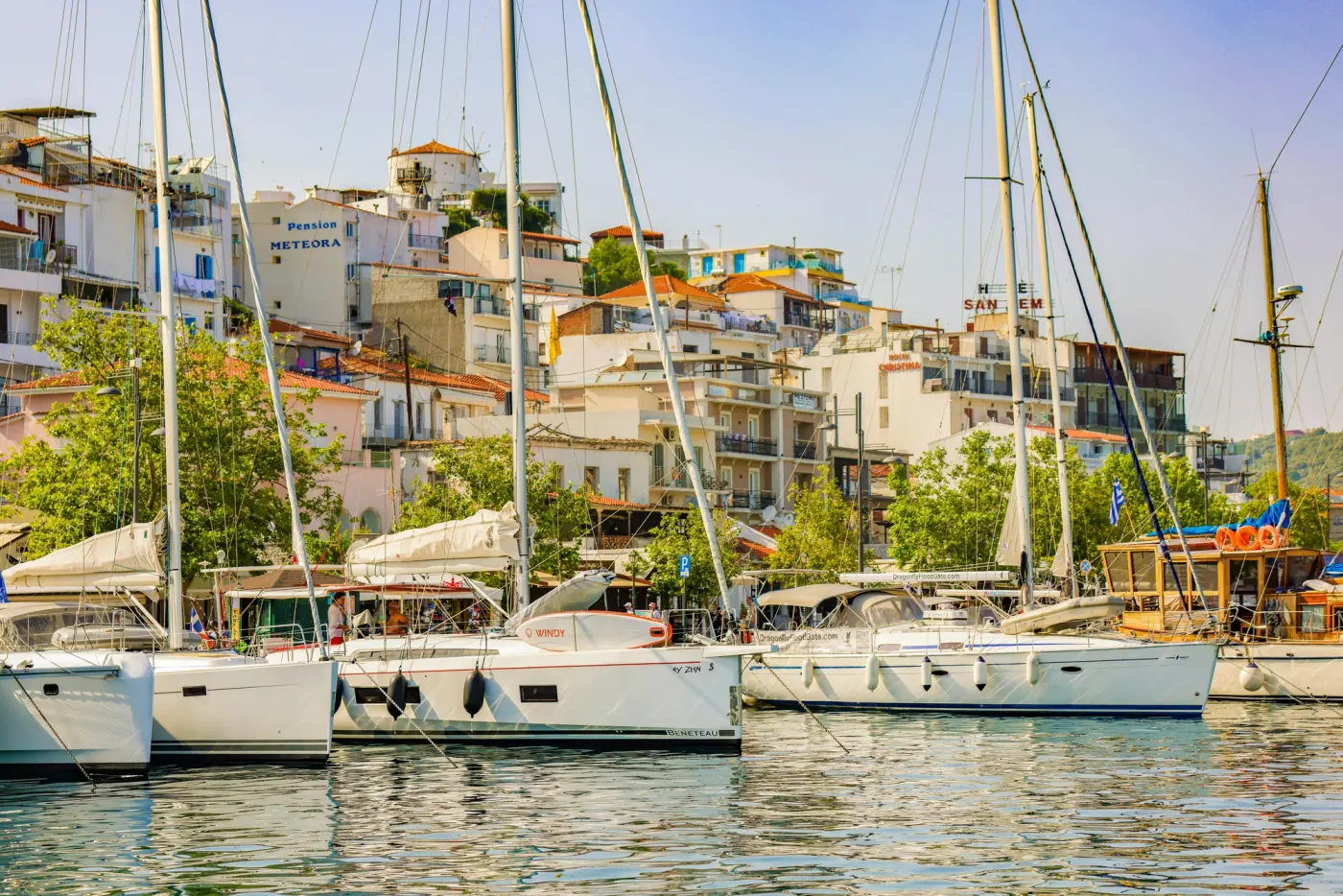
Most charter guides will tell you July and August are the months for Greece. They are right about volume - and wrong about the people who matter.
For the UHNW guest who values discretion, weather, and the unhurried attention of a crew that is not on its third turnaround of the day, the secret of Greek waters lives in two months: May and September. This is the shoulder season. And it is, quietly, where the more sophisticated end of the market has been moving for years.
This is not a "best time to visit Greece" travel piece. It is a working broker's read on why two specific windows in the Greek charter calendar deliver more of what your guests actually want - and why most articles miss it entirely.
What "shoulder season" actually means in Greek waters
The Greek charter season runs roughly from late April to mid-October. The peak is unambiguous: mid-July through August, with a smaller spike around the first week of September.
Shoulder season - the periods immediately before and after the peak - is conventionally understood as late spring (May through mid-June) and late summer (mid-September through early October). Within those two windows, two months stand out for UHNW charters: full May, especially the second half, and full September. The reasons are weather, crowd density, and crew rhythm - and they reinforce each other.
The weather reality, and why averages mislead
According to climate averages published by the Hellenic National Meteorological Service (ΕΜΥ), the Aegean delivers the following typical conditions across the season.
In May, air temperatures range from approximately 21°C to 26°C, sea surface temperatures climb from 18°C to around 21°C, and the meltemi , the strong northerly summer wind that defines high season in the Cyclades - is almost entirely absent.
In July and August, air temperatures often push 32-36°C in the islands, sea temperatures sit around 24-26°C, and the meltemi blows 4-7 Beaufort with regularity, particularly across the central Cyclades. This affects route planning, tender operations, and onboard comfort.
In September, air temperatures hold at 26-30°C, sea temperatures often reach their warmest of the entire year , typically 23-25°C - and meltemi activity tapers significantly week by week.
The implication for a charter operator is straightforward. In May, you trade a couple of degrees of swimming temperature for calmer seas, gentler light, and full route flexibility. In September, you keep the warm water and lose the wind. A Cyclades itinerary that fights weather every other day in late July often runs uninterrupted in late September.
The crowd differential
The pricing of a charter is rarely the most expensive part of the experience for a UHNW guest. The cost is the exposure: paparazzi at the Mykonos beach clubs in mid-August, a port that processes seventeen yachts in the same evening turnaround, a lunch reservation that requires a security plan.
Greek tourism volumes follow a sharp August curve. Data published by SETE, the Greek Tourism Confederation, and the Greek National Tourism Organization (ΕΟΤ) consistently show August as the dominant arrivals month - often by a wide margin over its neighbours. By mid-September, the curve has dropped meaningfully; by the end of September, the islands are recognisably emptier.
For the right guest, this is the entire game. Mykonos in May is a working town, with restaurants taking reservations rather than auctioning them. Hydra in early September is still warm, with mooring available rather than negotiated. Spetses, Poros, and Hydra in mid-May offer the Saronic at its most accessible, before the summer rush. Symi and the southern Dodecanese in late September are arguably the best two-week window of the year for that part of the map.
What this means for the boat itself
There is a part of the conversation that gets lost in volume-driven peak-season chatter: the crew is human.
In late July and August, a charter crew is often running back-to-back charters with same-day turnarounds. The captain, chef, and stewards are professionals - they will perform - but the rhythm is relentless. By the third charter of the season, a crew is operating with a different reserve of energy than they had on charter one.
A May or September charter typically lands in a more rested cycle. That difference shows up in small ways: a captain who has slept enough to suggest an anchorage you were not expecting, a chef who wants to cook the suckling lamb properly because there is time, a chief stew who notices the children's preferences rather than processing them.
That is the part of filotimo , the Greek principle of doing the right thing because of who you are, not because of what you are paid - that disappears when a season is run at maximum volume. It returns in the shoulder months.
Regional logic by month
The two months are not interchangeable. They favour different parts of the Greek map.
May favours the Saronic and the Ionian. The Saronic Gulf - Aegina, Poros, Hydra, Spetses - is sheltered and works beautifully in calmer weather. The Ionian - Corfu, Paxos, Antipaxos, Kefalonia, Lefkada - operates on a different weather logic from the Aegean entirely; it tends to be greener, milder, and more reliably calm in May than the Cyclades. A first-week-of-charter guest in May, particularly one with children or older guests, often finds the Saronic or the Ionian a better fit than fighting their way to Mykonos.
September favours the Cyclades, the Sporades, and the Dodecanese. By mid-September the meltemi is fading, the water is at its warmest, and the dramatic islands of the central and southern Aegean become more accessible. A Cyclades route - Santorini, Folegandros, Milos, Sifnos, Serifos - that becomes a wind-management exercise in late July often runs gently in late September. The same is true of a Dodecanese route through Symi, Tilos, and Astypalea.
This regional split is not a rule, but it is a strong heuristic - and it is part of how a working broker designs an itinerary rather than copies the brochure.
The booking window: this is where the math changes
There is one practical consideration that surprises many first-time charterers: shoulder season fills earlier than people expect.
Because the most experienced UHNW charterers - and many of the better travel advisors - have already moved their preferences toward May and September, the best yachts in those windows are often booked before the peak summer is fully sold. A guest who calls in mid-June asking about a 50-metre motor yacht for the third week of September is often calling several weeks late.
The practical lead times we see in Greek waters are roughly: for May charters, the ideal lead time is November to February of the prior year; for September charters, March to June of the same year.
A guest calling in March 2026 about a September 2026 charter is on the right side of the booking curve. A guest calling in early August about late September is, in most cases, choosing from what is left.
A short, honest list of trade-offs
Shoulder season is not strictly better than peak. Three honest counterpoints. First, beach club season: if the experience your guests want is the Mykonos beach club at full volume, August is the only honest answer; May and September are quieter by design. Second, children's school calendars: families travelling around U.S. or U.K. school holidays have less flexibility; July and August often remain the only realistic window. Third, water temperature for sensitive swimmers: May water in the high teens is invigorating but not for everyone; September water is warmer than August in many cases, so this trade-off only really applies to May.
For everyone else - for the guest whose primary preferences are privacy, weather quality, route flexibility, and crew rhythm - the case for shoulder season is strong.
Frequently asked questions
Is the weather reliable enough for a luxury yacht charter in May in Greece?
Yes, particularly from mid-May onward. Hellenic National Meteorological Service averages show settled, mild conditions across both the Aegean and Ionian for most of May, with the meltemi largely absent. Air temperatures of 21-26°C and gentle seas are the norm. The trade-off is sea temperature, typically in the high teens to low 20s Celsius, which is comfortable for most adults but cooler than peak summer.
How do September prices compare to July and August in Greek charters?
Pricing in Greek crewed charters varies by yacht, broker, and contract terms, but the general pattern across the market is that early-September rates are close to peak, while late-September rates begin to soften. By the second half of September, charter rates and the surrounding cost ecosystem - port fees, restaurants, helicopter transfers, villa supplements - all ease. The change is real but usually less dramatic than off-peak pricing in other Mediterranean markets.
Which Greek regions are best for a May charter?
The Saronic Gulf and the Ionian Sea perform best in May. The Saronic - Hydra, Spetses, Poros - is sheltered and accessible from Athens, ideal for shorter charters or first-time Greek charter guests. The Ionian - Corfu, Paxos, Lefkada, Kefalonia - has a milder climate than the Aegean year-round and is reliably calm in May. Cyclades charters in early May can work but become more weather-sensitive.
When should I book a September charter for the best yacht selection?
For September 2026, the practical booking window is March through June 2026. The yachts that travel-advisor and broker networks consider best-in-class for September are typically committed earlier in the year than peak August inventory, because experienced charterers have already shifted their preferences toward shoulder season. A six-month lead time is comfortable; three months is workable; six weeks is constrained.
Is the meltemi wind a problem for a September yacht charter in the Cyclades?
Considerably less than in July or August. The meltemi peaks during high summer and tapers from early September onward. By mid-to-late September, Cyclades routes that had been weather-managed in peak summer can typically run their full intended itinerary. A captain with experience in Greek waters reads the daily forecasts and adjusts; in September, those adjustments are minor in most weeks.
What are the trade-offs of choosing shoulder season for a Greek yacht charter?
The genuine trade-offs are cooler sea temperatures in May (high teens to low 20s Celsius), fewer beach-club nightlife options at peak intensity, and less flexibility for families bound to U.S. and U.K. school summer holidays. For guests whose priorities are privacy, weather quality, and crew attention, those trade-offs are usually a fair price.
Closing
The Greek charter season has a peak. Most of the published guidance is built around that peak. But the people who charter in Greek waters most often - the second-, third-, fifth-time charterers, the travel advisors with the best repeat-client books, the brokers who actually live and work in Greek waters - have been moving toward May and September for some time.
The reasons are not commercial. They are experiential. The water is warm. The wind is gentler. The crew has slept. The harbour is yours.
If you are planning a Greek charter for 2026 and the timing is genuinely flexible, the strongest single piece of advice - without commercial agenda, without flattery - is to look hard at May and at September before defaulting to August.
That is the shoulder season advantage.
George P. Biniaris is the Managing Broker of George Yachts Brokerage House LLC, a luxury crewed yacht charter brokerage operating in Greek waters. He is a licensed skipper with hands-on experience across the Ionian, Saronic, Cyclades, and Sporades, and works directly with central agents, captains, and travel advisors on UHNW charters in the Mediterranean.


