
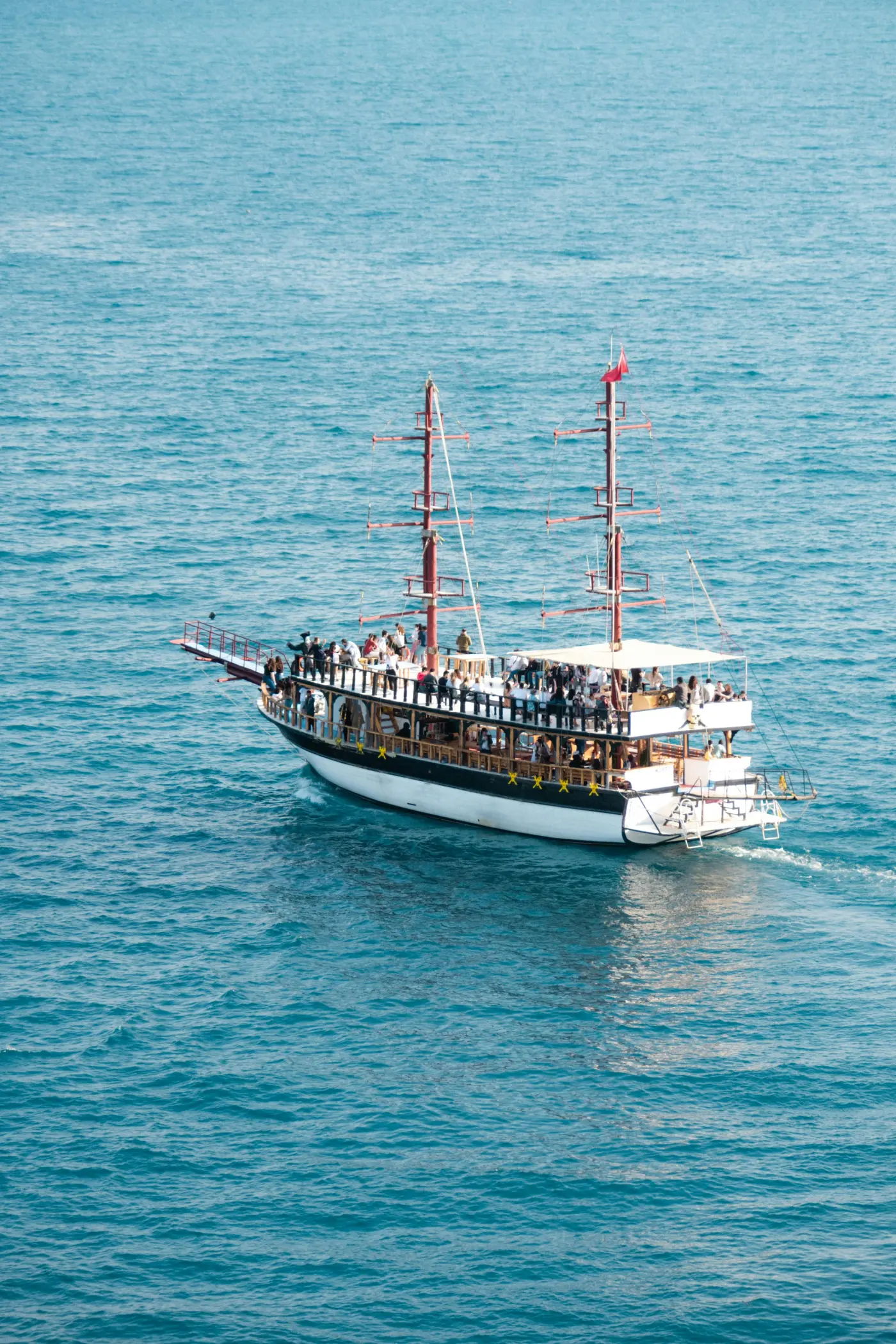
A family of fourteen lands at Athens International on a Friday in early August. The matriarch wants three generations under one roof for ten days in the Cyclades. She has spoken to three brokers. All three have given her the same answer: split into two yachts, or scale down to twelve.
She is right to feel the answer is too easy.
The number twelve appears in almost every conversation about yacht charter in Greece, written into proposals, repeated in client briefings, occasionally weaponised to close a sale. What few brokers explain is that the twelve-passenger limit is not a Greek law. It is an international one, with a specific history, a specific scope, and, in Greek waters, a specific exception that opens up options the family of fourteen never hears about.
This article is the working broker's complete answer to a question that should be straightforward and almost never is: how many guests can a crewed yacht in Greece legally carry, and what are the actual options for a group of more than twelve?
The Short Answer
- The "12-passenger rule" is not Greek law. It comes from SOLAS, the International Convention for the Safety of Life at Sea, the IMO treaty that classifies any vessel carrying more than twelve passengers as a passenger ship, subject to substantially stricter regulation.
- Greek domestic law allows commercial pleasure yachts to carry up to 49 passengers under Law 4926/2022 (Article 1, paragraph γ), provided the vessel meets the law's construction, accommodation and crewing requirements.
- For overnight charters, the practical limit is the number of berths registered on the vessel's General Inspection Protocol. Greek law (Article 12) requires the number of overnight passengers to equal the number of berths.
- Most luxury yachts still cap at 12 because Passenger Yacht Code compliance for 13 to 36 passengers under non-Greek flags is materially more expensive at build and refit. This is an economic reality, not a legal one.
- Groups of 14+ have four legitimate paths in Greek waters: a Greek-flagged commercial pleasure yacht licensed for the higher capacity; a Passenger Tourist Ship (Επιβατηγό Τουριστικό Πλοίο) licensed for up to 99; a tandem charter with two yachts; or a day-charter structure (up to 25 passengers, no overnight) on a vessel of up to 24 metres.
Where the 12-Passenger Rule Actually Comes From
The number twelve is a global threshold, not a Greek one. It is set by the International Convention for the Safety of Life at Sea, known by its acronym SOLAS, adopted in 1974 by the International Maritime Organization (IMO) and amended continuously since.
SOLAS Chapter I, Regulation 2 defines a passenger ship as any vessel carrying more than twelve passengers. Once a vessel crosses that threshold, the entire SOLAS regulatory framework activates: more demanding rules on subdivision and damage stability, fire protection, life-saving appliances, navigation equipment, crew certification, safety drills, and design margins. Construction costs increase materially. Operational costs follow.
In response to this binary cliff between yachts and full passenger ships, the Red Ensign Group flag administrations developed the Passenger Yacht Code (PYC), since folded into the REG Yacht Code Part B (current consolidated edition: July 2024). This is an IMO-accepted equivalence framework that allows pleasure yachts to carry between thirteen and thirty-six passengers without being treated as a cruise liner, provided they meet specific outcomes for fire protection, life-saving and watertight subdivision. Some flag states implement the PYC; others apply SOLAS more strictly.
Three operational facts follow from this:
- Crew do not count toward the twelve. This is why charter language consistently reads "12 guests + crew." The crew sits outside the passenger count under SOLAS and under Greek law.
- A yacht's flag state determines its certification path. A Cayman-flagged yacht, a Marshall Islands-flagged yacht and a Maltese-flagged yacht each sit somewhere on the SOLAS / PYC spectrum. The Greek 49-passenger framework does not apply to them; it applies to vessels certified as commercial under Greek flag.
- Most owners of 30 to 60-metre yachts choose to certify for twelve passengers. PYC compliance costs more at build and at every refit, and the global UHNW charter market does not reliably reward the additional capacity. The economics push the fleet toward twelve.
This is the global picture. In Greek waters, the picture has a second layer.
What Greek Law Actually Says: The 49-Passenger Ceiling
Greek domestic law on yacht charter is consolidated in Law 4926/2022, "Modernisation of the Institutional Framework for the Activity of Pleasure Yachts and Tourist Day-Boats", published in Greek Government Gazette A' 82 on 20 April 2022. It replaced the relevant provisions of the earlier Law 4256/2014 and was further updated by Law 5111/2024.
Article 1, paragraph γ defines a Commercial Pleasure Yacht (Επαγγελματικό Πλοίο Αναψυχής) as a pleasure vessel certified as commercial under the law of its flag state, operating under a full charter contract, with carrying capacity up to and including forty-nine passengers, equipped with adequate and appropriate accommodation spaces specifically for passengers.
Forty-nine. Not twelve.
The same article defines a passenger as any person on board other than the captain (πλοίαρχος), the skipper (κυβερνήτης), the crew (πλήρωμα), and children under one year of age. Crew exclusion matches SOLAS; the explicit children-under-one carve-out is a Greek refinement worth knowing about for families with infants.
There is a further category. Article 3, paragraph 5 permits Passenger Tourist Ships (Επιβατηγά Τουριστικά Πλοία) under Greek or other EU flag, with carrying capacity up to ninety-nine passengers, to operate under full charter contracts and fall within the same legal framework. These vessels exist; they are simply rare in the luxury crewed segment because their build and operational profile sits closer to a small passenger vessel than to a yacht.
So the legal ceiling for a Greek-flagged commercial pleasure yacht is forty-nine passengers. The legal ceiling for a Greek or EU-flagged passenger tourist ship under charter is ninety-nine. The international SOLAS twelve-passenger threshold remains relevant, Greek law does not override international law, but for vessels operating under Greek flag and Greek certification, the path beyond twelve exists and is regularly travelled.
The question becomes: if Greek law allows up to forty-nine, why does almost every yacht in the Greek charter fleet still cap at twelve?
Why Most Yachts in Greek Waters Still Stop at Twelve
Three reasons, in order of weight.
Flag. A large fraction of the premium charter fleet operating in Greek waters does not fly the Greek flag. Marshall Islands, Malta, Cayman, the Red Ensign jurisdictions and several others dominate the 30 to 70-metre segment. These flags follow SOLAS for any 13+ passenger certification, or implement PYC / REG Part B as their equivalence path. The Greek 49-passenger framework does not apply to them, because they are not certified under Greek law.
Build cost. A yacht designed for fewer than thirteen passengers can be built to a less demanding code, delivered faster and refitted more cheaply. A yacht designed for thirteen to thirty-six passengers under PYC must meet stricter outcomes for fire-zone subdivision, stairway redundancy, lifeboat capacity, evacuation timing and watertight bulkheads. The cost premium is real, and few owners commission yachts speculatively to capture the rare 13+ guest charter. Most build for the twelve-passenger market because that is where the demand reliably is.
Operational complexity. A higher passenger count means more crew, more lifesaving equipment, more drills, more certifications to renew, more insurance premium. Each of these has an annual operating cost. A yacht built for twelve passengers with eight crew has a fundamentally simpler operational profile than the same yacht recertified for fourteen passengers with ten crew.
The combined effect is that the fleet that genuinely operates with overnight capacity for thirteen to forty-nine passengers in Greek waters is small. It exists, but it is small, and it commands a premium when chartered. Brokers who do not regularly handle larger groups will default to "split into two yachts" because their inventory does not include the alternative.
A specialist Greek-waters broker should know which vessels in the local fleet actually carry the certification for higher capacity. That is working knowledge, not a brochure claim.
The Four Ways a Group of 14+ Actually Charters in Greece
For a family or party of thirteen or more, four legitimate options exist. They are not equivalent. The right one depends on the overnight versus day-only structure of the trip, the budget envelope, vessel preference, and itinerary.
Option One: A Greek-Flagged Commercial Pleasure Yacht Licensed for the Higher Capacity
Under Law 4926/2022, a Greek-flagged commercial pleasure yacht can be licensed for any passenger capacity up to forty-nine, provided it meets the construction, accommodation, safety and crewing requirements for that capacity. A small but real subset of the Greek fleet, including selected motor yachts, larger gulets and some traditional vessels, carries this certification.
For overnight charters, the operational limit collapses to the number of berths registered on the vessel's General Inspection Protocol (Π.Γ.Ε.) or Safety Certificate (Π.Α.). Greek law (Article 12, paragraph 4 of Law 4926/2022) requires that the number of overnight passengers equal the number of berths. A yacht legally licensed for fourteen passengers but built with twelve berths will sleep twelve overnight, regardless of certification.
Specifically for groups of fourteen to sixteen overnight, the most common available profile in the Greek market is a luxury gulet or large traditional motor sailer, often with seven or eight cabins built for two guests each. These vessels are genuinely beautiful, are quoted on request rather than carried on this list, vary widely in weekly rate with size and refit standard, and are a strong fit for an itinerary that prioritises authenticity and group cohesion over peak speed.
Option Two: A Passenger Tourist Ship Under a Full Charter Contract
The second route is the Επιβατηγό Τουριστικό Πλοίο category, vessels licensed for up to ninety-nine passengers under Greek or EU flag, operating with a charter contract under Article 3, paragraph 5 of Law 4926/2022. These are the rare vessels in the Mediterranean that combine yacht-grade interiors with genuine licensed capacity for thirty, forty, sixty or more guests overnight.
In practical terms, this category is usually the right answer for: corporate incentive groups, milestone family events such as a wedding party of thirty to sixty in the Cyclades, private music or sporting gatherings at sea, and the rare extended multi-family charter where everyone genuinely wants to be on the same vessel. Pricing sits well above standard yacht charter levels and is typically structured as a fully bespoke commercial agreement rather than a standard MYBA charter contract.
Option Three: A Tandem Charter, Two Yachts Operating Together
For many groups of fourteen to twenty-four, the optimal answer is two yachts chartered together, what the industry calls a tandem charter. Two twelve-passenger yachts moving on the same itinerary, anchoring in the same bays, dining together when the families want and apart when the children need to sleep.
The advantages are substantial. Each family branch gets its own captain and crew. Children, teenagers and grandparents can be split across vessels in the way that actually works for the group. Smaller yachts are far easier to dock in the constrained ports of the Cyclades and the Saronic, where a single sixty-metre vessel may struggle for a berth that two thirty-five-metre yachts can each find. Daytime activities can be combined; evenings can be separated.
The disadvantages are also real. Two crews, two APAs, two tip pools, two preference sheets, two charter contracts to negotiate. A skilled broker absorbs this complexity into a single experience for the principal; an unskilled broker creates the complexity and hands it back.
Option Four: The Day-Charter Structure (up to 25 Passengers, ≤12 Hours, No Overnight)
A specific provision of Greek law, Article 11, paragraph 1 of Law 4926/2022, exempts commercial pleasure yachts of up to twenty-four metres carrying up to twenty-five passengers from the obligation of mandatory organic crew composition, when the charter contract is for twelve hours or less and does not include overnight stay.
In practical terms, this means a smaller commercial pleasure yacht can operate a single-day charter for up to twenty-five guests legally and without the full crew structure required for overnight charters with more than fourteen passengers. The vessel must still be commercially registered, the contract must still be a full charter contract (σύμβαση ολικής ναύλωσης), the captain or qualified skipper must hold the required Greek qualifications, and the passenger count must respect the vessel's specific certification, but the larger group is permitted.
This is the right option for a single-day event: a wedding party that arrives by yacht for a private island ceremony before returning to a hotel for the night, a milestone birthday cruise from Athens to Sounion and back, a corporate group taking a Saronic day with lunch on board.
It is not a workaround for an overnight charter. The twelve-hour ceiling and the no-overnight requirement are absolute under the law.
What Changes for Captain and Crew at More Than Fourteen Passengers
Greek Law 4926/2022, Article 11, sets out crewing obligations by yacht size and passenger count. The structure is precise:
- Yachts up to 24 metres, with up to 12 passengers: no obligation of organic crew composition. The vessel can be operated by a captain or skipper with crew permitted but not legally required. This is the legal frame for bareboat charter.
- Yachts up to 24 metres, with up to 14 passengers: same, no obligation of organic crew composition.
- Yachts up to 24 metres, with up to 25 passengers, on charters of ≤12 hours without overnight: same, no obligation of organic crew composition.
- Yachts above 24 metres, regardless of passenger count: mandatory organic crew composition.
- Yachts up to 24 metres with more than 14 passengers on charters longer than 12 hours, or with overnight: mandatory organic crew composition.
Once mandatory organic crew composition activates, the vessel must carry crew at the full positions required by Greek maritime regulations, captain, engineer, deck hand, stewardess, chef and the specific positions corresponding to the vessel's size and category. Crew are insured under e-EFKA, work under maritime employment contracts, and the vessel's operating cost rises accordingly.
For the charter guest, this matters in only one practical sense: the larger the group, the more crew on board, the higher the gratuity pool at the end of the week, and the slightly different acoustic and social profile of the yacht. None of this is bad. It is simply the operational reality of a charter for fourteen, twenty or forty guests rather than ten or twelve.
A Pre-Booking Checklist for Groups of 14+
If you are organising a charter for thirteen or more guests in Greek waters, the following questions filter the brokers who will guess from the brokers who actually know the inventory:
- Ask for the vessel's flag and the exact number of passengers it is certified to carry overnight. A real broker gives you the precise number on the Π.Γ.Ε. or equivalent certificate. A vague answer is your signal.
- Ask whether the vessel is certified under SOLAS, PYC / REG Part B, or Greek flag (4926/2022). All three are legitimate; the answer determines what the legal maximum actually is.
- Ask the number of berths and the double versus single configuration. The bedding plan is where overnight reality lives, regardless of legal capacity.
- For day-only events, confirm the twelve-hour structure in writing. The exemption in Article 11 is conditional on the charter contract specifying ≤12 hours and no overnight.
- Ask about port and anchorage feasibility. A 60-metre vessel licensed for fourteen passengers cannot necessarily berth where a 30-metre vessel can. The Cyclades and Saronic have port-by-port constraints that materially affect the itinerary.
- For tandem charters, ask the broker who coordinates the captains. This is non-trivial. A weekly menu and itinerary across two vessels takes work, and the work should be invisible to you.
- Ask the broker how many 14+ charters they have personally delivered in Greek waters. Specialist knowledge is built through specific experience. A handful is a baseline; one or two is a learning curve and you do not want to be it.
Frequently Asked Questions
Does the 12-passenger rule include children?
Under Greek Law 4926/2022, Article 1, paragraph ι(α), the definition of passenger excludes children under one year of age. All other children, including infants over one year, toddlers and minors of any age, count as passengers. The international SOLAS framework applies a similar approach; specific flag states may have additional refinements. For practical purposes on a Greek charter, plan on the assumption that every guest aged one or older counts toward the legal capacity.
Do crew count toward the 12-passenger limit?
No. Crew are explicitly excluded from the passenger count under both SOLAS Chapter I, Regulation 2 and Greek Law 4926/2022, Article 1. This is why standard charter language reads "12 guests + crew." A fully-crewed forty-metre motor yacht might carry twelve guests and ten crew, twenty-two persons on board total, and remain legally a vessel licensed for twelve passengers.
Can I take 14 guests on a single-day charter in Greek waters?
Yes, on a commercial pleasure yacht of up to twenty-four metres operating under a charter contract of twelve hours or less without overnight. Under Article 11 of Law 4926/2022, this configuration is permitted with up to twenty-five passengers without triggering mandatory organic crew composition. The contract must be in writing as a day charter, the vessel must be commercially registered, and a qualified captain or skipper must be on board. For a charter of more than twelve hours or with any overnight component, the standard rules return.
What is the difference between SOLAS and the Greek 49-passenger framework?
SOLAS is the international treaty that classifies any vessel carrying more than twelve passengers as a passenger ship subject to its full regulatory regime. Greek Law 4926/2022 defines a Commercial Pleasure Yacht as a vessel of up to forty-nine passengers operating under a full charter contract, with adequate accommodation specifically for passengers. The two frameworks are not in conflict: a Greek-flagged commercial pleasure yacht of, say, twenty-five passenger capacity must still meet SOLAS-derived safety standards as implemented under Greek law and EU regulation. The forty-nine-passenger ceiling in Greek law is the domestic upper bound; vessels above that capacity fall into the Passenger Tourist Ship category up to ninety-nine.
Is one larger yacht always more expensive than two smaller ones for a big group?
Not necessarily. The arithmetic for fourteen to twenty guests often favours a single larger vessel licensed for the higher capacity, particularly a luxury gulet or large motor sailer. The whole-party cost of one fourteen-guest crewed vessel in Greek waters can be lower than two twelve-guest yachts together, because the second crew, the second APA and the second insurance premium do not have to be paid. The break-even point depends on vessel selection, season and itinerary. A specialist broker will model both options and present the comparison transparently before you commit.
How do I find a Greek-flagged yacht licensed for 14 or more passengers overnight?
Through a working broker who has placed groups of fourteen-plus in Greek waters in recent seasons. The vessels exist, but they are not searchable on most public charter platforms because the platforms are calibrated to twelve-passenger inventory. A specialist Greek-waters broker holds the relationships with the central agents, the management companies and the owners of these specific vessels. Provide your group size, your dates, your preferred region (Ionian, Cyclades, Saronic, Sporades or Dodecanese) and your overnight versus day requirements, and the broker should return with three to five real options and the certifications to back them up.
Can you rent a motor yacht in Greece for the week, with crew, for a group of twelve?
Yes, and it is the most common shape a group of ten to twelve takes on this list. The forty-six crewed motor yachts this house represents run from 18 to 50 metres, and the twelve-guest yachts among them sit from 27 metres up: NOEMA at 33.5 metres with six crew from EUR 72,000 a week, KINTARO at 38 metres with seven crew from EUR 85,000, LA PELLEGRINA 1 at 50 metres with nine crew from EUR 180,000, each from her own rate card, per yacht per week, before APA of 30 to 40 per cent, Greek VAT at the certified rate and a gratuity of 10 to 15 per cent. The weekly motor yacht page lists every one of them by size and rate.
Above twelve the answer changes, which is what the rest of this article is about: the yacht must be licensed for the higher number, and on this list that is ELYSIUM, a 64 metre passenger ship certified for forty-nine guests, or two yachts cruising together.
How to Decide, and the Next Steps
If your group is fourteen or larger and you have been told to split into two yachts as a default, ask one more question before you accept it: which Greek-flagged commercial pleasure yachts in your fleet are licensed for our exact group size, and what is the price difference against two twelve-passenger yachts? If the answer is precise, you have a working broker. If the answer is vague, you have your signal.
I work exclusively in Greek waters with groups of two to twenty-five guests overnight, and up to twenty-five guests on day charters. If the question of group size is the one slowing your trip down, book a thirty-minute consultation or reach me on WhatsApp at +1 786 798 8798. The first call is the one where the answer becomes precise.
Explore More
- The First-Timer's Complete Guide to Crewed Yacht Charter in Greece
- Motor Yacht, Catamaran, Sailing Yacht or Gulet? How to Choose
- How Much Does a Yacht Charter in Greece Actually Cost? The Complete 2026 Breakdown
- Private Yacht Charter vs. 5-Star Hotel in Greece for a Family of Eight
- The €50,000 Mistake: What Goes Wrong When You Book a Yacht Charter Without a Broker
Sources and References
- International Convention for the Safety of Life at Sea (SOLAS), Chapter I, Regulation 2, passenger and passenger ship definitions
- International Maritime Organization (IMO), passenger ship safety framework and amendments
- REG Yacht Code (Red Ensign Group), Part B (formerly Passenger Yacht Code), July 2024 consolidated edition
- Νόμος 4926/2022 (Greek Government Gazette A' 82 / 20.04.2022), Modernisation of the Institutional Framework for the Activity of Pleasure Yachts and Tourist Day-Boats
- Νόμος 5111/2024 (FEK A' 76 / 24.05.2024), consolidating amendments to Law 4926/2022
- Νόμος 4256/2014 (FEK A' 92 / 14.04.2014), predecessor framework, partially superseded by Law 4926/2022
- e-ΕΦΚΑ, official insurance guidance on crewing of commercial pleasure yachts and tourist day-boats (November 2023)
- Hellenic Ministry of Maritime Affairs and Insular Policy (ynanp.gr), official e-Registry of Pleasure Yachts and Tourist Day-Boats
- MYBA (Mediterranean Yacht Brokers Association), Standard Charter Party Contract and crew gratuity guidelines
- IYBA (International Yacht Brokers Association), broker standards and Charter Active Member ethics
- Working broker experience, crewed charters delivered in Greek waters across vessel categories and group sizes
About the Author
Written by George P. Biniaris, Managing Broker at George Yachts and IYBA Charter Active Member. Licensed skipper with hands-on experience across Greek waters. BSc in Shipping Management & Operations, Business College of Athens. Based in Athens. This article reflects working broker knowledge supported by primary sources in Greek and international maritime law.
Who sets the standards for a crewed charter in Greece?
The short version is below. The full answer, layer by layer, is a separate piece: who sets the standards for a crewed yacht charter in Greece, and what actually binds your week.
Three different things do, and they are regularly confused. Greek law sets who may carry how many guests. The contract sets what you and the owner owe each other. Trade associations set what their own members promise. None of the three is the same as the others.
The twelve passenger limit above is law, not a guideline, and it applies to the yacht regardless of who brokered her. The contract is almost always the MYBA charter agreement, which is the Mediterranean standard and sets out the advance provisioning allowance, the delivery and redelivery terms and the cancellation ladder.
What is the Greek Yachting Association?
The Greek Yachting Association, or GYA, is a trade body of Greek professional yachting companies working in charter, brokerage, management, insurance and the construction of large yachts. Its own stated objectives are to maintain high standards of professionalism in charter, sales and yacht management, to cooperate closely with MYBA, and to organise an annual charter yacht show for Greek and foreign flag charter yachts under central agency agreement. That show is the Mediterranean Yacht Show in Nafplion, whose eleventh edition ran from 2 to 6 May 2026.
The association states that it and its members represent over 90 per cent of the crewed charter yachts in Greece under central agency agreement. That is the association's own figure and it is worth reading precisely: it describes yachts held under central agency, not every yacht available to charter in Greece.
Is George Yachts a member?
No, and it matters that we say so plainly rather than let a page about standards imply otherwise. George Yachts Brokerage House is a member of the International Yacht Brokers Association and operates Charter Active. We are not a member of the Greek Yachting Association, and we are not a MYBA member either, although every charter we place runs on the MYBA standard contract. Our own credentials are set out here, and we would rather you checked them than took our word.
What this means in practice for you as a charterer is simple. Association membership tells you something about a company's peers and its commitment to a code. It does not tell you whether a particular yacht is legally allowed to carry your group of fourteen. For that, read the certificate, not the logo.
To explore a Greek yacht charter for a group of 14 or more, book a free consultation or contact george@georgeyachts.com.


