
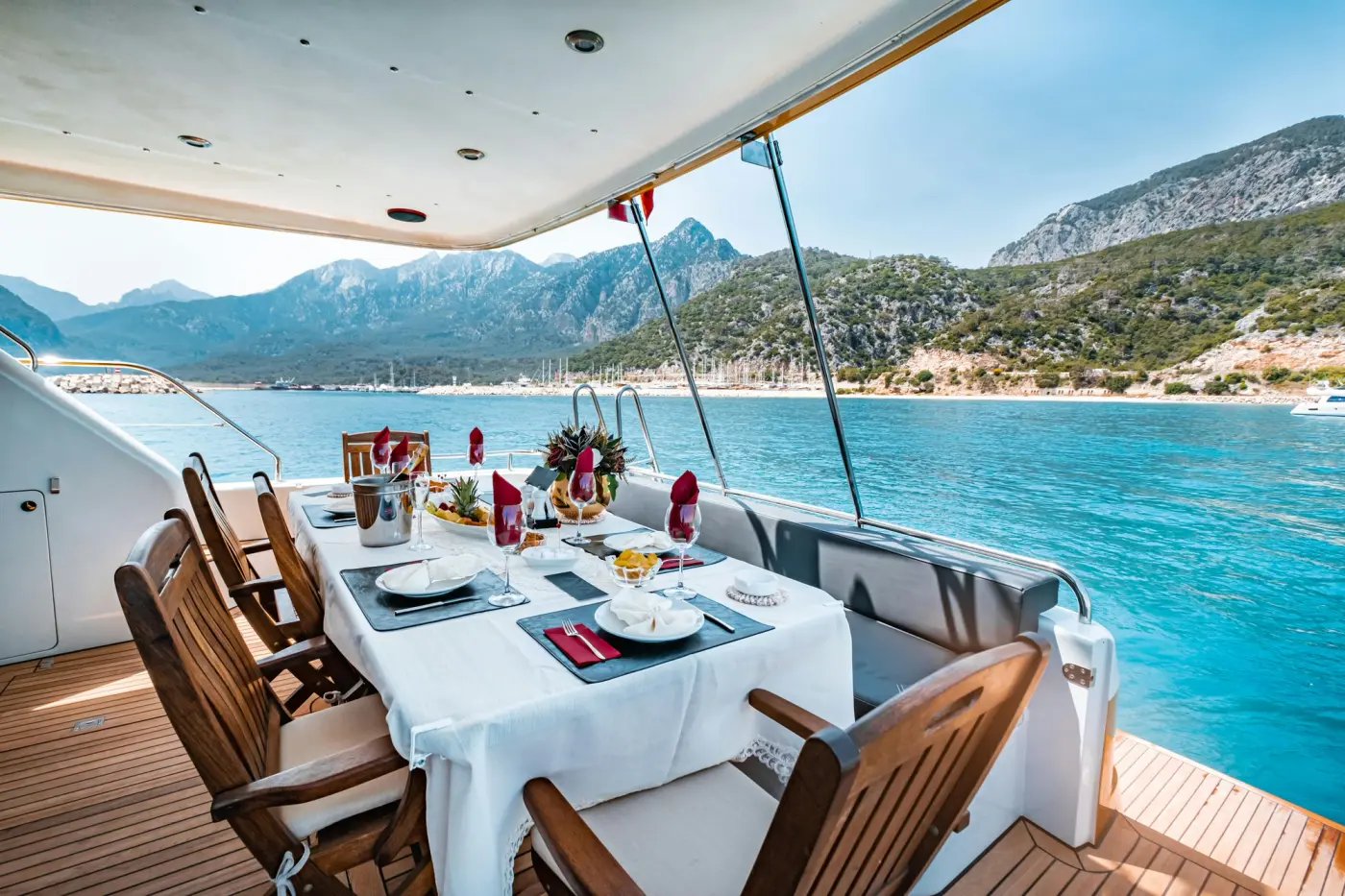
A crewed yacht charter in Greece puts a private vessel, a professional captain, a dedicated chef, and full crew at your disposal for a week or more across the Aegean or the Ionian - and it is, for those who have never done it, the single most transformative way to experience the Greek islands. This guide covers everything a first-time charterer needs to know: how the contracts work, what it actually costs, which vessel type suits your group, and why a broker matters more than a booking platform.
What a Crewed Yacht Charter in Greece Actually Is
A crewed charter is not a cabin rental on someone else's itinerary. It is not a flotilla holiday where you sail in convoy with strangers. And it is emphatically not a bareboat arrangement where you are expected to skipper the vessel yourself.
When you book a crewed yacht charter in Greece, you are hiring an entire vessel - hull to masthead - along with a professional crew whose sole job is to make your week exceptional. A typical crewed charter on a 20-to-30-metre yacht includes a captain who navigates and plans the route, a chef who provisions and prepares every meal to your specifications, and at least one deckhand who manages the vessel, the water toys, and the thousand small logistics that keep a charter running smoothly. Larger vessels - 35 metres and above - carry expanded crews: a chief stewardess, an engineer, additional deckhands.
The itinerary is yours. If you want to wake at anchor in the volcanic caldera off Santorini, sail to Folegandros for lunch, and arrive at Sikinos by sunset, the captain will make it happen - weather and sea state permitting. If you want to spend three consecutive days moored off the same beach in Antiparos because your children found the perfect cove, that is equally valid. The vessel moves when you decide it moves.
This is the fundamental distinction between a crewed yacht charter and every other form of luxury travel in Greece: the experience is entirely under your control, with professionals handling every operational detail.
What Is a MYBA Charter Contract and How Does It Protect You?
Every reputable crewed yacht charter in Greece operates under a MYBA contract - the standard agreement developed by the Mediterranean Yacht Brokers Association, the industry body that sets the professional and legal framework for charter worldwide.
The MYBA contract is not a hotel booking confirmation. It is a detailed legal document that specifies the charter fee, the vessel, the operating area, the crew obligations, cancellation terms, insurance requirements, and the financial mechanics of the voyage. Understanding its core components is not optional for a first-time charterer - it is the difference between a seamless experience and an unpleasant surprise.
The Charter Fee is the base cost of hiring the vessel and crew for the agreed period. A standard MYBA charter week runs Saturday to Saturday. The charter fee is fixed at the point of contract signature. It does not fluctuate with fuel prices, currency movements, or demand shifts. This is one of the structural advantages of chartering under MYBA terms: your primary cost is locked.
The Advance Provisioning Allowance (APA) is a separate, pre-charter cash deposit - typically 25% to 35% of the base charter fee - that covers variable running costs during the voyage. These include fuel, food and beverage provisioning, marina berthing fees, port charges, and other incidental expenses. The captain manages the APA on your behalf and presents a full accounting at the end of the charter. Any unused APA is refunded. If expenditure exceeds the deposit, the balance is settled at the end of the voyage.
The APA is where first-time charterers most often encounter confusion. It is not a hidden cost. It is a transparent, accountable mechanism for managing the operational expenses that vary by itinerary, by season, and by your own preferences. A week anchored in remote Ionian bays will consume far less APA than a week visiting marinas in Mykonos and Hydra, where berthing fees are significant.
The Crew Gratuity is customary but not contractually required. The industry standard in Greece is 10% to 15% of the base charter fee, paid directly to the captain at the conclusion of the voyage for distribution among the crew. Exceptional service - and on the best vessels, service is exceptional - warrants the upper end of that range.
How Much Does a Crewed Yacht Charter in Greece Cost
Pricing in the Greek charter market spans a wide range, and quoting a single number would be misleading. What I can offer is a realistic framework based on the vessels I place clients on every season.
Entry-level crewed charter (18-22m sailing yacht or catamaran): €8,000 to €15,000 per week charter fee, plus APA of approximately €2,000 to €5,000. Suitable for couples or small groups of up to six. These vessels typically carry a crew of two - captain and chef - and offer a genuine crewed experience without the full-service infrastructure of a larger yacht. A week through the Saronic Gulf from Marina Alimos, visiting Aegina, Poros, Hydra, and Spetses, is an ideal itinerary at this level.
Mid-range crewed charter (24-35m motor yacht, gulet, or sailing yacht): €15,000 to €50,000 per week, plus APA of €5,000 to €15,000. This is the sweet spot for families and groups of six to twelve. Crew of three to five. Dedicated chef producing restaurant-quality meals. Water toys - paddleboards, snorkelling gear, kayaks, sometimes a tender with a ski tow. A 10-day Cyclades itinerary from Athens through Kea, Kythnos, Serifos, Sifnos, Milos, and Folegandros operates beautifully at this level.
Premium and superyacht charter (35m+): €50,000 to €200,000+ per week, plus APA of €15,000 to €60,000. Full service crew of six to fifteen. Spa facilities, onboard gym, multiple tenders, jet skis, diving equipment, sometimes a helipad. These vessels operate itineraries across the Cyclades, the Dodecanese, and longer passages - Rhodes to Crete, or a full Athens-to-Corfu crossing through the Corinth Canal and into the Ionian.
One critical note on pricing: Greek-flagged vessels operating exclusively in Greek waters charge 12% VAT on the charter fee. Non-EU-flagged vessels may have a different VAT position. Your broker should clarify this before contract signature - not after.
Which Yacht Type Should You Choose: Motor Yacht, Sailing Yacht, Gulet, or Catamaran?
The vessel type you choose shapes every aspect of the charter experience. There is no universally correct answer - only the right answer for your group, your itinerary, and your priorities.
Motor Yachts offer speed, range, and interior volume. A 30-metre motor yacht can cover the distance from Athens to Mykonos in under four hours, making ambitious itineraries - Cyclades in a week, or a combination of Cyclades and Dodecanese in two weeks - entirely feasible. The ride is stable, the interior space generous, and the flybridge on most modern motor yachts doubles as an open-air living room. The trade-off is fuel consumption: a motor yacht on a Cyclades itinerary will consume more APA in fuel than a sailing yacht covering the same route.
Sailing Yachts deliver the most authentic Aegean experience. When the Meltemi - the strong northerly wind that defines the Cyclades from mid-June through August - is blowing at Force 4 to 5, a well-trimmed sailing yacht performing a beam reach from Paros to Naxos at eight knots under sail is as close to perfection as yachting gets. Sailing yachts draw less fuel, offer a quieter ride under canvas, and tend to attract charterers who value the act of sailing as part of the experience. The compromise is speed: covering ground takes longer, which means itineraries must be designed with wind patterns in mind.
Gulets are the open secret of the Greek charter market. Originally a Turkish design, the gulet - a wide-beamed, traditionally built wooden motor-sailer - has become one of the most popular crewed charter options in the Ionian and the southern Aegean. A 24-to-30-metre gulet offers deck space that rivals vessels twice its price bracket: a wide aft deck for alfresco dining, a cushioned foredeck for sunbathing, and a beam that provides stability in open water. The trade-off is performance: gulets are not fast. They cruise at 8 to 10 knots under power and are not competitive under sail. For clients whose priority is living space, comfort, and the experience of being on the water rather than racing across it, the gulet is hard to beat. In the Ionian - Corfu to Lefkada, through Paxos, Antipaxos, Meganisi, and Ithaca - a gulet itinerary at 15 knots of gentle westerly is one of the finest weeks afloat anywhere in the world.
Catamarans have surged in popularity for Greek charters over the past five seasons. The reasons are practical: minimal heel (critical for families with young children or guests prone to seasickness), shallow draft (a catamaran drawing 1.2 metres can anchor in bays that a monohull at 2.8 metres cannot access), and expansive deck layouts that make a 14-metre catamaran feel like a 20-metre monohull in terms of living space. The Saronic Gulf and the Small Cyclades - Koufonisia, Schinoussa, Iraklia - are ideal catamaran territory: short distances, sheltered waters, shallow anchorages.
George's Inside Info: In the past two seasons, I have placed more first-time charterers on gulets and catamarans than on motor yachts or monohull sailing yachts combined. The reason is simple: these clients are not sailors. They are not interested in performance metrics or hull speed. They want space, stability, and the feeling of being on a floating villa with the Aegean underneath them. If this describes you, start your search there. If your broker steers you toward a vessel you did not ask for without explaining why, find a different broker.
When Is the Best Time to Charter a Yacht in Greece?
The Greek charter season runs from late April through October, but not all months are equal.
April and early May are the shoulder season opening. Water temperatures hover around 17-19°C - refreshing rather than warm. Crowds are minimal. Port fees are lower. Marina Zeas in Piraeus, which becomes a circus of superyachts in August, is calm and navigable. This period suits experienced travellers who prioritise empty anchorages and cultural sites without the tourist crush. The flip side: some island restaurants and services do not open until mid-May.
Late May through June is what I call the insider's window. Air temperatures are in the high 20s. Water temperature climbs through the low 20s. The Meltemi has not yet established its summer pattern, meaning the Cyclades are navigable without the wind management required in July and August. Availability across vessel categories is strong. Pricing is 15% to 20% below peak. For a first-time charterer unsure whether to commit to peak season, June in the Cyclades - departing from Lavrion or Marina Alimos, sailing through Kea, Kythnos, and Serifos - is the lowest-risk, highest-reward entry point.
July and August are peak season. The Meltemi dominates the Aegean, blowing Force 4 to 7 from the north. For experienced sailors, this is exhilarating. For families on a crewed motor yacht, it is a factor that shapes itinerary design - your captain will plan routes that use island lee shores for overnight anchorage and open-water crossings for morning departures before the wind builds. Mykonos town quay, Naousa in Paros, and Fira anchorage in Santorini are at full capacity. This is the period when crewed charter demand peaks and availability is thinnest. In 2026, with the ongoing reallocation of UHNW summer travel away from the Gulf, summer 2026 charter availability is already narrowing fast.
September is the connoisseur's month. The Meltemi fades. Water temperature peaks at 25-26°C - the warmest of the season. The light across the Aegean in September is softer, more golden, more photogenic than the stark midsummer glare. Crowds thin dramatically after the first week. Restaurants that were impossible to book in August now have tables. September in the Dodecanese - Rhodes, Symi, Patmos, Leros - is one of the finest yachting experiences in the entire Mediterranean.
October is the graceful close. Southern islands - Crete, the Dodecanese, parts of the Cyclades - remain viable through mid-October. Northern waters cool faster. October is a calculated choice: the reward is extraordinary solitude and value, the risk is an early autumn storm system that limits your options.
Why Should You Use a Yacht Broker Instead of a Booking Platform?
Online charter platforms aggregate vessel listings. They show you photographs, specifications, and indicative pricing. What they do not show you is which vessels have a captain who knows the night-time approach into Fiscardo harbour by heart, which chef trained under a Michelin-starred Athens restaurateur before going afloat, or which owner quietly dropped their asking rate by 15% last Tuesday because a cancellation opened a two-week window in August.
A broker operates in the space between information and intelligence. At George Yachts, my inventory is not scraped from a database. It is built from direct relationships with vessel owners and captains across the Ionian, the Cyclades, and the Saronic Gulf. When a client tells me they need a 28-metre gulet for ten guests in the first two weeks of August, I do not search a portal. I call the three owners I know who have that profile, I confirm real-time availability on the phone, and I present options that include operational intelligence no platform can provide: this captain is exceptional with families, this vessel's chef specialises in dietary requirements, this gulet had its teak deck replaced last winter and is in immaculate condition.
The MYBA contract structure that insulates your charter economics is one element. The broker relationship that insulates your experience is another.
What Should You Prepare Before Your First Yacht Charter?
Before you contact a broker, have the following information ready. It will compress the consultation from an hour of general questions to thirty minutes of precise, productive planning.
Dates. Be specific - or at minimum, provide a preferred window. "Sometime in summer" is not actionable. "Any Saturday-to-Saturday in the last three weeks of July" is.
Group composition. How many adults, how many children, what ages. A family with toddlers requires a different vessel profile - higher gunwales, enclosed cockpit, experienced crew accustomed to young children - than a group of eight adults in their forties.
Budget. State a realistic range for the charter fee. Your broker will then advise on vessel categories that fall within it and explain the likely APA on top. Transparency on budget is not a weakness - it is the fastest route to a vessel recommendation that fits.
Priorities. Rank them. Privacy versus nightlife. Sailing versus relaxation. Gastronomy versus water sports. Remote anchorages versus charming harbour towns. No single vessel or itinerary optimises for everything. Knowing what matters most to your group allows the broker to design around it.
Experience level. Be honest about whether anyone in your group has sailed before, gets seasick, or has mobility considerations. This shapes vessel type, itinerary design, and crew matching.
Frequently Asked Questions
How far in advance should I book a crewed yacht charter in Greece? For peak season - July and August - six months ahead is the standard recommendation. In 2026, the redirection of luxury travel demand toward the Eastern Mediterranean has compressed that timeline significantly. If your target is July or August, the conversation should happen now. June and September offer more flexibility, but premium vessels fill across all months. Contact George Yachts for a current availability assessment at your preferred dates.
Do I need sailing experience to charter a crewed yacht in Greece? None whatsoever. On a crewed charter, the captain and crew handle all navigation, anchoring, docking, and vessel operation. Your role is to enjoy the experience. First-time charterers are a significant proportion of our client base, and the best crews are specifically skilled at making novice guests feel entirely at ease.
What is included in the charter fee and what costs extra? The charter fee covers the hire of the vessel and crew for the agreed period. Variable costs - fuel, food, beverages, marina fees, and other running expenses - are covered by the Advance Provisioning Allowance (APA), a pre-charter deposit typically set at 25-35% of the charter fee. The captain manages this budget transparently, and any unspent APA is refunded. Crew gratuity is customary at 10-15% of the charter fee.
What is the best Greek island group for a first charter? The Saronic Gulf is the ideal starting point for first-time charterers: short sailing distances from Athens, sheltered waters, and a mix of cosmopolitan harbours like Hydra and Spetses with quieter anchorages at Dokos and Agistri. The Ionian - particularly the route from Corfu through Paxos and Meganisi - is equally suitable, with lighter winds and calmer seas than the Cyclades.
Can I customise the itinerary on a crewed charter? Completely. The itinerary is yours to design in collaboration with your captain. Before the charter, your broker and captain will propose a route based on your interests, the season, and the expected weather patterns. Once afloat, the schedule flexes to your preferences - stay longer at an anchorage you love, skip a planned stop, change direction entirely. The crew adapts around you.
If your remaining questions are the human ones, seasickness, safety for the children, whether the grandparents can come, what happens when the wind picks up, I have given every first-timer worry an honest answer in a dedicated piece.
And if a full crew of three or more sounds like more than your week needs, do not assume the only alternative is taking the boat yourself. There is a middle tier, a skipper alone or a skipper and a cook, and I have written out what each rung costs and where they overlap in Skippered or Fully Crewed? The Middle Tier of Greek Chartering.
Peak-season availability for crewed yacht charters in Greece is tightening across all vessel categories for summer 2026. Whether you are considering your first charter or returning to Greek waters after years away, the right vessel and crew exist for your group - and the right broker knows exactly where to find them.


