
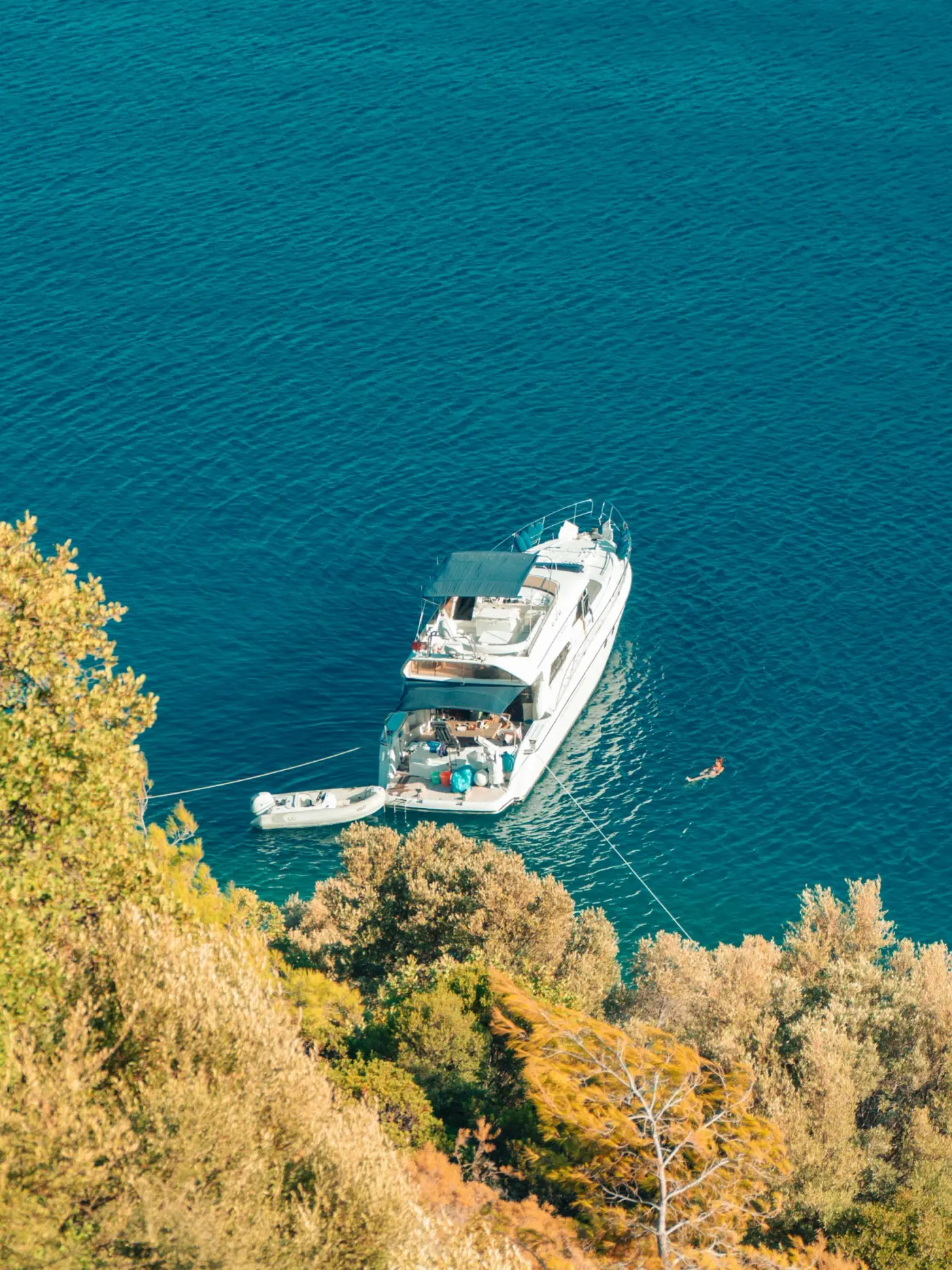
The right charter yacht for Greece depends on three things: where you're sailing, how many guests are onboard, and what your week actually looks like. Motor yachts dominate the Cyclades for speed and range. Catamarans win in the Ionian and Saronic for space and value. Gulets surprise everyone. Here's the honest breakdown from a broker who matches these decisions every week from Athens.
By George P. Biniaris, Managing Broker, George Yachts | IYBA Member, Last Updated: April 2026
Why Does the Type of Yacht Matter More in Greece Than Anywhere Else?
Greece is not one sailing destination. It is four.
The Ionian sits on the western coast, calm mornings, gentle afternoon thermals, islands so close together you can see the next one from the one you're standing on. The Cyclades stretch across the central Aegean, longer passages, open sea, and the Meltemi wind that blows Force 5 to 7 from July through August. The Saronic Gulf wraps around Athens, short hops, sheltered water, and you're onboard 45 minutes after landing at Eleftherios Venizelos. The Dodecanese and Sporades sit further afield, longer transits, fewer crowds, and anchorages you'll have to yourself.
Each of these regions rewards a different yacht. Choose correctly and your week flows, harbour to anchorage to harbour, every stop reachable, every day comfortable. Choose badly and you lose days. Your guests get seasick crossing from Paros to Santorini in a catamaran fighting a 30-knot headwind. Your APA burns through fuel pushing a motor yacht on a route where a sailing yacht would have done the job for a quarter of the cost.
Over 12 MYBA charters I've managed in these waters, the single biggest factor in client satisfaction has never been the yacht's age, its interior designer, or the thread count of the linens. It has been whether the yacht type matched the itinerary. Get that decision right and everything else falls into place.
If this is your first charter, I'd recommend reading The First-Timer's Complete Guide to Crewed Yacht Charter in Greece before continuing, it covers the full booking process, MYBA contracts, and APA budgeting. This article focuses specifically on the yacht itself.
What Are the Four Types of Charter Yacht Available in Greece?
There are four categories worth knowing. Each carries distinct advantages, and trade-offs that rarely appear in brochure copy.
Motor Yacht
A motor yacht is a power-driven vessel with no sails, typically ranging from 18 to 60+ metres in length for the crewed charter market. Motor yachts rely on diesel engines for propulsion, offering cruising speeds of 10 to 20 knots and the ability to cover 60 to 100 nautical miles in a single day without fatigue.
In Greek waters, motor yachts dominate the premium charter segment. They carry larger crews (4 to 12 depending on LOA), offer multiple deck levels with distinct social zones, and handle open-sea conditions, including the Meltemi, with stabiliser systems that keep the ride smooth when the Aegean is anything but.
The trade-off is cost. Fuel consumption on a 25-metre motor yacht runs approximately €3,000 to €5,000 per week in the Cyclades, depending on itinerary. On a 40-metre superyacht, that figure can reach €8,000 to €15,000. This comes out of the APA, the Advance Provisioning Allowance, a pre-charter cash deposit (20 to 30 percent of the base on catamarans, 30 to 40 on motor yachts) that covers fuel, food, berthing fees, and running expenses during the voyage.
Sailing Catamaran and Power Catamaran
A catamaran is a twin-hulled vessel, either sail-driven or engine-powered, that offers exceptional beam (width) relative to its length. A 15-metre catamaran delivers roughly the same living space as a 20-metre monohull.
Sailing catamarans are the workhorses of the Greek charter fleet under €30,000 per week. Modern models from Lagoon, Fountaine Pajot, and Bali offer 4 to 6 cabins, wide trampolines for lounging, shallow drafts of 1.2 to 1.5 metres (meaning access to bays where deeper-keeled vessels cannot anchor), and fuel costs that are a fraction of a motor yacht's, often under €800 per week.
Power catamarans combine catamaran stability with motor yacht speed. They're a growing segment in Greece, particularly for clients who want the space and comfort of a catamaran but need to cover Cycladic distances efficiently.
The trade-off: catamarans struggle in strong headwinds. The wide beam catches wind. Upwind passages in Meltemi conditions, the kind you encounter between Mykonos and Naxos in August, can turn a 3-hour crossing into a 6-hour ordeal. And in busy marinas like Mykonos town quay or Ermoupoli, that wide beam means higher berthing fees and fewer available slots.
Sailing Monohull
The classic. A single-hulled sailing yacht, typically 12 to 25 metres for charter, with a deep keel, a mast, and the ability to sail upwind in conditions that would stop a catamaran dead.
Monohulls offer the most authentic sailing experience. They heel (lean) under wind, thrilling for sailors, unsettling for first-timers. They have deeper drafts (1.8 to 3.0 metres on a 15-metre yacht), which limits access to shallow anchorages but provides stability and upwind performance.
In Greece, the crewed monohull market sits at the entry-to-mid price range, €8,000 to €25,000 per week. Crew size is typically 2 (skipper and chef/hostess). Cabins tend to be more compact than equivalent-length catamarans, but the sailing experience itself, particularly in the Ionian, is unmatched.
Gulet
A gulet is a traditional wooden motorsailer, originally Turkish-built, with a wide beam, a shallow draft, and a design philosophy that prioritises deck space above all else. Gulets in the Greek charter market range from 20 to 40 metres, typically carry 8 to 16 guests in 4 to 8 cabins, and come with crews of 4 to 7.
The gulet is the most misunderstood yacht in the Greek fleet. Clients either don't know it exists or assume it's outdated. In reality, a well-maintained gulet offers more outdoor living space per euro than any other yacht type. The aft deck alone, where meals are served under a canvas canopy, seats 12 to 16 comfortably. Cushioned sunbathing areas stretch the full length of the foredeck.
Gulets motor-sail at 8 to 10 knots. They will not win any races. But for families, multi-generational groups, or anyone whose week is about long lunches at anchor, swimming off the stern platform, and reading in the shade while the coastline of Kefalonia drifts past, a gulet is hard to beat.
The trade-off: performance in open sea. A gulet is at its best in the Ionian, the Saronic, and the calmer stretches of the Dodecanese. In the Cyclades during Meltemi season, a gulet is the wrong choice.
Yacht Type Comparison at a Glance
Motor Yacht, Speed: 12 to 20 kn · Stability: High (with stabilisers) · Living space: Large (multi-deck) · Draft: 1.5 to 3.0 m · Fuel cost/week: €3,000 to €15,000 · Crew: 3 to 12 · Weekly rate 2026: EUR 17,500 to 235,000 base · Best for: Cyclades, long range
Sailing Catamaran, Speed: 6 to 8 kn · Stability: Very high · Living space: Very large (beam) · Draft: 1.2 to 1.5 m · Fuel cost/week: €500 to €800 · Crew: 2 to 4 · Weekly rate 2026: EUR 17,000 to 90,000 base · Best for: Ionian, Saronic
Power Catamaran, Speed: 10 to 15 kn · Stability: Very high · Living space: Very large · Draft: 1.2 to 1.8 m · Fuel cost/week: €1,500 to €3,000 · Crew: 2 to 4 · Weekly rate 2026: EUR 21,000 to 90,000 base · Best for: Cyclades crossover
Sailing Monohull, Speed: 6 to 8 kn · Stability: Moderate (heels) · Living space: Compact · Draft: 1.8 to 3.0 m · Fuel cost/week: €300 to €600 · Crew: 2 · Weekly rate 2026: €8,000 to €25,000 · Best for: Ionian, purists
Gulet, Speed: 8 to 10 kn · Stability: Moderate to High · Living space: Very large (deck) · Draft: 1.5 to 2.5 m · Fuel cost/week: €1,000 to €2,500 · Crew: 4 to 7 · Weekly rate 2026: quoted on request, about EUR 9,500 to 44,500 (est.) · Best for: Ionian, families
Which Yacht Type Fits Which Greek Waters?
This is where most online guides fail. They list features in a vacuum. But features mean nothing until you map them to a specific stretch of the Aegean.
The Cyclades: Motor Yacht Territory
The Cyclades are Greece's marquee destination, Mykonos, Santorini, Paros, Milos, Naxos, Koufonisia. But they're also the most demanding. Island-to-island distances run 20 to 40 nautical miles. The Meltemi wind dominates from late June through August, regularly blowing Force 5 to 7 from the north. A classic Athens to Mykonos, Santorini to Athens loop covers over 300 nautical miles.
A motor yacht handles this effortlessly. You leave Naousa harbour in Paros after breakfast, arrive at Oia anchorage in Santorini for a late lunch. Your guests never felt the sea state because the stabilisers did their job.
A sailing catamaran on the same route? Possible in May or September when the Meltemi sleeps. In July, your captain will spend half the week explaining why you can't make the crossing today. Your guests will remember the pounding, not the sunset.
Recommendation: Motor yacht (first choice) or power catamaran (strong alternative). Sailing catamaran only in shoulder season (May, late September to October). Avoid gulets and monohulls for full Cyclades itineraries in high season.
The Ionian: Every Yacht's Happy Place
The Ionian is the opposite of the Cyclades in almost every way. Calm mornings. Gentle afternoon westerlies. Islands separated by 5 to 15 nautical mile hops, Corfu to Paxos, Gaios to Sivota, Meganisi to Fiscardo. The water is sheltered by the mainland to the east. Wind rarely exceeds Force 4.
Every yacht type works here. Sailing monohulls find their purest expression, steady breezes without the aggression. Catamarans thrive on the short passages and shallow anchorages of Antipaxos and Vathi. Gulets were practically designed for the Ionian's rhythm: slow, social, deck-focused. Even motor yachts perform beautifully, though their speed advantage is less relevant when the next island is 40 minutes away regardless.
Recommendation: Catamaran or gulet for families and groups. Sailing monohull for couples and sailing enthusiasts. Motor yacht if you're combining Ionian with a longer passage south toward Zakynthos or the Peloponnese.
The Saronic Gulf: The All-Rounder
The Saronic sits directly below Athens, Marina Zeas, Marina Alimos, and Flisvos Marina are your embarkation points. Within 90 minutes of casting off, you're anchored off Aegina or approaching Poros. Hydra is a 3-hour motor from Athens. Porto Heli and Spetses sit at the southern end.
Distances are short. Seas are sheltered. This is the most forgiving sailing ground in Greece, which is why it's the best region for first-time charterers regardless of yacht type.
Recommendation: Whatever matches your group and budget. The Saronic doesn't penalise any yacht type. If you're unsure about your sea legs, start here. For the full day-by-day route, see The Saronic Gulf: The 5-Day Crewed Charter That Starts Where You Land.
The Dodecanese and Sporades: Longer Range, Bigger Rewards
The Dodecanese (Rhodes, Symi, Kos, Patmos, Leros) and the Sporades (Skiathos, Skopelos, Alonissos) are for clients who've done the Cyclades and the Ionian and want something different. Anchorages are quieter. Tourism infrastructure is lighter. The National Marine Park in the northern Sporades offers some of the cleanest water in the Mediterranean.
Distances between islands are longer, 25 to 50 nautical miles in the Dodecanese. Motor yachts and large power catamarans handle this best. Sailing catamarans work if you plan generous daily windows. Gulets suit the Dodecanese well, the calm, warm water between Rhodes and Symi is gulet heaven.
Recommendation: Motor yacht or power catamaran for ambitious itineraries. Gulet for relaxed Dodecanese routes. Sailing catamaran for Sporades (sheltered, short hops, exceptional anchorages).
How Do You Match Yacht Type to Your Group?
The second decision, after region, is people. Who's onboard? How do they move through space? What does the group dynamic look like?
Families With Young Children (Ages 2 to 10)
Best fit: Sailing catamaran. Stability matters when toddlers are onboard. A catamaran barely moves at anchor. The wide trampoline net between the hulls is where children live, they'll spend hours on it. The shallow draft means your captain can anchor 30 metres from a beach on Koufonisia while deeper-keeled vessels sit 200 metres out.
The open-plan salon connects to the cockpit, so parents maintain sightlines while children move between indoor and outdoor spaces.
Couples and Honeymoons
Best fit: Sailing monohull or boutique motor yacht (under 25m). Intimacy matters here more than space. A 15-metre sailing monohull with a skipper and chef creates a


