
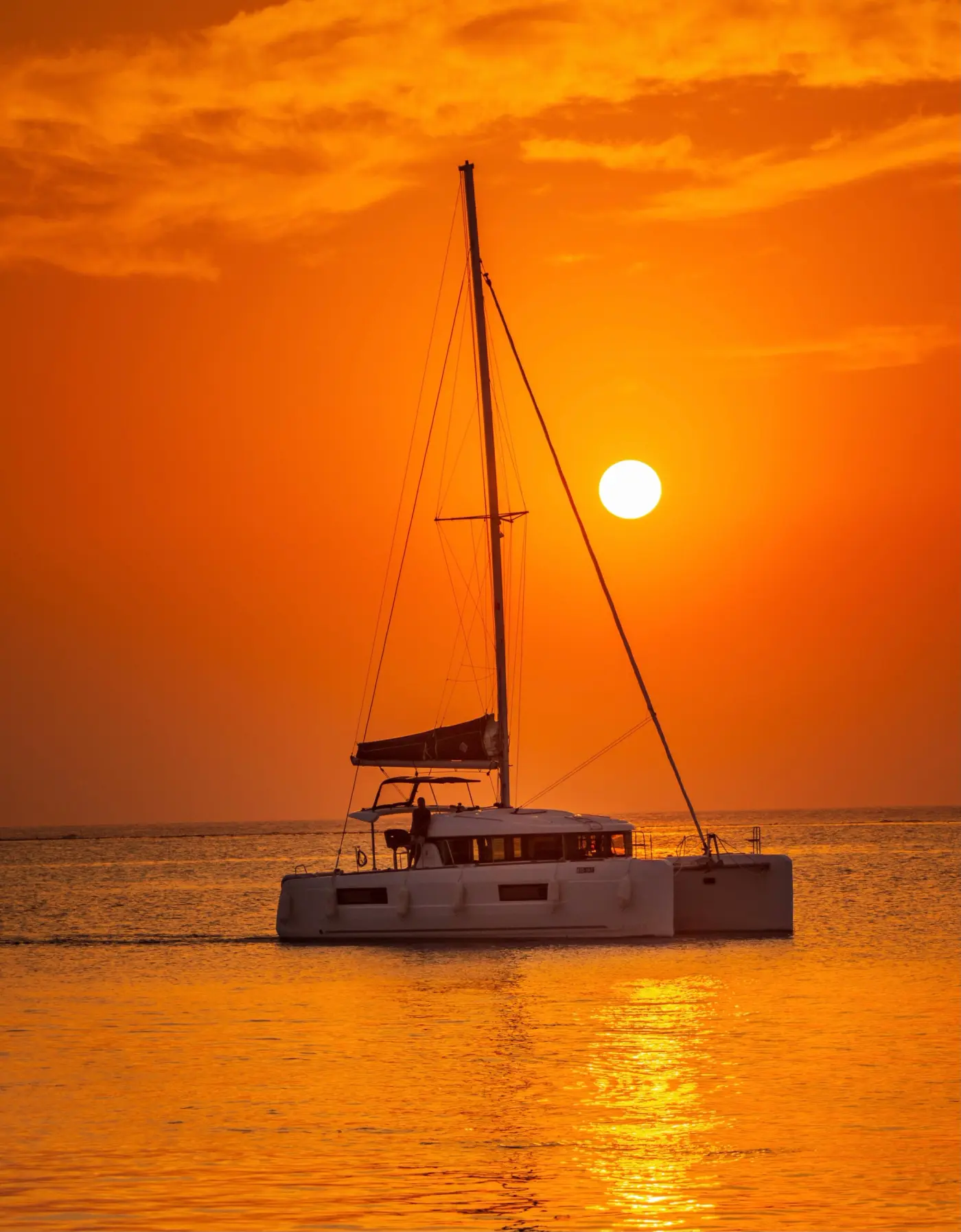
Every spring the same email arrives, usually in February or March. A couple getting married in June wants ten days in Greece. They have seen Santorini at sunset on someone's feed and Mykonos at midnight on someone else's. They ask for both.
I usually talk them out of half of it.
A honeymoon charter is a specific product. It is not a party charter with two guests, and it is not a family itinerary with the children removed. It is built around the two things the famous islands ration most carefully in summer: privacy and calm water. This guide is how a working broker actually plans one, with the routes, the anchorages, the real costs and the add-ons that earn their fee.
The Short Answer
- The best honeymoon windows are late May to late June, and September. The meltemi, the dry northerly wind of the central Aegean, peaks between mid-July and mid-August and regularly closes the exposed anchorages you chartered for. September has the warmest sea of the year and the islands exhale after August.
- The honeymoon route is not the Instagram route. The western Cyclades (Kythnos, Serifos, Sifnos, Milos, Polyaigos, Folegandros) deliver the same light and the same white villages at a fraction of the traffic. The Saronic Gulf is the calm-water alternative.
- The right yacht for two is smaller than couples expect. A crewed catamaran of 44 to 50 feet with a captain and chef starts around €14,000 to €17,500 per week in 2026. Larger crewed sailing catamarans run €31,500 to €42,500. Motor yachts climb from roughly €49,000.
- Privacy comes from the anchorage, not the yacht. Anchoring in an empty bay instead of berthing in a busy port is the single decision that changes the character of the week.
- Budget all-in, not on the charter fee. Add an APA of 25 to 30 percent for fuel, provisioning and port fees, Greek VAT, and a customary crew gratuity. A realistic all-in plan for a week for two on a quality crewed catamaran is €22,000 to €27,000.
Why the Honeymoon Route Is Not the Instagram Route
Santorini is a magnificent place to be a hotel guest and a frustrating place to be a yacht. The caldera is hundreds of metres deep, anchoring inside it is mostly impossible, mooring options are scarce, and the ferry and cruise traffic puts a swell through the bay all day. Mykonos has the opposite problem: the anchorages exist, and in July everyone is in them.
Either island works as a single dramatic stop if your heart is set on it. Neither works as the spine of a honeymoon.
The spine should run through the western Cyclades. Same Aegean light, same whitewashed villages, same volcanic blues. The difference is that at Polyaigos or Kolona you will often share the bay with nobody at all. That is the product you are actually buying.
The 7-Day Western Cyclades Honeymoon Itinerary
This is the route I build most often for couples chartering out of Athens in June or September. Distances are short, every overnight is sheltered from the prevailing northerlies, and the drama builds through the week instead of peaking on day one.
- Day 1. Athens (Alimos Marina) to Kythnos. Four to five hours underway. Anchor at Kolona, a double-sided sand spit with turquoise water on both flanks. First dinner is served aboard, at anchor, with nothing around you but the spit and the stars.
- Day 2. Kythnos to Serifos. Two to three hours. Morning swim at Kolona, lunch underway, afternoon at Psili Ammos beach. In the evening, taxi up to the Chora of Serifos, one of the steepest and least commercialised hilltop villages in the Cyclades, for sunset from the top.
- Day 3. Serifos to Sifnos. A short hop. Anchor in Vathi, a horseshoe bay with a chapel on the waterline. Sifnos is the gastronomic island of the Cyclades and the birthplace of Nikolaos Tselementes, the man who wrote the book on Greek cooking. Dinner ashore here is the one restaurant booking the crew will insist you keep.
- Day 4. Sifnos to Milos. Around three hours. Kleftiko, the white pirate caves on the southwest corner, is best visited by tender in the early evening, after the day boats have gone. Overnight at Provatas or inside Adamas bay, depending on the wind.
- Day 5. Milos to Polyaigos. Under an hour. Polyaigos is the largest uninhabited island of the Aegean. No port, no taverna, no road. Turquoise shallows over a white seabed. This is the day the photographs come from, and the day most couples name first when they write to me in October.
- Day 6. Polyaigos to Folegandros. Two to three hours. The Chora of Folegandros sits on the edge of a 200-metre cliff, and dinner in its small squares is the most romantic evening ashore in the Cyclades. I will defend that claim against any island you name.
- Day 7. The return north. Break the passage at Serifos or back at Kolona so the last day is a swim, not a delivery. Disembark at Alimos the following morning.
The Calm Alternative: A 5-Day Saronic Honeymoon
Not every couple wants open-sea passages, and not every honeymoon falls in the calm months. The Saronic Gulf, an hour from the runway at Athens International, is the answer for couples who worry about seasickness, marry in the meltemi weeks of July and August, or have five days instead of eight.
- Day 1. Alimos to Poros. Two and a half hours. Anchor off Love Bay, a pine-backed cove that earned the name honestly.
- Day 2. Poros to Hydra. Cars are banned on Hydra, the harbour rises like an amphitheatre, and by six in the evening the whole town turns gold. Dinner ashore, then back aboard.
- Day 3. Hydra to Dokos. Twenty minutes away and a different world: an almost uninhabited island whose Skintos Bay gives you the quietest night of the trip.
- Day 4. Dokos to Spetses. Old-money Greece. Horse-drawn carriages, pine forests, and a drink at the Poseidonion before dinner.
- Day 5. Spetses to Ermioni, then home. A last swim on the mainland coast before the run back toward Athens.
No leg on this route exceeds three hours, and every anchorage is sheltered. I have written a full guide to the 5-day Saronic charter if this is your version of quiet.
The Anchorages Couples Ask to Return To
If you take nothing else from this article, take the names. These are the anchorages that come up, unprompted, when honeymoon clients write back.
- Polyaigos, the blue lagoon side. Uninhabited, unlit, and on a clear September night the Milky Way is visible from the deck.
- Kolona, Kythnos. The double beach. Swim across one side before breakfast and the other before dinner.
- Kleftiko, Milos, by tender at seven in the evening. White rock arches, green water, no day boats. Timing is everything here.
- Vathi, Sifnos. A chapel on the waterline, a horseshoe of calm, and two tavernas worth the dinghy ride.
- Skintos Bay, Dokos. The Saronic's best-kept silence, twenty minutes from Hydra's crowds.
- Voutoumi, Antipaxos, for Ionian honeymoons. If your wedding falls in July or August, the green, sheltered Ionian is often the smarter sea, and Voutoumi is its postcard.
Privacy on a Crewed Yacht: How It Actually Works
The most common honeymoon hesitation I hear is the crew. Two of you, two or three of them, one boat. Will it feel like a hotel corridor at sea?
No, and here is the mechanics of why. On a crewed catamaran for two, the crew lives in separate quarters, typically the forward cabins or the opposite hull. The service rhythm is set by you, in writing, in the preference sheet before you ever step aboard: breakfast at ten, dinner ashore three nights, no service after eleven. Good crews are professionals at being present when needed and invisible when not. It is the core skill of the job.
The rest of the privacy equation is route design. Anchor out instead of berthing stern-to in a busy port, and the evening belongs to you instead of the promenade. Charter contracts in the Greek fleet follow the MYBA standard, and for clients with a public profile, specific written confidentiality terms can be added to the agreement before signing.
I have written separately about hushpitality and quiet luxury in Greek waters. A honeymoon is the purest version of that brief.
Concierge Add-Ons Worth Paying For (and Two That Are Not)
- A photographer for one golden hour. One hour, one evening, usually at Polyaigos or Kolona. Phone photos never quite hold that light.
- An onboard massage afternoon. A therapist is arranged ashore on Sifnos, Milos or Spetses and brought to the yacht by tender while you are at anchor.
- A beach dinner set by the crew. Table, linen and lanterns on an empty cove. This is logistics, not magic. Tell your broker a week ahead and it happens.
- Provisioning to a wine list. Send your preferences with the preference sheet. Greek labels worth meeting on your own deck: Assyrtiko, Malagousia, and a Xinomavro for the one cool evening.
- Skip the fireworks. Summer fire risk makes permits close to impossible on most islands, and the wind makes the final call anyway.
- Skip the oversized floral installation. Spectacular at embarkation, wilted by Wednesday. A few fresh stems renewed at each port does far more.
What a Honeymoon Charter Costs in 2026
Working numbers from the 2026 Greek fleet, for two guests with full crew:
- Crewed power or sailing catamaran, 44 to 50 ft, captain plus chef or host: €14,000 to €17,500 per week. This is the honeymoon sweet spot, and the category I place most couples in.
- Larger crewed sailing catamaran, 60 to 67 ft: €31,500 to €42,500 per week. More space than two people can use, which is exactly the point for some couples.
- Crewed motor yachts: from roughly €49,000 per week for a 70 ft power catamaran, climbing past €100,000 for a 40-metre yacht with a crew of eight. For a honeymoon this is rarely necessary and occasionally exactly right.
On top of the charter fee sits the APA, the Advance Provisioning Allowance, typically 25 to 30 percent. It covers fuel, food, drinks, port fees and everything consumed aboard, with the unspent balance returned to you at the end. Greek VAT applies to the charter fee at a rate that depends on the itinerary, and a crew gratuity, customarily 10 to 15 percent at your discretion, closes the week.
Worked example: a €15,000 catamaran week plus a €4,500 APA, VAT and gratuity lands between €22,000 and €25,000 all-in. For the line-by-line mathematics, see the complete 2026 cost breakdown.
When to Go, and When to Book
The Hellenic National Meteorological Service data is unambiguous: the meltemi blows from June to September and peaks between mid-July and mid-August, frequently reaching force 6 to 7 in the central Aegean. It is a dry, sunny wind, and it is also the reason a July Cyclades honeymoon can spend two days waiting in port. June gives long days and warming water before the peak. September gives the warmest sea of the year, around 24 degrees, with the crowds gone.
On booking: the best crewed catamarans for the first two weeks of September 2026 are thinning out now. For a 2027 honeymoon in June or September, eight to ten months ahead secures first pick of yacht and crew. The month-by-month guide covers every window in detail.
Frequently Asked Questions
How much does a honeymoon yacht charter in Greece cost for two?
A crewed catamaran with captain and chef starts at €14,000 to €17,500 per week in 2026. Add an APA of 25 to 30 percent for fuel, provisioning and port fees, plus Greek VAT and a customary crew gratuity of 10 to 15 percent. A realistic all-in figure for a week for two on a quality crewed catamaran is €22,000 to €27,000. Larger sailing catamarans run €31,500 to €42,500 per week before extras, and motor yachts climb from roughly €49,000.
What is the best month for a honeymoon yacht charter in Greece?
Late May, June and September. The meltemi wind peaks between mid-July and mid-August and can blow at force 6 to 7 for days in the central Aegean, closing exposed anchorages exactly when you want them empty. June offers warm water and long days before peak crowds. September offers the warmest sea of the year, around 24 degrees, with the islands far quieter after August.
Is a crewed yacht private enough for a honeymoon?
More private than any hotel. The crew of two or three lives in separate quarters, usually the forward cabins or the opposite hull, and the service rhythm is agreed by you in the preference sheet before boarding. Professional charter crews are trained to be present when needed and invisible when not. The remaining privacy comes from route design: anchoring in empty bays such as Polyaigos or Dokos instead of berthing in busy ports.
Do we need any sailing experience for a crewed honeymoon charter?
None. On a crewed charter the captain handles navigation, weather routing, anchoring and all paperwork. Your only decisions are where to swim and what to eat. If you are curious, most captains are happy to hand you the helm in open water, and it makes a good photograph.
Cyclades, Saronic or Ionian for a honeymoon charter?
Cyclades for drama: white villages, volcanic coastlines, the postcard Greece, with the western islands offering the privacy the famous ones cannot. The Saronic for calm: short sheltered hops with no open-sea passage over three hours, ideal for May, September or a five-day charter. The Ionian for green: olive and cypress shorelines with gentler summer winds, the right call for couples who marry in July or August or who feel the sea easily.
How far in advance should we book a honeymoon charter in Greece?
For September 2026, immediately: the best crewed catamarans for early September are usually committed by midsummer. For a 2027 honeymoon in June or September, eight to ten months ahead secures first choice of yacht, crew and anchorage plan. Last-minute gaps do appear, but a honeymoon is the wrong trip to gamble on leftover inventory.
How to Plan Yours
Three pieces of information start the work: your dates or a flexible range, your budget envelope, and the version of quiet you are looking for. From there, a working broker should return with two or three specific yachts, a route built around your weather window, and the per-week mathematics laid out before you commit to anything.
I plan honeymoon charters exclusively in Greek waters, and I have anchored in every bay named in this article. Book a free thirty-minute consultation or reach me on WhatsApp at +1 786 798 8798.
Explore More
- Best Time to Charter a Yacht in Greece: Month-by-Month Guide 2026
- How Much Does a Yacht Charter in Greece Actually Cost? The Complete 2026 Breakdown
- Hushpitality: The Quiet Luxury Trend Greek Waters Invented First
- What Actually Happens on a Crewed Yacht Charter in Greece, Hour by Hour
- The 7-Day Cyclades Itinerary: What Your Captain Won't Tell You Until You're Onboard
Sources and References
- Hellenic National Meteorological Service (HNMS / EMY): climatology of the etesian (meltemi) winds in the Aegean, seasonal intensity and sea conditions
- Νόμος 4926/2022 (Greek Government Gazette A' 82 / 20.04.2022): legal framework for commercial pleasure yacht charter in Greek waters
- MYBA (Mediterranean Yacht Brokers Association): Standard Charter Party Contract, APA structure and crew gratuity guidelines
- IYBA (International Yacht Brokers Association): broker standards and Charter Active Member ethics
- George Yachts 2026 Greek fleet data: published weekly rate bands across crewed catamarans, sailing yachts and motor yachts
- Working broker experience: crewed honeymoon and couples charters delivered in Greek waters
About the Author
Written by George P. Biniaris, Managing Broker at George Yachts and IYBA Charter Active Member. Licensed skipper with hands-on experience across Greek waters. BSc in Shipping Management & Operations, Business College of Athens. Featured in Forbes, May 2026. Based in Athens. This article reflects working broker knowledge supported by primary sources in Greek maritime regulation and meteorology.
To plan a honeymoon charter in Greek waters, book a free consultation or contact george@georgeyachts.com.


