
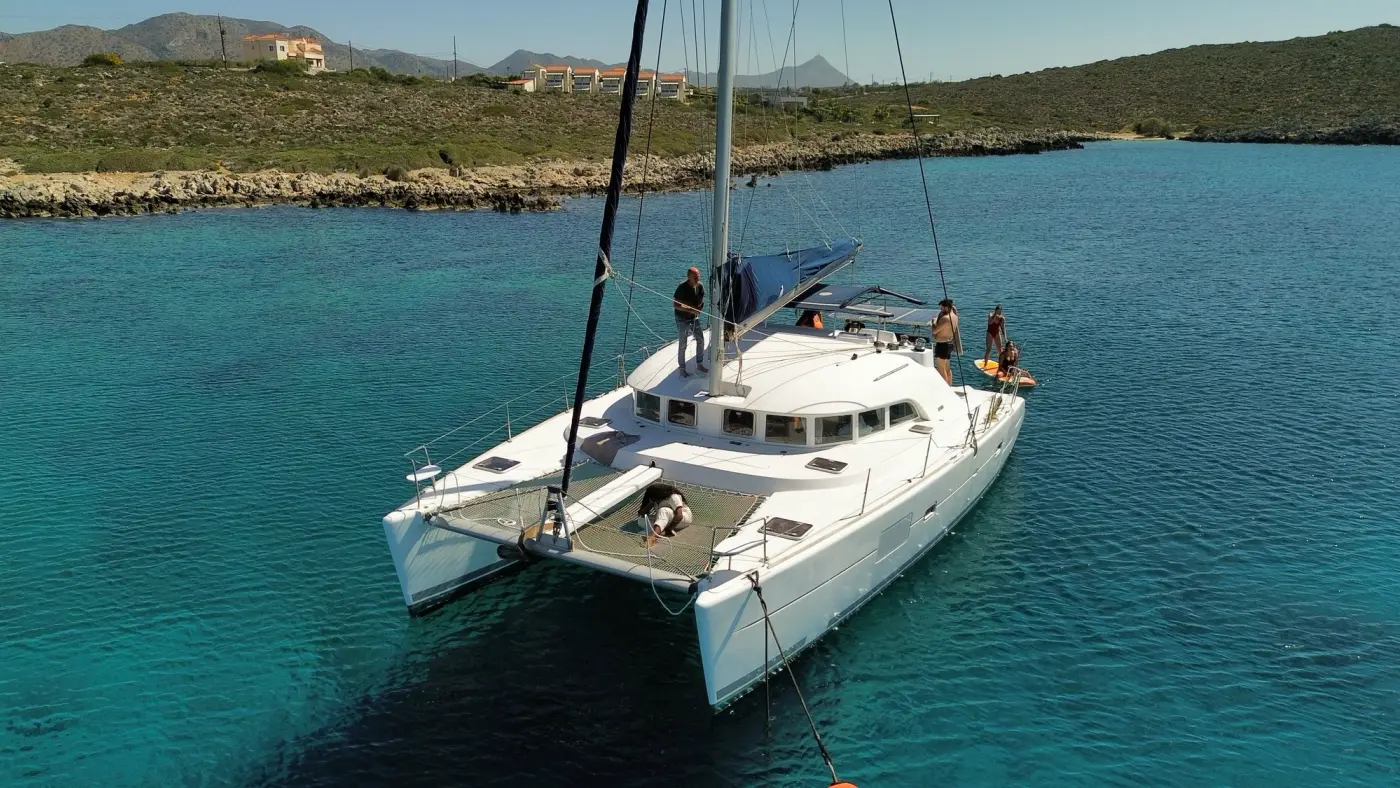
Every week of the season, somewhere between the first email and the signed contract, a version of the same question arrives on my desk. It is rarely phrased directly. It hides inside questions about cabin sizes and itineraries, but what the family actually wants to know is this: are we the kind of people a yacht charter is for? Will someone be sick? Is it safe for the children? What if the wind comes up? My grandmother is eighty-one, is this madness?
I have answered these questions for years, first over dinners and now for a living, and I have learned that the honest answers are better than the reassuring ones. So this is the honest version, the companion piece to our first-timer's complete guide: every worry I actually hear, answered the way I would answer a friend, including the cases where my answer is that a charter is not the right holiday for you. Those cases exist. We will get to them.
Will we get seasick on a Greek yacht charter?
Almost certainly less than you fear, and the reason is not luck. It is geography. The picture in most first-timers' heads comes from ocean documentaries: a small boat, a vast sea, a horizon that will not hold still. A Greek charter is nothing like that picture. The Aegean and the Ionian are archipelago seas. You are cruising between islands that sit within sight of one another, in legs of two to four hours, and the rest of your day the yacht lies at anchor in a bay chosen precisely because the water there is calm. Across a full charter week, the hours in genuine open water are few, and a good captain arranges even those with the wind and swell behind or beside you, in the shelter of the islands, in the gentler hours of the morning.
If you want to see what this actually looks like across a day, we have written the hour-by-hour account of a crewed charter day. Read it and count the hours of movement. Most guests are surprised: the yacht is a moving vessel for a morning, and a waterfront villa for the rest of the day.
For the genuinely sensitive, the practical toolkit is simple and it works. Choose a catamaran, of which more below. Ask your captain to favour morning passages, when the sea is at its calmest. Stay on deck with your eyes on the horizon during legs rather than reading in a cabin. Take the tablet the night before if you know you are susceptible, not after you feel unwell. And tell your broker in the first conversation, because the itinerary itself is a remedy: a route through the Saronic or the Ionian can be drawn with almost no exposed water at all.
How rough is the Aegean, honestly? The Meltemi, explained by someone who works with it
You will read the word Meltemi in every forum thread about Greek sailing, so let me give you the working broker's version. The Meltemi is the dry north wind of the Aegean summer. It peaks in July and August, it blows hardest over the open Cyclades, and on the days it works it turns the famous blue water white-capped and boisterous. It is also, and this is the part the forums miss, a fact of planning rather than a danger. Charter yachts are crewed by professionals who read the forecast days in advance, and the Greek island map is so dense with shelter that avoiding an honest Meltemi day is mostly a matter of choosing the lee side of things. The wind's whole calendar, month by month, is laid out in our month-by-month guide.
And if your group would simply rather not think about wind at all, you have two elegant outs. The first is regional: the Ionian, the Saronic and the Sporades sit largely outside the Meltemi's reach. The second is seasonal: June and September deliver the same Greece with a softer sky. I have made the full case for September elsewhere; for nervous first-timers it is close to a cheat code.
Which yacht is best if motion worries us?
A catamaran, and it is not a close contest. Two hulls change the physics of the holiday. A monohull sailing yacht heels, beautifully if you love sailing, alarmingly if you do not. A catamaran sits flat under way and, just as important, rolls far less at anchor, which is where you will spend most of your week. The beam is enormous for the length, so the decks feel like terraces rather than walkways, and there is always a stable, shaded place to sit. I wrote an honest full-length answer on catamarans this month, and stability for mixed, multi-generation groups is the heart of the argument. If that sounds like your family, start with our crewed catamaran page.
Two refinements. If your group wants to cover more islands with less time under way, a power catamaran gives you the twin-hull stability with motor yacht pace, which shortens every passage. And among conventional motor yachts, ask specifically for a hull fitted with stabilisers, which take the roll out of the anchorage hours. M/Y NAYLA on our list is exactly that brief: stabilisers at anchor and under way, which is unusual at 24 metres, four cabins for nine guests and a crew of four.
Is a crewed yacht safe for children?
Families are not an edge case in Greek chartering; they are the market. On a crewed yacht your children are surrounded by professionals whose entire job is the wellbeing of the people on board. The rhythm of a family day is built around water: a shallow, sandy anchorage by mid-morning, swimming off the stern for hours, paddleboards and snorkelling gear rigged before the children have finished breakfast. The captain gives a plain-language safety briefing on day one. Life jackets in children's sizes are aboard or arranged in advance. And unlike a beach, the swim platform of an anchored yacht is a defined, watched, contained territory. I have compared the whole experience with a hotel week, honestly and in numbers, in our yacht-versus-five-star-hotel breakdown.
The honest caveat, and I give it to every parent: a yacht is not a fenced pool, and the crew are professionals, not babysitters. Non-swimmers need an adult's eyes on them whenever they are on deck, the same rule as any waterfront villa. Families who internalise that one rule have, in my experience, the best holidays of their lives. For the practical question of where everyone sleeps, the five-cabin catamarans are the family sweet spot: parents, children and grandparents each with a door to close.
Can the grandparents come? The three-generation question
Some of the finest weeks I have ever arranged were three-generation charters, and I will argue that a crewed yacht suits an eighty-year-old better than most holidays: no daily packing and unpacking, no airport transfers between islands, no restaurant marches in the heat. The island comes to the deck. The checklist that makes it work is short. Choose a yacht with easy boarding and a layout that does not demand steep companionway stairs for every meal. Keep the legs short and the anchorages long. Tell your broker about any mobility or medical consideration in the first conversation, not the last one, so the crew can set the yacht up properly. Greek island towns keep medical centres and pharmacies, and a sensible itinerary is never far from a port. On the right platform, a stable catamaran or a stabilised motor yacht, the sea is the gentlest part of the week.
What happens if the weather turns during our week?
The plan changes and the holiday does not. This is the single most under-appreciated argument for a professional crew, and the reason I steer first-timers away from skippering themselves, a comparison I have written up in full in crewed versus bareboat. Greece has hundreds of islands and thousands of anchorages. When a forecast hardens, your captain does not grit teeth and push through it; he redraws the day. The exposed bay becomes the sheltered one around the headland. The long crossing becomes two short ones a day apart. The windy island becomes its calm neighbour, which you had never heard of and will talk about for years. In a decade of doing this I can count on one hand the weeks that lost more than a single day's original plan to weather, and none of them lost the week.
Which waters are gentlest for a first charter?
Three answers, in the order I give them to nervous families. The Saronic Gulf begins an hour from the Athens airport and is effectively protected water throughout: short hops, historic harbours, and the easiest logistics in Greece. The Ionian, on the country's green western side, is the softest sea we have, largely beyond the Meltemi's reach, and its seven-day itinerary is the one I hand to families with young children. The Sporades add sandy, shallow bays and the shelter of the Alonissos marine park waters. And the open Cyclades, the Greece of the postcards? Magnificent, and breezier in high summer. Many first-timers save the Cyclades route for the second charter, or take it in June or September. There is no wrong answer, only a right order.
The honest chapter: when I advise against a charter
I promised you the cases where the answer is no, and here they are, because a broker who cannot say no is a salesman. If a member of your party has severe, medication-resistant motion sensitivity, the kind that ruins car journeys, then even the gentlest itinerary carries a risk I would not sell you; a villa with day-boat excursions on the flattest days is the better holiday. If your picture of the week involves children roaming unsupervised while the adults switch off entirely, a yacht is the wrong container for that picture. If anyone aboard needs to be within minutes of a major hospital at all times, the honest answer is that island cruising cannot promise that, and I would rather lose the booking than pretend otherwise. And if your party seasickness test is a genuine unknown, book the shorter Saronic week first, not the ten-day Cyclades odyssey. The sea will still be there next summer. So will I.
What does trying it actually cost?
Real numbers from our own fleet, because reassurance without numbers is marketing. Crewed catamarans in our book start at €17,000 per week at the accessible end and rise to €90,000 for the flagship sailing catamarans. The family workhorses sit in between: S/CAT Libra, five cabins and a crew of three, runs €18,900 to €26,900 per week; the stabilised M/Y NAYLA runs €39,500 to €47,500. On top of the charter fee sit the APA, VAT at the yacht's certified rate, and crew gratuity, all of which I walk through line by line in the complete cost breakdown. For where the whole market sits this season, the Greek Charter Index is the reference we keep for exactly that question.
So: is it right for you?
If your family can enjoy a waterfront villa, you can enjoy a crewed yacht charter, because that is what it is: a villa that anchors in a new bay each evening, with a staff who happen to be able to move the view. The worries that kept you reading this far are the right worries to have, and every one of them has a professional answer: geography for the seasickness, a catamaran for the motion, a crew for the children, a captain for the weather, and a broker who will tell you no when no is the truth. When you are ready for the practical end of things, the packing guide answers the suitcase questions this article has probably raised.
And when you want the answers that are specific to your family rather than every family, write to me with the month, the group and the mood, including the worries. Especially the worries. Tell me who is eight and who is eighty-one, who gets carsick and who cannot swim, and I will tell you honestly whether a Greek week works for you, and on which yacht, in which waters. I answer personally, usually within hours.
P.S. If the worry that brought you here is specifically a small child, there is now a longer piece on chartering in Greece with children under ten: which yachts actually have a twin or bunk cabin, what child equipment is really aboard, and why the Ionian beats the Cyclades in August.


