
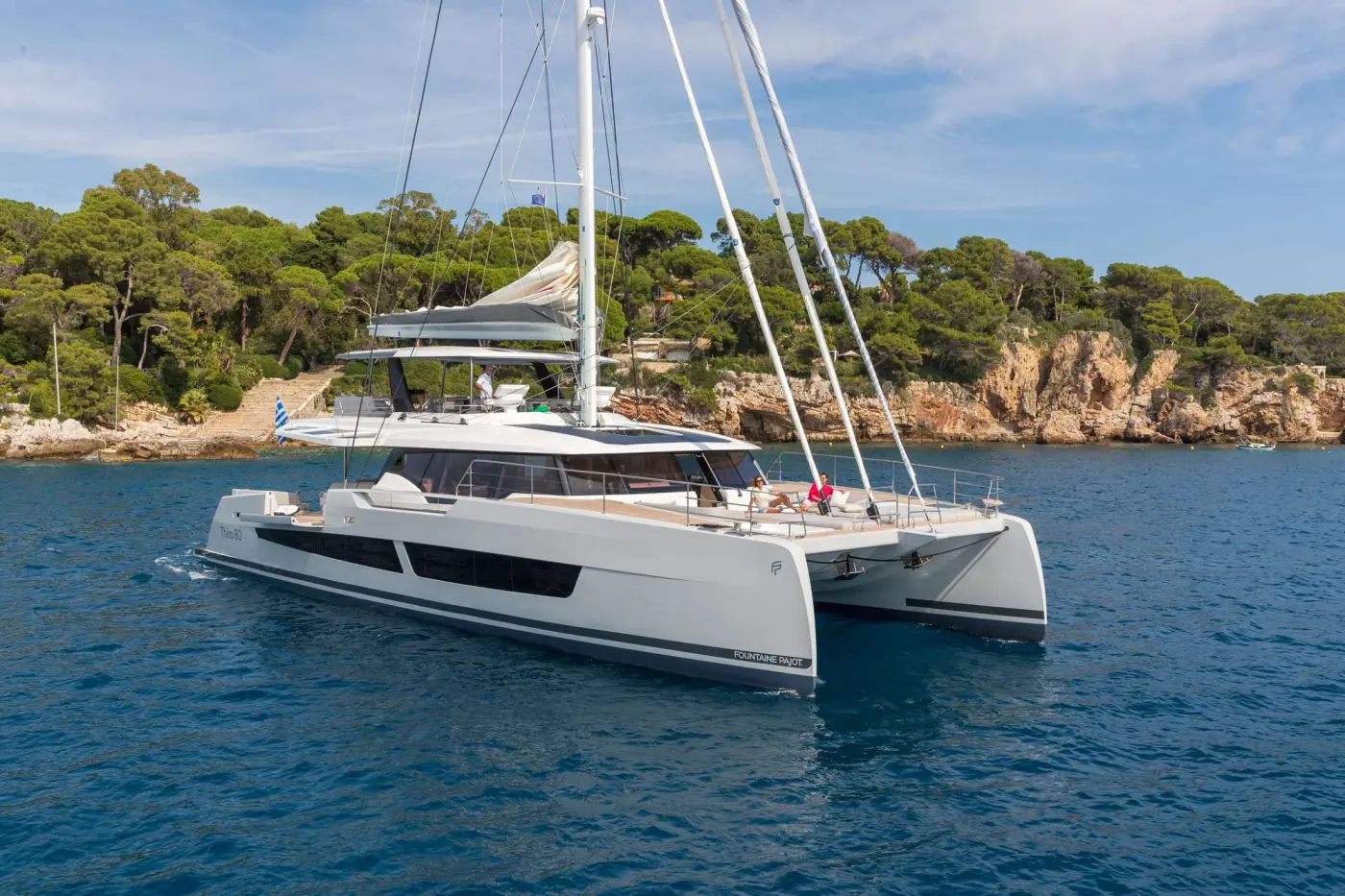
A client wrote to me in June with the cleanest question I have been asked all year. He had two quotes in front of him for the same week in the same islands, one at €26,000 and one at €61,000, and the photographs looked broadly similar. What, exactly, am I paying the difference for?
That question deserves numbers rather than adjectives. What follows is the honest anatomy of the upper tier, drawn from the weeks I actually price and book. Every rate here is a live band from our own fleet, cross-checked against the Greek Charter Index. The short version, before the detail: below about €45,000 you are mostly buying length. Above it you are buying people, beam and hours. Both are legitimate weeks. Only one of them is right for your particular group, and I have talked as many clients down a tier as up one.
What does a €50,000 week actually buy on a Greek charter?
Three things, in this order: a second layer of crew, roughly a third more living space, and the freedom to treat passage time as optional. At €50,000 the Greek fleet crosses from the 55 to 67 foot class with three crew to the 78 to 80 foot class with five or six. The cook who also ran the interior becomes a chef who does nothing but cook. The single tender becomes a tender, a jet ski and a toy locker that takes a deckhand twenty minutes to rig. Nothing about the sea changes at that threshold. Everything about the service standing around it does.
The change is not linear, which is what confuses people who compare rate sheets side by side. Between €20,000 and €35,000 each additional euro mostly buys feet. Between €45,000 and €90,000 it buys hands.
Where exactly is the line between a €25,000 week and a €50,000 week?
Lay the fleet out by band and the line draws itself. At the entrance to the crewed tier, the Lagoon 55 Azul carries eight guests in four cabins with three crew at €20,000 to €26,900, and the Bali Catspace 55 Libra takes ten at €18,900 to €26,900. One step up sits the heart of the book, the Fountaine Pajot Alegria 67s: Kimata and Serenissima at €31,500 to €42,500, Alexandra II at €33,500 to €43,500, and the power version ChristAl MiO at €34,000 to €48,000. On the motor side the Sunseeker 75 M FIVE runs €31,000 to €33,000 and the 30 metre Marine 99 Aizu €33,000 to €39,000. That is a fine Greek week, and most of our crewed catamaran clients book inside it happily.
Then the tier turns. The Pershing 90 ONE runs €45,000 to €49,000, the Admiral 101 Summer Fun €45,000 to €65,000, the Sunreef 80 Genny €56,000 to €79,000, the 37 metre Brooklyn €60,000 to €75,000 with six crew, and the Fountaine Pajot Thira 80s Ad Astra and Sol Madinina €65,000 to €90,000. At the ceiling of the band the Tecnomar 116 Can't Remember takes twelve guests at €80,000 to €90,000. Cross €98,000 and you are in the 37 to 39 metre class, Pareaki II, Riana II and NAIA, which is a different article entirely.
How much of the difference is crew?
Most of it. Count the ratio and the price stops being mysterious. Azul gives you three crew for eight guests, one per 2.7. Serenissima gives three for ten, one per 3.3. Ad Astra and Sol Madinina give five for ten, one per two. Genny gives six for ten, one per 1.7. Can't Remember gives seven for twelve, and at the very top La Pellegrina 1 gives nine for twelve, one crew member per 1.3 guests. The rate sheet is, to a first approximation, a payroll.
What matters more than the ratio is what the fifth person does. On a three crew yacht the chef is also the hostess: she cooks lunch, so the salon is not turned down while she cooks, and the menu is built around what one pair of hands can hold. On a five or six crew yacht the chef never leaves the galley, a chief stewardess owns the interior and the service rhythm, and one or two deckhands own the tenders, the toys and the swim platform. That is why the same anchorage feels different at the two price points, and it is the whole of what a private chef charter is actually selling.
Crew quality is not a function of price alone, and this is where a broker earns the fee. Sol Madinina's captain holds a Master 500GT with more than 40,000 nautical miles and over 160 luxury charters behind him. Above & Beyond's chef took first place Platinum at MEDYS 2022 and first place Diamond at EMMYS 2023. Those crews are the reason those specific yachts sit at the top of their bands rather than the middle, and no photograph will ever tell you that.
What does the extra beam actually change?
More than length does. Beam is the dimension nobody shops for and everybody feels. Genny, a Sunreef 80, carries 340 square metres of living space with a 47 square metre main salon, which is larger than a great many Athens apartments. The practical consequence is that ten people can be in three different moods at once without negotiating: two reading in the salon, four on the flybridge, four in the water, and nobody in anybody's way. On a 55 foot catamaran, ten people are always aware of each other.
The detail that decides more charters in this band than any other is two master suites. Genny has two, each with a walk-in closet, plus three VIP queens. When two couples pay equally for a week, a single owner's cabin creates a small social problem on the first afternoon that no amount of service repairs. That is the real argument for the five cabin class, and it is why I ask who is travelling before I ask what the budget is. The toy locker follows the same logic: a jet ski, SeaBobs, paddleboards and a towable are only luxuries if somebody is free to rig them, which is exactly what the deckhand in this tier is for.
Does the money buy more islands, or just a more comfortable boat?
It can buy either, and you choose which at the moment you choose the hull. A sailing catamaran in this band cruises at 8 to 10 knots. A power catamaran does 14 to 16. A planing motor yacht does 20 to 25, and the Pershing 90 cruises at 33. On a 40 nautical mile leg, the classic Cycladic hop, that is five hours under sail, two and a half on a power cat, and a bit over an hour on the fast motor yacht. Same money, entirely different week: the sailing week gives you the passage as part of the pleasure, the motor week converts passage time into swim time.
Speed is also the most underrated form of insurance in Greek waters. When the Meltemi fills in during the second week of August, a yacht that can move 60 miles in two hours has options a yacht that needs seven hours does not. In practice this is what the upper tier buys that guests never think to ask about: the itinerary stops being a plan and starts being a preference.
What does €50,000 become once APA, VAT and gratuity are counted?
Three lines sit on top of the base rate, and only one of them is a fee. The APA runs roughly 25 to 35 percent on sail and 30 to 40 percent on motor, where fuel dominates. Greek VAT follows the yacht's certification rather than her price: the statutory rate for a crewed charter over 48 hours is 13 percent, and certification based reductions bring most yachts on 2026 rate sheets to 5.2, 6.5, 7.8 or 12 percent. Anyone who quotes you one flat VAT number for the whole Greek fleet has not read the certificates, and the rules are public.
Worked through on a €60,000 sailing catamaran with a 6.5 percent certified rate: an APA near €18,000 at 30 percent, VAT of about €3,900, and a customary crew gratuity of 10 to 15 percent of the charter fee, so €6,000 to €9,000, given at the end and entirely at your discretion. Plan on the base rate plus 40 to 55 percent and you will not be surprised by anything.
One clarification that saves a great deal of anxiety: the APA is a fund, not a fee. It is spent on your behalf on food, wine, fuel, berths and port dues, itemised against receipts, and whatever remains is handed back to you on the last morning. A quiet group on a sailing week frequently gets a meaningful part of it returned. You can model your own week on the cost estimator, and the full line by line breakdown lives in our costing guide.
Who charters at this level, and why?
Three shapes, almost every time. The first is two or three couples travelling as equals, where the dual master layout is the entire reason for the yacht. The second is a family of eight to ten with young children or grandparents aboard, where the value of a fifth crew member is that somebody is always free: to hold the ladder, to take the toddler off your hands for twenty minutes, to serve dinner early for the children and late for the adults. The third is a celebration, a milestone birthday or an anniversary, where the menu and the service are the event rather than the backdrop. All three consume the service they are paying for, which is the only real test of whether a tier is worth its price.
One legal boundary governs all of it: twelve guests is the ceiling on any Greek charter yacht, whatever her size and whatever her price. A 50 metre yacht carries twelve, exactly as a 24 metre catamaran with six cabins does. Groups of fourteen or twenty charter two yachts cruising together, which is lawful, common, and often a better week than one larger hull would have been.
When is a €25,000 week the better charter?
Often enough that I say it out loud several times a season. If you are six adults who intend to swim, read, eat well and go to bed early, you will not consume six crew. You will consume three, and the other three will be an expensive presence in your peripheral vision. If your week is the Ionian rather than the open Cyclades, the sea is calm enough that the extra waterline and the stabilised platform earn less than they do further east. And if this is your first charter, there is a real argument for the smaller yacht: you learn what you actually want from a week at sea, and the next one is chosen with knowledge rather than hope.
There is also a lever that almost nobody uses deliberately. Every rate in this article is a band, not a number, and the spread between the ends of that band is the season. Genny is €56,000 in the quiet weeks and €79,000 in the first half of August. The same yacht, the same crew, the same islands, for €23,000 less. Moving a week to early June or September is the single cheapest way to buy a tier upgrade in Greek chartering, and the water in September is warmer than it is in June.
What would I book at €35,000, €60,000 and €90,000?
At €35,000, an Alegria 67 with three crew, Serenissima for ten guests in five cabins or Kimata for eight who want more room each. It is the most honest value in the catamaran fleet: modern, wide, shallow enough for the anchorages the monohulls cannot enter, and crewed by three people who will be at your table by Wednesday. Nine out of ten first charters should start here, and our crewed charter page holds the current availability.
At €60,000, Genny if the group is ten and the two master suites matter, Meli if you want a 27 metre Ferretti and 21 knots under you, or a Thira 80 in the low season weeks when €65,000 becomes reachable. If the group's real appetite is islands rather than sailing, a power catamaran at 16 knots is the most underrated hull in Greece: catamaran space and stability, with the passages cut nearly in half.
At €90,000, the honest answer depends on the head count. For twelve guests the Admiral 101 Summer Fun, six cabins, seven crew, freshly refitted, is the best cost by the head anywhere in this band at €45,000 to €65,000. For twelve who want speed with it, the Tecnomar 116 Can't Remember at €80,000 to €90,000, 25 knots and 35.6 metres. For ten who want the finest sailing platform in the fleet, a 2024 or 2025 built Thira 80 with five crew. The full motor fleet sits alongside them, priced the same way, all year.
Does the extra money buy a calmer night?
Partly, and less than the brochures imply. Three things decide whether you sleep well at anchor, and they are not equally expensive. The first is the hull: a catamaran sits on two hulls and simply does not roll, which is why families with a nervous member end up on catamarans regardless of budget. The second is stabilisation, and here I would ask a direct question rather than assume: not every motor yacht in this band carries it. On our own list the yachts that document it are Freedom at €28,000 to €35,000, Lady Natasa at €34,000 to €37,000, NAYLA at €39,500 to €47,500, Summer Fun at €45,000 to €65,000 and Project Steel at €55,000 to €67,000, then Pareaki II, Daloli, Riana II, NAIA and La Pellegrina 1 above the band. The specification that matters is zero speed stabilisation, which works at anchor rather than only under way, and it is genuinely transformative on the night a swell wraps into the bay. Ask for it by name, and see the yachts that actually have it.
The third costs nothing and matters most: the captain. A captain with twenty seasons in these islands knows that the northern bay of Kythnos is unusable when the wind backs west at midnight, and he moves you at two in the morning while everybody sleeps rather than letting the yacht roll until four. No amount of equipment substitutes for that judgement, which is why I care more about who is on the bridge than about the specification sheet, and why the seasickness question is answered by the crew and the itinerary far more than by the price.
What does a week in this tier cost by the head?
This is the number that changes the conversation, and almost nobody runs it. Take the €60,000 sailing catamaran with ten guests. Add the APA, the VAT and a generous gratuity and the landed week sits near €87,000. Divide by ten and you are at roughly €8,700 a head, or €1,240 a head per night, and that figure already contains every meal, every bottle, every transfer between islands, the tenders, the toys and a crew of six. The same arithmetic on the €35,000 catamaran with ten aboard lands near €720 a head per night.
I am careful with that comparison, because it flatters the yacht if the honest alternative was one good hotel and a couple of ferry tickets. It is a fair comparison when the alternative was a villa with staff, a driver, restaurant dinners for ten every night and a day boat three times in the week, which is what these groups are usually choosing between. Run that comparison properly and the upper tier stops looking like an indulgence and starts looking like a logistics decision. It also explains why five cabin yachts convert so much better than four cabin ones at the same price: an extra couple aboard moves the number by the head by a fifth, and nobody's week gets worse.
The answer I gave that client in June
I told him that the €61,000 yacht would not give him a better Greece. The water off Polyaigos is the same water from a 55 foot catamaran and from an 80 foot one, the taverna in Vathy does not know what you arrived on, and the light at seven in the evening over Folegandros is free. What the extra €35,000 buys is that nobody in his party ever has to think about logistics: not the towels, not the ladder, not the lunch, not the timing of the crossing, not the child who is bored at four in the afternoon. For his group, eleven people including his parents and three grandchildren under six, that was worth every euro. For the same money and a party of six, I would have told him to book the smaller yacht and go twice.
That is the whole calculation, and it is the one I would rather have with you before a quote than after one. Write to me with the month, the group and the mood, and I will tell you honestly which tier your week belongs in, including the times that answer costs me money.
P.S. If the economics of this tier interest you beyond one week, my UHNW charter trends analysis for the Greek market looks at where this money is moving and why.


