
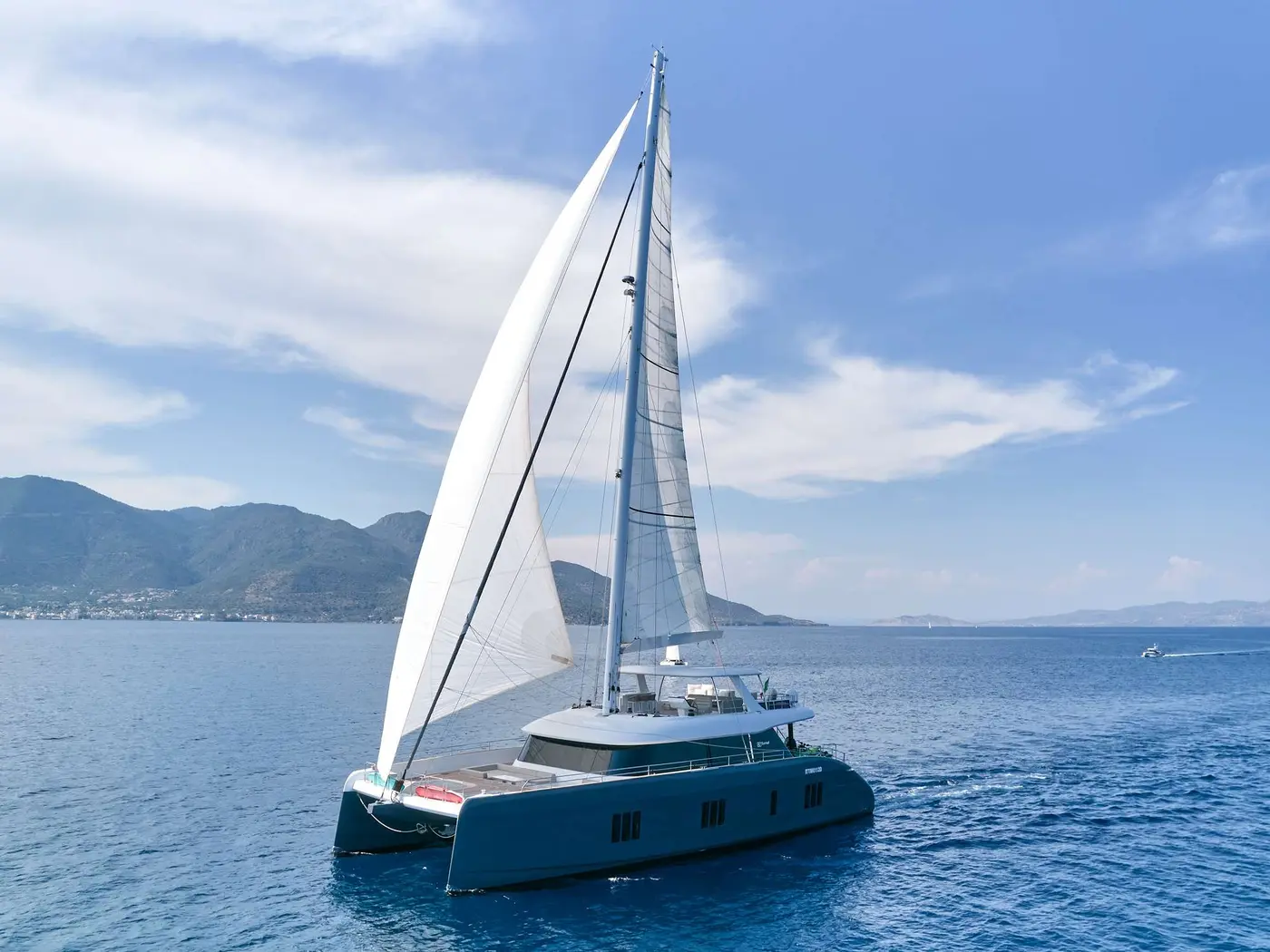
Ask me which yacht to charter for a family week in Greece and, more often than not, the honest answer has two hulls. Not because catamarans are fashionable, though they are, but because the Aegean itself argues for them: shallow turquoise coves, afternoon wind on the crossings, and groups who came to live on deck rather than admire a corridor.
This is the working answer I give clients who ask whether a catamaran is the right boat for a Greek weekly charter. Every figure in it is quoted from our own fleet and the Greek Charter Index, the weeks we actually price and book, not from a brochure.
Why the crewed catamaran became Greece's default family charter
Stand in the salon of Genny, our Sunreef 80 sailing catamaran, and the argument makes itself. She carries 340 square metres of living space on a 24 metre hull, with a 47 square metre salon that Sunreef bills as the largest on any catamaran her size. Nothing with one hull offers that at this length: the beam of a catamaran turns the same 80 feet into a floating villa rather than a corridor with cabins.
The second argument is motion. Two hulls do not heel. The table stays level under sail, drinks stay where they were put, and the guests who usually decide whether a sea holiday happens again, grandparents and young children, stay comfortable. Children under eight in particular do better on catamarans, and every family week we run keeps proving it. Add a draft shallow enough to anchor a few metres off a beach, and the catamaran simply gets closer to the Greece you came for.
The product all of this serves is the weekly crewed charter, the seven day, one crew, one boat formula that Greece does better than anywhere else in the Mediterranean. It is also the tax sensible formula: a crewed charter longer than 48 hours carries the reduced VAT treatment: statutory 13 percent instead of the 24 percent short and static charters pay, and in practice 6.5 or 12 percent on certified catamarans. If the format itself is new to you, our crewed yacht charter guide walks through the whole week.
What does a crewed catamaran week in Greece cost in 2026?
Our own list holds forty five catamarans, thirty sailing and fifteen power, so the ranges below come from boats we actually book, not market averages. The fully crewed tier opens with S/CAT Summer Star and S/CAT EFFIE STAR, 52 and 51 foot Lagoons for ten guests each, at €17,000 to €22,000 per week.
The heart of the catamaran book is the 67 foot class. Three Fountaine Pajot Alegria 67s, Alexandra II, Kimata and Pixie, charter at €31,500 to €43,500 with crews of three to four, and their power sisters on the Power 67 platform, ChristAl MiO and Majesty of Greece among them, hold €34,000 to €48,000. Four to five cabins, eight to ten guests, a genuine chef: for most families this class is the answer.
Above them sit the 80 foot flagships. Genny charters at €56,000 to €79,000 with six crew for ten guests. The Fountaine Pajot 80 sisterhood, Ad Astra, Aloia, Serenissima III and Sol Madinina, runs €65,000 to €90,000. On the power side, Alina and ChristAl MiO 80, both delivered in 2026, hold €70,000 to €90,000, and ChristAl MiO 80 sleeps twelve guests in six cabins, the legal maximum in Greece.
There is a lower path in the market too, the skippered catamaran: you keep the two hulls and the sea, you give up the chef and the service. It is not a week we place, because every yacht on our list is crewed, from €17,000. Whether that trade makes sense for your group is exactly the crewed versus bareboat question, and we have answered it at length.
Whatever the tier, the weekly rate is not the whole bill. Add the APA, the provisioning fund your crew draws on for fuel, food and mooring and accounts for openly at the end of the week, the VAT at the yacht's certified rate (6.5 or 12 percent for most catamarans), and a discretionary crew gratuity. The full rate table, every catamaran and every band, lives on our crewed catamaran charter page.
Sailing catamaran or power catamaran?
Choose sail for the rhythm. A sailing catamaran like Genny cruises near 10 knots, the crossings become part of the holiday, and the loudest sound at anchor is water against two hulls. This is the version guests describe afterwards as the week that slowed time down.
Choose power for the reach. A power catamaran covers the same legs materially faster, which buys either more islands or more hours at anchor inside the same seven days, and the platform keeps the villa scale deck space that made you look at catamarans in the first place. Alina, Crazy Horse and the rest of that book live on our power catamaran page.
What a catamaran week in Greece actually looks like
Here is a route we actually run on Genny, not a brochure sketch. Athens to Kea for a deliberately gentle first night, the double sided sandbar at Kolona on Kythnos, Vathy on Sifnos with its chapel at the waterline, the uninhabited clarity of Polyaigos, the near vertical chora of Folegandros, Manganari bay on Ios, and a final easy sail to Paros. Two hundred and forty nautical miles across seven days that never once feel like a delivery run.
What makes the week is the crew behind it. Aboard Genny that route is run by six crew for ten guests, a ratio usually reserved for far more expensive motor yachts, and the chef provisions as you go: fish bought dawn fresh on the island you woke at, tomatoes from the morning market, a cellar matched to the route. The hour by hour of that rhythm is its own article, and we have written it.
How many guests can a catamaran carry in Greece?
Greek commercial charter rules cap any charter yacht at twelve guests, however large the boat. Most crewed catamarans sleep eight to ten in four or five cabins, which is why the four cabin and five cabin questions get their own shortlists. If you are exactly twelve, ChristAl MiO 80 carries you legally in six cabins. For anything beyond twelve there is a lawful multi yacht answer we have detailed separately.
When a catamaran is the wrong boat
The same honesty that recommends a catamaran for most Greek weeks rules it out for some. If the brief is formal, uniformed service for a party that dresses for dinner, the 40 metre tier is a different product and we have written what that tier actually buys. If the joy for you is heel, winches and the physics of a monohull under load, a sailing yacht will make you happier. And if the plan is to cross long stretches of open water on a schedule, a fast motor yacht remains the honest tool. The four way comparison is here when you want it.
Where to take this next
If a catamaran week has started to form while you read, the working page is the crewed catamaran fleet with live rate bands. Or simply write to me with the month, the group and the mood, and I will answer with three boats, honestly ranked, usually within a few hours.
And if the question in your household is less about the boat and more about the people, whether anyone will be seasick, whether it is safe for the children, whether the grandparents can join, I have answered every first-timer worry honestly in its own piece.
P.S. The itinerary series has grown since this was written: if the quieter, castle-and-monastery Greece calls to you, read the 7-day Dodecanese route from Rhodes, a week a catamaran wears beautifully.
P.S. The 23 to 24 metre class, the Sunreef 80 and Thíra 80 boats at EUR 49,000 to 90,000 a week, has its own piece now: Luxury catamaran charter in Greece for 2027.


