
A father wrote to me in February with a single line. They had a four year old and a seven year old, his wife thought a yacht was a terrible idea, and he wanted to know, honestly, whether she was right.
She was not right, but she was not being unreasonable either. A charter week with small children is a genuinely different product from the same week with adults, and most of what is written about it online is written by people selling the dream rather than by anyone who has stood on a quay at seven in the morning watching a family board with a pushchair, a car seat and a child who has decided, that day, to be afraid of water.
So this is the version I give clients on the telephone. It is built on what our own fleet listings actually document rather than on what sounds reassuring, and where something is not documented I say so instead of filling the gap with a promise. Some of it will talk you out of the idea. That is the point. The families who have the best weeks are the ones who knew what they were buying.
What actually changes when you charter with children under ten?
The week stops being organised around distance and starts being organised around the swim ladder. That single sentence covers most of it.
An adult week in the Cyclades can absorb four hour passages, late dinners ashore and an anchorage chosen for its view rather than its shelter. A week with a four year old cannot. Passages get shorter and move to the morning. The yacht anchors earlier because the hours between four and seven in the afternoon are when children need water, and a child who has swum for three hours sleeps. Dinner moves aboard more often than it moves ashore, not because the tavernas are unsuitable but because a tender ride at eleven at night with a sleeping child in your arms is a thing you will do once.
The second change is that the yacht becomes the destination. Adults use the boat to reach islands. Small children use the sea platform, the tender, the towable and the shade of the cockpit, and are largely indifferent to which island is behind them. This is worth knowing before you pay for speed you will not use.
Which are the best charter yachts in Greece for families with young children?
The best charter yachts in Greece for families with young children are the ones that document three things: a twin or bunk cabin, a stable platform at anchor, and child sized equipment actually carried aboard. Very few document all three, which is why the honest answer is a short list rather than a category.
Across the 91 yachts we list, fifteen document a twin or bunk cabin in their specification. Among them: S/CAT World's End, which sleeps ten in one king master, three queens and a twin, from 20,500 euro; S/CAT Sahana at 19,500 to 27,500 euro with three doubles and a twin; M/Y SEA U at 21,000 to 24,000 euro with a master, a VIP double and a twin bunk; S/CAT NOVA at 27,300 euro, with one cabin of two bunk beds and a desk; S/CAT DAIQUIRI at 32,000 to 42,500 euro, ten guests in four doubles and a bunk cabin; M/Y ONE at 45,000 to 49,000 euro, which sleeps ten in only four cabins because two of them are twins with bunk beds; P/CAT Crazy Horse at 50,000 to 69,000 euro with two twin cabins; M/Y BROOKLYN with a convertible twin to double; M/Y M FIVE, M/Y LADY NATASA and M/Y FREEDOM with twins that convert to doubles; and M/Y CAN'T REMEMBER at 80,000 to 90,000 euro, whose six staterooms include a playroom with bunk beds.
That is the list. Fifteen of ninety one. It is short because the charter market is built for couples, and a cabin with two single beds earns less than a cabin with one large one. If your two children are of an age where they will not share a double, you are not choosing from the whole fleet. You are choosing from those fifteen, or you are paying for a fifth cabin you would not otherwise need.
Why does the cabin layout matter more than the yacht's length?
Because a family of four with two small children fits differently from a group of four adults, and length does not solve it.
Take the real comparison. M/Y ONE is a 27 metre Pershing that sleeps ten guests in four cabins, because two of those cabins carry bunk beds. M/Y ANDILIS is the same length to within a centimetre and sleeps ten guests in five cabins. Same length, same guest number, and for a family travelling with four children not the same boat: one has bunk cabins built for them, the other reaches the number with a fifth door. Which suits you depends on whether your children will share a bunk room or need rooms of their own, and the headline guest number tells you neither.
The same logic runs the other way at the smaller end. A 16 metre crewed catamaran with five cabins gives a family of eight more usable private space than a 27 metre motor yacht with four, and costs a third as much. Length is what people quote at dinner parties. Cabin count and cabin type are what determine whether anybody sleeps. If you are set on a motor yacht, read the weekly motor yacht rates with the cabin plan open beside them.
Does a catamaran actually make a difference with small children?
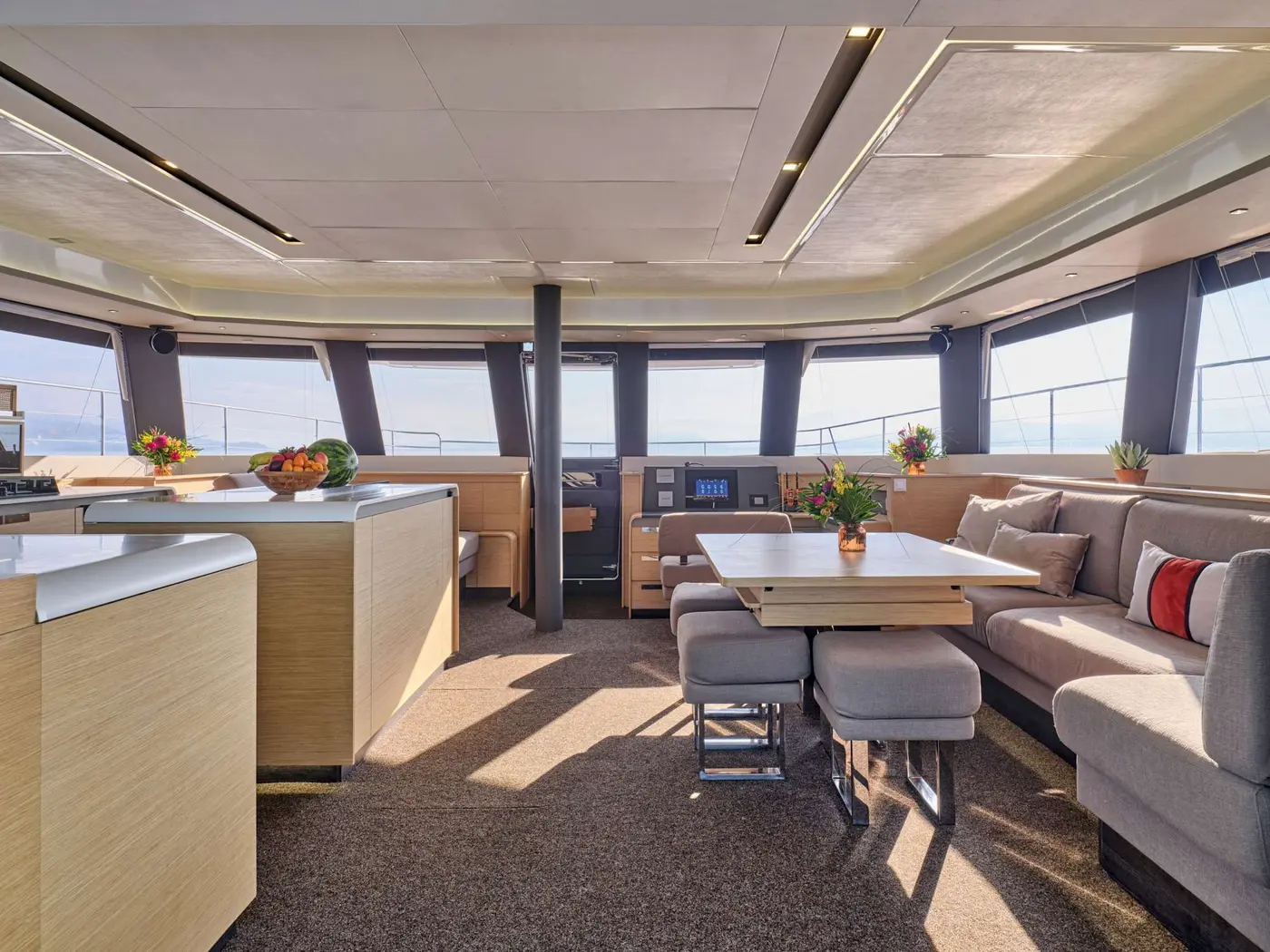
Yes, and it is the single most useful thing I can tell a nervous parent. A catamaran does not heel, so a child can walk across the saloon while the yacht is moving. The decks are wide and flat. The bow trampolines are, in practice, the most popular square metres on any family charter I have ever booked. And a catamaran sits quietly at anchor: our own listings describe the twin hull platform as giving virtually zero roll at rest, which is what a parent is actually buying at two in the morning.
Draft matters too. A catamaran draws far less water than a monohull of the same accommodation, which means it can anchor closer in, in shallower and calmer water, where a child can reach a beach in a two minute tender ride rather than a ten minute one. Eight of our listings document their draft explicitly, and one of them, S/CAT NOVA, states one metre fifty five for close beach access.
The honest limit: a catamaran is not immune to swell, and in a beam sea it can move sharply rather than slowly, which some people find worse. If motion is your family's real fear, the answer is not automatically a catamaran but a stabilised motor yacht. Ten of our listings document stabilisers, all of them motor yachts, and eight of those hold the yacht steady at anchor as well as underway. There is more on motion, seasickness and children in the first timer's piece.
What safety equipment is actually aboard, and what do you have to ask for?
This is the part where I will disappoint you slightly, and I would rather do it here than on the quay.
Of all the yachts we list, exactly one documents child sized flotation as carried equipment: P/CAT ALINA lists life jackets in adult and children's sizes. Twenty nine yachts document children's size water skis, which tells you the market has thought carefully about entertainment and less carefully about safety.
Guardrail netting is documented by one yacht in ninety one: M/Y SANJANA lists safety nets rigged on deck. That does not mean no other yacht can fit it, and in practice a good management company will rig netting on request before your embarkation if you ask early enough. But it does mean netting is a request you make in writing before you sign, not an assumption you carry aboard. The same applies to a travel cot, a high chair, a stair gate at the companionway and a monitor that works through a hull.
My standing rule with families is simple. Anything your child needs in order for you to relax goes on the preference sheet, in writing, at contract stage. A crewed charter crew will move mountains for a family, and they cannot move a mountain they hear about on the morning of embarkation.
Which Greek waters are right for a family with young children?
The Ionian and the Saronic Gulf, in most cases, and not the Cyclades in July or August.
This is not taste, it is wind. The Meltemi blows hardest through the central Cyclades in exactly the two months when school holidays force most families to travel, and a fifteen to twenty five knot afternoon in a Cycladic channel is a fine sail for adults and a miserable one for a five year old. Our own Greek Charter Index is blunt about the alternative: the Ionian and the Saronic offer calmer seas, are close to Athens with little or no repositioning cost, and are ideal conditions for catamarans. They are also the best value bands in the index.
One of our own listings puts it more plainly than I could. The brief for P/CAT ARIVA, a five cabin power catamaran based at Corfu, describes her as being for families with young children who should not meet the Meltemi, for groups who want short passages between green islands, and for anyone flying into Corfu rather than Athens. That is the family case in a sentence.
The Ionian's practical advantages compound. The islands are close together, so a passage is often under two hours. The scenery is green and shaded rather than bare and bright. And you can fly a family directly into Corfu, which removes a road transfer from a day that is already long. If you would rather understand the wind before you choose, the Meltemi guide is the piece to read.
What does a day with a four year old aboard actually look like?
It starts earlier than your holiday at home and it ends earlier too.
Children wake at six on a boat because the light comes through every window and there is water three metres away. The crew know this and the good ones are up before you, which means coffee exists by the time you have found your second child. Breakfast is long and on deck. The passage, if there is one, runs between about nine and eleven, while everyone is fresh, and it is short. On an Ionian week it is frequently ninety minutes.
The yacht anchors before lunch, and this is the part parents underestimate: the swim platform becomes a private beach that nobody else can walk onto. Lunch is aboard. The afternoon is water, and the water toys do the work. Five of our listings carry an inflatable sea pool or a water slide, which is the single best piece of equipment for a child too small to be confident in open water. P/CAT ARIVA carries an inflatable round pool with a net floor, three metres across, which is exactly what a two year old needs to be in the sea without being in the sea. P/CAT ELLY carries a four by four metre inflatable sea pool. M/Y CAN'T REMEMBER carries an inflatable water slide, and M/Y SEAS THE DAY an inflatable trampoline with a slide.
By six the children are exhausted in the specific, satisfied way that only a day of salt water produces. Dinner aboard is at seven. By half past eight the deck belongs to the adults, and the reason families come back is not the islands. It is that hour.
How does the chef handle a child who eats three things?
Directly, and without judgement, provided the chef knows before you board.
Provisioning on a crewed yacht works from a preference sheet you complete at contract stage, and the chef then shops per island rather than loading a week of food in Athens. This is the mechanism that makes children easy: pasta, chicken, watermelon and bread are available at every island market in Greece, and a chef who has been told in advance simply builds two menus in parallel. What causes problems is not the fussy child. It is the fussy child who is a surprise.
Write down the actual list. Not "he is a bit picky" but the three meals your child will reliably eat, plus the allergy, plus the brand of milk if it matters. Send it with the preference sheet. I have never once had a chef complain about too much information.
What does a family week actually cost, all in?
The base fee is roughly two thirds of what you will spend. Our Charter Index works the arithmetic: a 20,000 euro base catamaran week lands at roughly 28,000 to 32,000 euro all in, before gratuity.
The additions are APA at 25 to 35 per cent of base for sailing yachts and catamarans and 30 to 40 per cent for motor yachts, where fuel weighs more; Greek VAT, which runs from 5.2 to 12 per cent depending on how the yacht is certified, with 13 per cent the statutory ceiling and 24 per cent applying to short and bareboat arrangements rather than a full crewed week; and a customary gratuity of 10 to 15 per cent of the base, at your discretion.
Those percentages are not uniform, and our listings show it. P/CAT ARIVA is quoted with 12 per cent VAT and 30 per cent APA. P/CAT ELLY is quoted with 6.5 per cent VAT and 25 per cent APA. On a 40,000 euro base that difference is roughly 4,200 euro before anyone has eaten anything, which is why I always send families the fully built number rather than the headline rate. The full cost breakdown does this line by line.
How many cabins do you need, and who sleeps where?
Fewer than you think if the children are small, more than you think if they are between about eight and twelve.
Under roughly six, most families put both children in one cabin and sleep across the passage from them, and a four cabin yacht is ample. Between six and twelve, children start to object to sharing a double bed with a sibling, and this is precisely where the fifteen twin and bunk cabin yachts above become the whole market. Over twelve, they want their own door, and you are now pricing a five or six cabin yacht, which moves you up a band.
One warning that costs people money. A yacht advertised as sleeping ten is not always a yacht that sleeps ten adults comfortably. Read the cabin breakdown, not the guest number. S/CAT World's End sleeps ten in one king, three queens and a twin, which is genuinely five separate rooms. Other yachts reach the same number with a convertible saloon berth, which is a different holiday. If your group is heading past twelve guests, the twelve passenger rule changes the legal picture entirely and is worth reading first.
When should you book a family week for 2027?
Earlier than everyone else, because school holidays remove your flexibility and flexibility is what usually buys you a late deal.
The Charter Index puts peak July and August lead time at six to twelve months, with the best premium yachts confirmed a year or more ahead. For families that is effectively a hard rule rather than a guideline, because you cannot move to September to catch availability. May, June and late September need only three to four months and run 15 to 25 per cent below peak, which is a real saving if your children are not yet in school. If they are, treat the 2027 August weeks as something to hold now. Our own booking data on how far ahead people actually commit sits in a separate piece.
One practical note that has nothing to do with yachts: book the flights and the yacht in the same conversation. Families lose more good weeks to a flight schedule than to availability.
When is a Greek charter the wrong holiday for your family?
There are four cases where I say so on the telephone, and I would rather lose the booking than have the week go badly.
If your child is under about eighteen months, wait. Not because it is unsafe, but because the things that make a charter wonderful, swimming and space and long days outside, are things a baby cannot use, and the things a baby needs, routine and a fixed room and a pharmacy at the end of the street, are the things a yacht is worst at.
If anyone in the family has a medical condition that needs a hospital within minutes, choose the Saronic or do not choose a yacht. The Ionian and Saronic are close to real medical infrastructure. The outer Cyclades and the Dodecanese are not, and a captain can only move at the speed of a boat.
If your children cannot swim at all and you are not prepared to accept a life jacket on deck as a permanent rule for the week, this is not the holiday. Good crews enforce that rule and you will not enjoy arguing with them about it.
And if what your family actually wants is a kids' club, a fixed base and the freedom for adults to disappear for three hours, book a hotel. A crewed yacht gives you extraordinary togetherness. It does not give you separation. That comparison is worked through properly in the yacht versus five star hotel piece, and I have sent clients to the hotel more than once.
What would I book, at three budgets?
At the entry level, S/CAT Summer Star, a 16 metre Lagoon 52 at 17,000 to 22,000 euro for the week, five cabins for ten guests. Her own listing says what matters: ideal for families, children consistently loved by the crew. At that price a family of eight is buying a whole yacht for less than two suites in a good Mykonos hotel.
In the middle, two answers depending on which fear is bigger. If it is motion and heat, M/Y NAYLA at 39,500 to 47,500 euro: stabilisers at anchor and under way, which is unusual at 24 metres, four cabins for nine and a crew of four. If it is wind and long passages, P/CAT ARIVA at 34,000 to 48,000 euro out of Corfu, with the netted sea pool and the short green Ionian hops.
At the top, M/Y CAN'T REMEMBER at 80,000 to 90,000 euro, thirty five metres, seven crew, twelve guests in six staterooms, one of them a playroom with bunk beds, and an inflatable water slide off the stern. That is a yacht designed by someone who had met a child.
If none of those is your family, tell me what you are actually worried about rather than what size boat you want. I have placed enough families now to know that the boat is rarely the question. Start with the crewed charter overview or the family charter page, and if your week is going to run out of Corfu or Lefkada, the Corfu family page has the local detail. Or simply write to me and describe the children.
P.S. If the grandparents are coming too, the yacht changes again: where they sleep, how many cabins, how still she lies at anchor. I wrote that week up separately, in the calm water where I would send it first: a multi-generational family yacht charter in the Ionian.


