
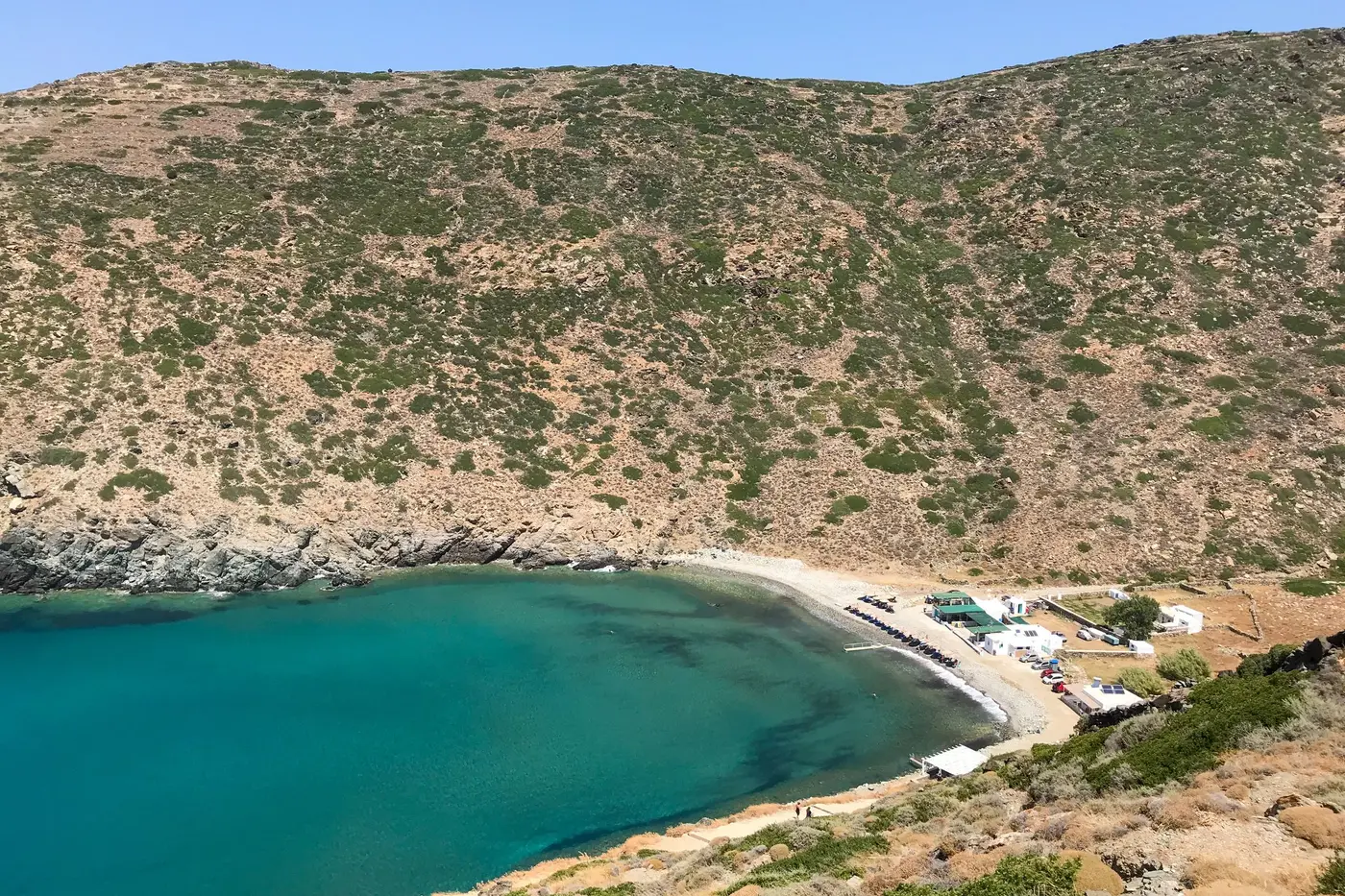
A client wrote to me last spring with a sentence I have now heard, in one form or another, perhaps forty times. She said: we want the Cyclades, but we do not want to spend the week looking at other people's yachts.
It is a fair thing to want, and it is more achievable than most people believe. The Cyclades are twenty four inhabited islands. Two of them absorb most of the attention, most of the ferry traffic and, in July and August, most of the anchored fleet. The other twenty two are still there, still reachable in the same week, and in several cases they hold the better anchorages.
This is not an argument against Mykonos or Santorini. Both are extraordinary, and I place clients on both every season. It is an argument about proportion. A seven night week has six usable overnight stops, and giving four of them to the two busiest islands in the archipelago is a choice most people make by default rather than on purpose.
What follows is the quieter half of the Cyclades as a working broker sees it: which islands, which anchorages, what the wind does to each of them, and the honest cases where the quiet route is the wrong answer for you. The anchorage detail below is drawn from published cruising sources, chiefly the Greek Waters Pilot, and where a depth or a holding quality has not been documented I say so rather than invent one.
Which Cyclades islands are actually quiet in July and August?
Sifnos, Serifos, Kythnos, Folegandros, Amorgos and the Small Cyclades are the six that consistently stay calm through peak season. Milos and Naxos sit in the middle: busy in their main ports, genuinely quiet twenty minutes further along the coast.
The pattern is not random. The crowded islands are the ones with an airport or a high frequency ferry link from Piraeus. Mykonos and Santorini have both. Naxos and Milos have airports but thinner schedules. Sifnos, Serifos, Kythnos, Folegandros and the Small Cyclades have no airport at all, which means every visitor arrives by sea, which caps the numbers in a way nothing else does.
From a yacht this works in your favour twice. You arrive without the ferry queue, and you arrive somewhere the day trip boats have not reached.
Why does Sifnos come up again and again with my clients?
Sifnos has the best combination in the western Cyclades of shelter, food and walking, and it is the island I put into more quiet week routes than any other. It is also, quietly, the island our own search data says people are already looking for.
Vathy on the southwest coast is the safest harbour on the island, with sand in three to four metres and all round shelter that holds even in a southwester. That last part matters more than it sounds. Most Cycladic anchorages are lees, good until the wind goes round. Vathy is one of the few that simply works.
Kamares is the ferry port and the provisioning stop, roughly five metres, with holding that is not always good and rewards plenty of chain. Fikiada, also on the southwest, is solid in sand and weed and takes a line ashore. Three anchorages is not many, but they are three that a captain can plan around.
Ashore, Sifnos is the island Greeks name when you ask them where to eat. The pottery and the cooking tradition are the island's own, not a tourist overlay, and the footpath network between the villages is the best in the Cyclades. If your week has one long lunch that everyone still talks about a year later, there is a good chance it happened here.
The full picture, with the yachts we place there, is on the Sifnos charter page.
What makes Milos different from every other Cycladic island?
Milos is volcanic, and the coastline is the reason to go: white mineral cliffs, sea caves and a colour of water that people assume has been edited. It is the one Cycladic island where the geology, not the village, is the attraction.
Adamas Bay is the practical base, five to ten metres over mud and sand with generally good holding, and it is an effective lee from the Meltemi. It is the most reliable anchorage on the island and the one a captain will default to when the forecast turns.
The south coast is where the week gets interesting. Provatas holds well in three to six metres of sand, sheltered from the northerlies and open to the south. Tsigrado, near Cape Zefyros, has good holding and the same north shelter. Agios Ioannis on the east coast is solid in sand with weed patches and works in northeasterlies through southeasterlies.
Four documented anchorages, spread across three coasts, is unusual for a Cycladic island and it is what makes Milos so forgiving in a changeable week. See the Milos charter page for the yachts and the routing.
Is Folegandros worth the crossing?
Folegandros is worth it for the village and the cliffs, and it is the one island on this list where I will tell you plainly that the anchoring is difficult. Go, but go in settled weather, and let the captain decide on the morning rather than the week before.
Karavostasi is the only port. The bottom is sand and rock and it does not always hold, it is not safe in a strong Meltemi, and the sensible approach is stern to the quay. Vathi, also called Angali, on the south coast gives four to five metres over sand and weed with good holding, but takes very strong gusts and swell when the Meltemi is up. Agios Georgios in the southeast is solid in sand in four to six metres, protected by its islet but open from east northeast round to southwest.
None of that makes Folegandros a bad call. It makes it a fair weather call. The Chora is built along a cliff edge two hundred metres above the sea and there is nothing else quite like arriving there from below.
Where do the Small Cyclades fit into a week?
The Small Cyclades, and Koufonisia above all, are the quietest genuinely reachable stop in the archipelago, and they sit conveniently between Naxos and Amorgos, which is exactly where an eastern route wants a night.
Ano Koufonisi has a purpose built marina, laid moorings in five to six metres and stern to berthing on the east pier. It is built for all round shelter, though reflected waves build inside in strong wind. Pori on the northeast is surprisingly usable in stronger northerlies, with swell when the Meltemi really blows. Fanos in the southeast gives sand and shelter from the Meltemi.
The one to ask your captain about is Nero bay on Kato Koufonisi, a near uninhabited protected inlet that is ideal in settled conditions. It is the kind of anchorage that justifies the whole idea of chartering rather than taking ferries.
Which quiet island gives the best shelter when the Meltemi blows?
Kythnos, Serifos and Amorgos. Each has an anchorage that published cruising sources single out specifically for Meltemi protection, which is the reason these three islands belong in a peak season route rather than a shoulder season one.
On Kythnos, Loutra on the northeast coast is the port with the best Meltemi protection on the island, stern or bows to the breakwater quay. Kolona, the sandspit on the northwest, is very well protected from both the Meltemi and southerlies in three to ten metres, though the bottom is weed and you drop on a sand patch and check the set. Agios Stefanos on the east has a muddy seabed and the best holding on the island.
On Serifos, Megalo Livadi on the west coast is commodious in the Meltemi, a deep bay where you anchor close to the steep rising shore. Koutala on the south holds well in sand in five to fifteen metres and shelters from the Meltemi, with a warning attached: violent katabatic gusts come down off the high ground. Vagia, inside Koutala bay, gives unexpected all round shelter and is useful in south winds.
On Amorgos, Katapola on the west coast is the main port and shelters well from the Meltemi in three to five metres over sand with some rock and weed. Aegiali at the north end is a second port with good Meltemi shelter around six metres over mud and weed, taking some swell when it blows hard. Kalotaritissa at the southwest tip offers more all round shelter at its south anchorage.
Katabatic is the word to listen for. It means wind falling off high ground, and it arrives in gusts far stronger than the forecast. Serifos and Kythnos both have anchorages where a calm evening can produce forty knots at two in the morning. This is why the captain sets the anchor twice and why you should let him.
Can you still see Mykonos and Santorini in a quiet week?
Yes, and I usually recommend it. The version that works is one night each, positioned deliberately, with the other four nights on the quiet islands. What does not work is basing the week around them and treating everything else as filler.
Mykonos is best as a lunch and an evening rather than a base. The bays fill by late morning in July and August, and the side anchorages matter more each season. Santorini has no sheltered anchorage in the caldera worth the name, which is why so many charter weeks visit it by tender from a mooring and move on the same evening. Neither of those is a criticism. They are simply facts that should shape where you sleep.
If you want a route that visits both properly, the classic seven day Cyclades itinerary sets it out day by day, and the Cyclades destination guide covers the region as a whole.
What does the Meltemi actually change about a quiet route?
The Meltemi is the northerly that dominates the Cyclades in summer, strongest from mid July to mid August, and published cruising guidance puts it around Force 5 to 7 with higher gusts in open water. It changes the direction you travel, not whether you travel.
The rule every Greek captain works to is simple: plan the long legs downwind, southbound, and overnight on lee and south coasts. A quiet week that starts in Athens and works south and west through Kythnos, Serifos, Sifnos and Milos is running with the wind for most of its passages. The same islands in reverse order in early August is a different and much less pleasant holiday.
This is the single strongest argument for the quiet islands in peak season. They sit on the sheltered side of the archipelago, and the busy ones do not. The full Meltemi guide explains the timing and the routing in detail, and the month by month guide covers how it fades through September.
Which yacht suits the quiet Cyclades?
A catamaran, in most cases. The quiet islands reward shallow draft, and the anchorages that make them special sit in three to six metres where a deep keeled monohull simply cannot follow.
Look again at the numbers above. Vathy on Sifnos is three to four metres. Vathi on Folegandros is four to five. Katapola on Amorgos is three to five. Kalotaritissa is three to five. These are catamaran depths, and a crewed catamaran in the Cyclades will get you into all of them.
There is a second reason, less technical. A catamaran does not roll at anchor, and a quiet week is a week where you spend more nights at anchor than alongside. Of the ninety one yachts we place, thirty are sailing catamarans and fifteen are power catamarans, which is not an accident of taste. It is what these islands ask for.
If you want to sail rather than motor, a crewed sailing yacht in the Cyclades makes real sense here too, because the Meltemi that complicates the schedule is the same wind that makes the sailing worth doing.
What does a quiet Cyclades week cost in 2027?
Between roughly 17,000 and 27,000 euro base for a fully crewed catamaran sleeping eight to ten, before VAT and APA. The quiet islands do not cost more than the famous ones. In one respect they cost less.
From our own fleet, taking real rates rather than a market average: S/CAT Summer Star, a Lagoon 52 for ten guests in five cabins, starts at 17,000 euro a week. S/CAT Libra, a Bali Catspace 55 for ten guests in five cabins with a crew of three, runs 18,900 to 26,900. S/CAT Azul, a Lagoon 55 for eight in four cabins, runs 20,000 to 26,900. Above that the fleet continues to S/CAT Serenissima III at 65,000 to 85,000 and well beyond.
On top of the base fee come three separate things, and any broker who blurs them is doing you no favours. The APA is your own running float for fuel, provisioning and berthing, and it runs from about 20 percent of the base on a sailing yacht to about 40 percent on a motor yacht, because the figure tracks fuel burn. Greek VAT follows the yacht's certification, in practice between 5.2 and 12 percent on certified commercial yachts rather than one flat number. The crew gratuity is customary at 10 to 15 percent, calculated on the base fee alone and entirely at your discretion.
The place the quiet route genuinely saves money is the APA. Fewer marina nights and shorter passages mean a smaller fuel and berthing bill, and the unspent balance comes back to you. I would not choose a route to save money on berths, but it is worth knowing which direction the number moves.
When are the quiet Cyclades the wrong choice for you?
There are four cases where I say so, and I would rather say it now than read it in a review.
If the nightlife is the point, go to Mykonos and stay there. The quiet islands close early, and a group that wants to be out at two in the morning will spend the week feeling short changed by scenery.
If you have three days rather than seven, stay in the Saronic Gulf or the near Cyclades. The quiet islands are quiet partly because they are further apart, and a short week spent mostly on passage is a poor trade.
If anyone aboard is genuinely anxious about motion, understand that the quiet islands in peak Meltemi still involve open water crossings. The Ionian, not the Cyclades, is the honest recommendation for that family.
And if you want certainty in your itinerary, the Cyclades in August will disappoint you. The captain will change the plan, sometimes twice in a day, and he will be right to. Guests who enjoy this treat the route as a suggestion. Guests who need the printed schedule find it hard.
How do you actually build the week?
Start from the wind and work backwards. Pick the two islands you would be genuinely sorry to miss, put them where the wind makes them easy to reach, and leave the rest of the week loose. Then choose a yacht whose draft matches the anchorages you have just chosen, not the other way round.
In practice that means one of two shapes. A western loop from Athens through Kythnos, Serifos, Sifnos and Milos, running downwind most of the way, with Folegandros added if the forecast is kind. Or an eastern loop through Paros, Naxos, Koufonisia and Amorgos, which is longer, wilder and better suited to people who have chartered in Greece before.
Antiparos, Tinos and Ios each fit into either shape as a single night, and each is quieter than its neighbours' reputation suggests. Eight real itineraries, five of them copied from proposals I actually sent this season, are on the itineraries page.
Peak weeks in the Cyclades are decided early. If you are reading this with 2027 in mind, the piece on how far in advance to book sets out the real lead times, and September is the month I recommend to anyone whose dates are flexible, because the Meltemi fades and the quiet islands become quieter still.
If you would like a route built around the anchorages in this article rather than around a brochure, send me the brief. I read every one myself, and you will have my reply the same day.
P.S. If the route you have in mind runs the other way, from Mykonos down to the caldera, the distances and the direction matter more than the islands do. Mykonos to Santorini by yacht sets out all 80 miles of it, leg by leg.
George P. Biniaris is the founder and managing broker of George Yachts Brokerage House, a boutique house working exclusively in Greek waters. He holds a sailing skipper's licence and a powerboat licence, spent a decade running luxury hospitality in Mykonos before broking, and is an IYBA Charter Active Member.


