
What do people mean by charter standards in Greece?
They mean three different things, and the confusion between them is the reason this question gets asked. When somebody types the name of the Greek Yachting Association next to the word standards, they are usually hoping for a rulebook: a document that says what a crewed yacht in Greece must provide, what the crew must do, and what happens if it does not. There is no such document, and I would rather say that in the first paragraph than let you read two thousand words expecting one.
What there is instead is a layered arrangement. Greek law decides what a yacht may legally do and carry. The charter contract, almost always the MYBA form, decides what you and the owner owe each other. Two trade associations, one Greek and one international, decide what their members promise to their peers. And the broker, if you have a good one, is the person who reads all three on your behalf before you sign anything. This article walks those layers in order, says exactly what each one binds, and is honest about where this house stands inside them.
If you already know the contract and only want the mechanics, the MYBA agreement is explained clause by clause here. This page is about the question one level up: who wrote the rules, and which of them actually reach your week.
Does the Greek Yachting Association publish standards?
No. The Greek Yachting Association, GYA, is a trade body. Its own site describes its members as Greek professional yachting companies involved in charter, brokerage, management, insurance and the construction of large yachts. It states three objectives: to maintain high standards of professionalism in charter, sales and yacht management, to cooperate closely with MYBA as MYBA members and MYBA companies, and to organise an annual charter yacht show for Greek and foreign flag charter yachts. That show is the Mediterranean Yacht Show in Nafplion, whose eleventh edition ran from 2 to 6 May 2026.
Read those objectives carefully. The first is a commitment to professionalism, not a published code you can hold a yacht against. The second tells you where the actual written standard lives: in MYBA. The third is a show. I looked again at gya.gr this morning before writing this, and there is no code of conduct, no service standard and no inspection scheme published there. That is not a criticism of the association. It is simply what a trade body is.
The association also states that it and its members represent over 90 per cent of the crewed charter yachts in Greece under central agency agreement. That is the association's own figure and it deserves a precise reading. It describes yachts held under a central agency agreement, which is the arrangement where one company represents a yacht to the whole market. It does not describe every yacht available to charter in Greek waters, and it says nothing about the quality of any particular one.
So when a search engine or an assistant is asked about GYA charter standards, the honest answer is that GYA sets none. It gathers companies that have agreed to work to MYBA's standard and to each other's. The standard is MYBA's. The law is Greece's. The association is the room where the Greek members of that trade meet.
What does MYBA actually set?
MYBA is the Mediterranean Yacht Brokers Association, an international professional organisation founded in 1984 with both corporate and individual members. What it sets, for practical purposes, is the contract. The MYBA Charter Agreement is the standard form for crewed yacht charters across the Mediterranean, and it is the document nearly every Greek crewed charter runs on, whether or not the broker who arranged it is a member.
That last clause matters, and it is where honesty about this house belongs. George Yachts Brokerage House is not a MYBA member. We are not a member of the Greek Yachting Association either. We are an IYBA Charter Active Member, and every charter we place runs on a contract based on the MYBA standard. Those three facts sit together on our credentials page with the documents behind them, and I would rather you checked them than took my word.
How can a non-member place a charter on the MYBA form? Because the yacht's own representative, the central agent or the management company that holds her, issues the agreement, and the retail broker, which is what we are, brings the charterer to it. The paperwork you sign is the same form. The company whose name is on the letterhead as the yacht's agent is usually a MYBA member company. The company that found you the boat and negotiated the week on your side may or may not be. Which name certifies what is set out here, and it is worth ten minutes before you book with anyone, including us.
The form itself was revised in April 2025. For years the reference version was the 2017 agreement; the 2025 terms added identity and document checks under anti money laundering rules, a sanctions warranty from each party, clearer rights for the charterer when an owner claims force majeure after a breakdown, and an entire agreement clause, which means an email promise that is not in the signed document is not part of the contract. Through 2026 both versions are in circulation, so the first thing to confirm on any Greek charter is which one yours uses. The clause by clause reading lives on its own page; a shorter definition is in the glossary.
What does Greek law bind, that no association can change?
Two things above all: how many guests a yacht may carry, and what tax the charter bears. Neither is negotiable by a broker, a central agent or an association, and both are the source of most of the surprises that reach my desk from people who booked elsewhere.
Guests first. The twelve passenger limit that shapes almost every crewed charter in Greek waters is law, not a guideline, and it applies to the yacht regardless of who brokered her. The framework is Greek Law 4926 of 2022, consolidated by Law 5111 of 2024, sitting on top of the international passenger ship definitions in SOLAS. A yacht certified for twelve carries twelve. A group of fourteen needs a different certificate or a different plan, and the four ways a larger group actually charters in Greece are laid out here, with the rule itself defined in the glossary.
Tax second. A Greek charter is invoiced with VAT at the rate the yacht is certified for, which in 2026 means 5.2, 6.5, 7.8 or 12 per cent depending on her certification, under a statutory ceiling of 13 per cent. Short charters and bareboat hire are a different regime at 24 per cent, which is one of several reasons this house writes weekly crewed charters and nothing shorter than the five night Saronic week. The 2027 VAT page carries the worked examples. No association sets that rate. The yacht's certificate does.
There is a third layer of law that guests rarely see and should know exists: the Greek charter licence and registry. Commercial pleasure yachts and tourist day boats are registered with the Ministry of Maritime Affairs, and a yacht offered for charter without that standing is not a bargain, it is a problem waiting for a harbour master. A broker who will not show you the yacht's registration when asked is telling you something.
What is a central agency agreement, and why does that 90 per cent figure matter to you?
A central agency agreement is the contract between a yacht's owner and one company that represents her to the whole charter market. That company, the central agent, holds her calendar, sets her rate, issues the charter agreement in her name and pays the retail broker a share of the commission when a broker brings a charterer. Every other broker in the Mediterranean, including this one, books that yacht through her central agent. It is the ordinary structure of the trade and there is nothing hidden about it; the four roles a broker can play are set out here.
So when the Greek Yachting Association says its members represent over 90 per cent of the crewed charter yachts in Greece under central agency agreement, what it is telling you is that most Greek central agents are members. That is useful information. It means the company issuing your MYBA agreement is very likely a member of both associations, and it means the standard those companies hold each other to is MYBA's. It does not mean the yacht was inspected by the association, and it does not tell you anything about the retail broker who found her for you. Ask both questions separately, of both companies, and you will have the whole picture.
The practical consequence for a charterer is that there are usually two firms in the chain, and each is accountable for a different thing. The central agent answers for the yacht: her certificate, her crew, her condition on delivery. The retail broker answers for the match: whether this yacht, at this rate, on this route, in this week, is the right call for this party. When something goes wrong at sea, you want the first firm. When something goes wrong before you ever board, it was the second firm's job to see it coming.
What does a broker check before offering a yacht at all?
Standards are what the industry publishes. Judgment is what a broker applies before a yacht reaches your inbox. I can only speak for this house, and these are the rules its listings run on, all of them visible on the site rather than promised in private.
Every yacht is offered in the waters she is actually based in and the house actually works: Athens, the Saronic, the Cyclades and the Ionian. A yacht based elsewhere is not dressed up as a Cyclades week. Every yacht carries one price, per yacht, per week, fully crewed, on the Greek Charter Index; there is no head count arithmetic and no rate that changes depending on who is asking. When a yacht leaves the fleet her page is retired and redirected rather than left standing with last season's rate on it. And every photograph and film on a yacht page has been looked at, frame by frame, before it went up, so that what you see is the boat and nothing else.
None of that is a standard anyone imposed on us. It is what a retail broker owes a client who is spending a serious sum on a week they cannot repeat. The associations are silent on all of it, and rightly so; it is not their job. It is the broker's, and it is the reason to choose a broker rather than a platform.
Why does this house write nothing shorter than the five night Saronic week?
Partly because of the law described above. Short charters and bareboat hire sit in the 24 per cent VAT regime, while a crewed week on a certified yacht is invoiced at 5.2 to 12 per cent, and the difference is not a rounding error on a forty thousand euro charter. Partly because a crewed yacht is a house with a staff, and a staff needs a day to learn how you like your mornings before the week can become what you paid for. And partly because the Saronic, an hour from the Athens airport, is the one cruising ground where five nights is a whole holiday rather than a taste of one. That week, from Alimos to Hydra and back, is the shortest thing on our books, and it is the only exception to a weekly rule.
What binds the crew: the contract, the flag, or the association?
The contract binds the owner, and through the owner the crew, to deliver the yacht as described, seaworthy, crewed and provisioned for the dates agreed. The flag binds the crew to the safety and manning rules of the state the yacht is registered in. The association binds nobody aboard; it binds the companies ashore that belong to it.
In practice that means the standard of service you experience on a Greek crewed week comes from three places that are not the association: the owner's choice of captain, the management company's training and turnover, and the broker's willingness to say no to a yacht he would not put his own family on. I have declined to offer yachts that were perfectly legal and perfectly MYBA and simply not good enough. No rulebook did that. Judgment did, which is what a discretionary broker is for.
Where does the APA fit, and who governs it?
The Advance Provisioning Allowance is the fund you place with the yacht before the charter to cover fuel, food, wine, berths and port dues at cost. It is not a fee and it is not a tip. Its mechanics come from the MYBA agreement: the amount, typically 20 to 40 per cent of the charter fee depending on the yacht type and the plan, is stated on the first page, spent against receipts, and whatever remains is returned to you on the last morning. The APA page explains the arithmetic and the reconciliation.
Nobody in Greece sets a standard APA percentage. The association does not, the law does not, and any page that tells you there is one flat figure for all yachts is guessing. A quiet sailing week on a catamaran and a fast motor yacht week through the Cyclades have different fuel lines, and the APA follows the plan.
Is crew gratuity a standard, and who decides it?
Gratuity is custom, not contract. The MYBA agreement does not require one, and neither does Greek law. The convention across the Mediterranean, and the one I give my own clients, is 10 to 15 per cent of the base charter fee, handed to the captain on the last evening for distribution to the crew, and it is entirely at your discretion. The gratuity guide sets out the reasoning and the worked figures. It is not a standard anyone sets. It is a courtesy the trade has settled on.
How do IYBA and MYBA differ, and why does this house belong to one and not the other?
IYBA is the International Yacht Brokers Association, established in 1987 in Florida and formerly the Florida Yacht Brokers Association, dedicated by its own description to professionalism and ethics in yacht transactions. MYBA is the Mediterranean body, founded in 1984, and the author of the contract. They are peers, not rivals. Many companies belong to both.
George Yachts Brokerage House is a Wyoming entity with an Athens desk, and its clients are overwhelmingly American. IYBA is the association our clients' own brokers, lawyers and family offices recognise, and Charter Active is the membership class for firms that place charters. That is where we hold membership. Our contracts are MYBA standard because the Mediterranean market runs on that form and because it is the better document. We have not applied for MYBA membership, and I would rather write that sentence than let a page about standards imply otherwise. If MYBA membership is a condition for you, the broker verification guide tells you exactly how to check any firm's status, and you should use it on us.
What should a charterer actually check, in order?
First, the yacht's certificate and registration: how many guests she may carry, and that she is registered for commercial charter in Greece. Second, which version of the MYBA agreement the charter runs on, 2017 or 2025, and that every promise that matters to you is inside it rather than in an email. Third, the VAT rate on the quote, which should match the yacht's certification and never be a round number somebody guessed. Fourth, the APA percentage and the plan it was calculated for. Fifth, who the yacht's agent is and who your broker is, and what each one's name on the paperwork certifies.
That list is the whole of what binds a Greek crewed week. Everything else, including the crest of any association, is context. How a booking with this house runs from enquiry to disembarkation is here, and the fleet it draws on, 88 yachts across crewed catamarans and weekly motor yachts, is priced per yacht per week on the Greek Charter Index.
What does this look like on a real yacht?
Take one hull from our listings as the worked example, because standards are abstract until they touch a boat.
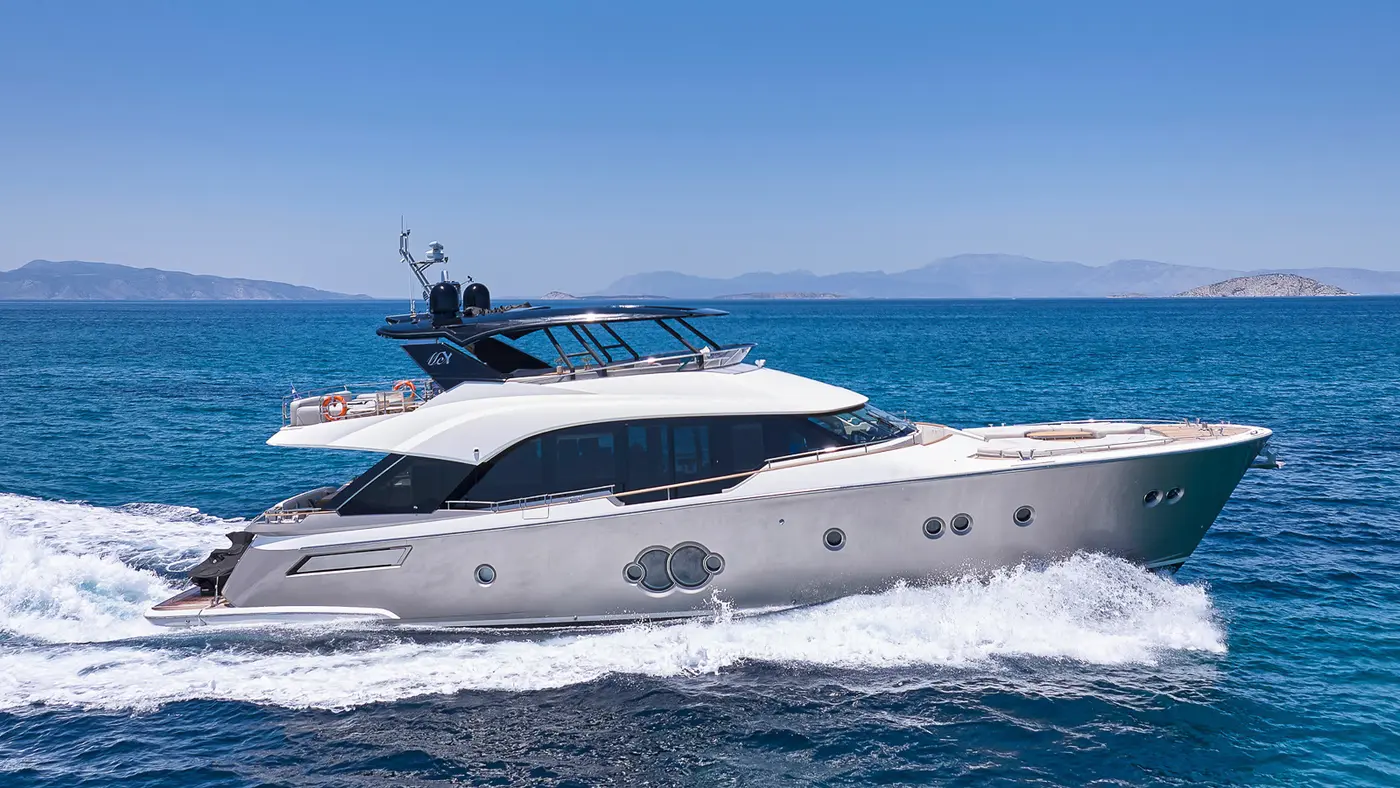
M/Y NAYLA is a 24.6 metre Monte Carlo Yachts motor yacht built in 2018, four cabins for nine guests, a crew of four, stabilisers at anchor and under way, and a weekly base rate of 39,500 to 47,500 euro on the Index. Here is what each layer does to her. Greek law: she is certified for her guest count, which is nine, not twelve, and no association can raise it. VAT: at her certified rate, stated on the quote. Contract: the MYBA form, 2025 terms if her agent has moved to them, and the stabiliser specification belongs in the signed document if it is the reason you chose her. APA: calculated for her plan, not for a catamaran's. Gratuity: your call, 10 to 15 per cent by convention. Association: her agent's affair, not hers.
When is none of this the right question for you?
If you are chartering a small crewed catamaran for a week in the Saronic with two crew aboard, this layered picture still applies, but it is lighter. Four yachts in our listings run with a crew of two, from S/CAT Summer Star at 17,000 euro a week upward, and on those boats the captain is the standard: the contract is the same MYBA form, the law is the same twelve guest ceiling, but the experience is a person, not a system. The difference between skippered, two crew and fully crewed weeks is its own article.
And if what you actually want is a guarantee that a rulebook exists and somebody inspects against it, I have to tell you plainly that no such rulebook exists in Greece for crewed charter service. What exists is law for safety and tax, a contract for obligations, and reputations for everything else. A good broker is the inspection. Choose that person with the care you would give the yacht.
What should you do next?
If a 2027 week is in view, the honest sequence is: decide the region and the party, let the yacht's certificate and the calendar narrow the list, then read the contract version and the VAT line before anything is signed. The crewed yacht charter page is where that conversation starts with us, and every line of it will be in writing.
P.S. For the question one level down, what a crewed luxury charter actually is and what it costs all-in, that article is here.


