
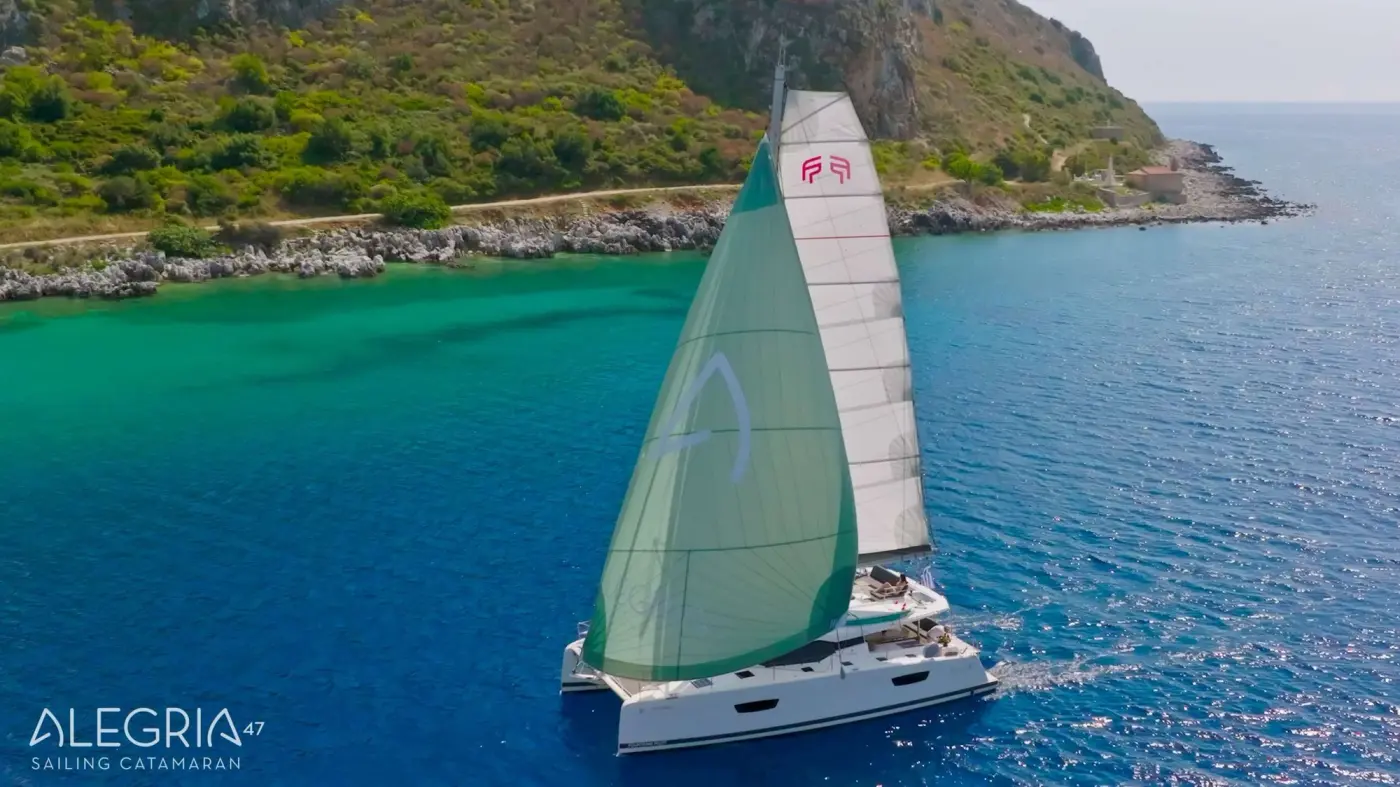
There is a question I am asked more often than almost any other, and it is almost never asked in these words. It arrives as "we do not want a huge crew, but we certainly do not want to cook". It arrives as "is there something between the bare boat and the full production". There is. In Greek waters it is the most misunderstood part of the whole market, because the brochures offer two options and the sea offers three. What follows is that middle ground, written out honestly, with the numbers taken from the rate cards on my own desk rather than from anybody's marketing.
This piece sits alongside our crewed versus bareboat guide, which explains the two ends of the market: the yacht you drive yourself, defined properly on our bareboat charter page, and the yacht that arrives with a full professional household. The ground between them is where a surprising number of the best weeks of my year are quietly booked, and nobody writes about it because it is harder to describe than either extreme.
What is the difference between a skippered and a fully crewed yacht charter in Greece?
A skippered charter puts one professional aboard. He navigates, he handles the yacht, he knows which bay will hold when the wind backs into the north at four in the afternoon, and he carries the legal responsibility for the vessel and for everyone on it. Everything else, the provisioning, the cooking, the washing up, the beds, belongs to you and your friends. A fully crewed charter puts three or more professionals aboard, and on most of them one of those people is a chef whose entire job is that you eat better at anchor than you do in restaurants ashore. I have set out what each crew role actually does elsewhere. Between those two sits the arrangement almost nobody names: two people, a skipper and a cook-hostess, who between them run the boat and feed you.
What does each rung actually cost?
The first rung, skipper only, is the cheapest professional week in Greek waters, and it is not one we place: since September 2026 every yacht on our list carries two crew or more, so I describe that rung here honestly and quote no figure for it. The second rung, two crew, runs on our rate cards from 17,000 euros for S/CAT Summer Star and S/CAT EFFIE STAR to 24,000 euros for the 22-metre Riva M/Y Sea U. The third rung, three crew or more, opens at the same 17,000 euros with S/CAT PI 2 and climbs from there to the largest yachts in Greek waters. Every one of those figures is a whole-yacht weekly base before expenses, and every one of them comes from a rate card we hold rather than from a market average.
Notice the shape of that. The step from one professional to two is the large one in this market, and the step from two to three does not move the opening figure at all. That is not a pricing quirk, it is the whole argument of this article, and I will come back to it. If you want the full picture of what a week costs by yacht type and size, our Greek Charter Index prices the crewed fleet band by band, and the complete cost breakdown walks through every line that lands on a charter invoice.
How many yachts sit on each rung?
None on the first rung, and I would rather say so plainly. We used to list a handful of skipper-led catamarans. In September 2026 the list was cut to fully crewed yachts only, which is the week our clients actually ask for, and our Charter Index now prices ninety six fully crewed yachts and defines fully crewed as two crew or more. The skipper-led market in Greece is real and large. It is simply not ours to quote, and if that is the week you want I will tell you so rather than sell you a different one. The catamarans sit in our Explorer Fleet, while the larger crewed motor yachts sit in the Private Fleet.
Four yachts run with two crew. S/CAT Summer Star and S/CAT EFFIE STAR open at 17,000 euros, M/Y MANU at 18,500 out of Zakynthos and Sea U at 21,000. Four boats is a very small tier, and that scarcity matters more than the price does when you are choosing a week in late July. Everything else on our list, the great majority of the fleet, carries three professionals or more.
What does the skipper do, and what is left to you?
He does the part you cannot do and would not enjoy learning under pressure. He reads the forecast properly, which in the Aegean means reading it three times a day and believing the third reading. He decides whether tonight is the harbour or the bay behind the headland. He sets the anchor so that it holds at three in the morning when the wind veers, and he is the reason you sleep through that. He berths the yacht stern-to in a crowded harbour in August with an audience, which is a skill that takes years and looks like nothing when done well.
What is left to you is the domestic life of the boat, and it is more than people expect. Somebody shops before departure and again mid-week. Somebody makes breakfast for eight while the boat rolls gently at anchor. Somebody washes up in a galley the size of a generous wardrobe, using water that has to last. On a good week with the right group this is genuinely part of the pleasure, the shared cooking, the long lunch that four people built together. On the wrong week it is the reason somebody stops speaking to somebody else by Thursday. The sheltered water of the Saronic Gulf and the Ionian makes all of this considerably easier than the open Cyclades in a blow.
What changes when you add a cook?
Everything, and this is the least appreciated fact in Greek chartering. The second crew member on these yachts is a cook-hostess, and the title undersells her. She provisions before you arrive, so the fridge is full of the right things rather than whatever the supermarket near the marina had. She produces three meals a day from that wardrobe-sized galley. She keeps the saloon and the cabins, she clears up after nine people, and she does it without ever appearing to be working, which is the actual skill. If you want to know what the rhythm of such a day feels like, I have described a crewed day hour by hour.
The difference this makes to a week is not culinary, it is temporal. It gives you back the two hours before dinner and the hour after it, every single day, and those three hours are the ones a Greek evening is actually made of. That is what the second crew member buys. Not better food, though the food is usually better. Time.
What does a full crew add that two people cannot?
Simultaneity. Two crew have to sequence their day: while she cooks, nobody is launching the tender, and while he is anchoring, nobody is pouring anything. Three crew, and certainly four, can do things at the same time. The tender runs you ashore while lunch is being plated and the deck is being rinsed. A dedicated chef also cooks differently from a cook-hostess, not because she is more talented but because cooking is the whole of her job rather than half of it: a chef plans a week as a sequence, sources at three different islands, and builds a menu around what the boat found at Sifnos rather than around what keeps. On S/CAT Libra the chef offers cooking lessons, which tells you how much spare capacity a third pair of hands creates. Our fully crewed charter page sets out that tier properly.
Where do the rungs overlap, and which side should you take?
Here is the part that surprises people, and the reason I wanted to write this at all. Above roughly 17,000 euros a week, the second and third rungs overlap completely. S/CAT PI 2 is a 15.5-metre sailing catamaran sleeping ten, with a captain, a chef and a stewardess, from 17,000 euros. M/Y Sea U is a 22-metre Riva Splendida sleeping six, with two crew, from 21,000 euros. The Riva is faster, more beautiful, vastly more comfortable on a windy passage and carries a name that means something to anyone who knows boats. The PI 2 week is the one where somebody else cooks every meal for ten people.
Neither of those is the upgrade. They are two different holidays that happen to cost about the same, and once you see that clearly the whole question changes. You stop asking how much crew you can afford and start asking what this particular week is for. That is a much better question, and it is the one I ask clients within about two minutes of the first call.
Does three crew always mean a chef aboard?
No, and I would rather you heard this from me than discovered it in week thirty-two. Of the twenty three yachts on our list that carry exactly three crew, twenty document a chef or a cook among them and three do not. On M/Y Lady L, a 19.5-metre motor yacht whose captain has more than twenty-five years behind him, the three aboard are a captain, a stewardess and a deckhand. That is an excellent boat and a completely legitimate crew, and it is not the week you were imagining if you were imagining a chef. Headcount and roles are separate questions. Ask for the crew roles in writing, always, on any yacht and with any broker, and never infer the kitchen from the number.
Do you need a licence to charter a yacht in Greece?
Not if a skipper comes with the yacht, and for most people that single sentence resolves the entire problem. Taking a boat out yourself in Greek waters, which is what bareboat chartering means, requires a recognised certificate of competence and a second person aboard with a certificate or declared experience. Every yacht in this article arrives with at least one professional, so the question does not apply. This is also the honest answer to a question I get in Greek more often than in English, from people who want a sailing yacht for a week and do not hold a licence: you do not need one, you need a skipper, and he costs less than you fear.
Where does the crew sleep, and does it cost you a cabin?
On the smallest yachts, yes, and the listings say so plainly if you read them. A typical skipper-led catamaran is described as four cabins, three double plus one skipper, or five cabins, four double plus one crew. At 11 to 14 metres there is no separate crew quarter, so the professional aboard occupies accommodation that would otherwise have been yours, and a party of ten on a five-cabin boat becomes a party of eight on a four-cabin boat the moment you add a skipper. On the larger yachts the crew live forward or below with their own access from the deck, and you will genuinely never encounter them at night. This is a small point that changes group arithmetic completely, and it is the one I most often have to raise myself because nobody thinks to ask it.
How do VAT, APA and the gratuity change between the rungs?
The weekly rate is the beginning of the number, never the whole of it. Greek VAT on a weekly crewed charter is invoiced at 5.2, 6.5, 7.8 or 12 per cent depending on how the yacht is certified, with 13 per cent as the statutory ceiling, while short charters under 48 hours and bareboat charters are taxed at 24 per cent. It is genuinely per yacht: P/CAT Ariva is quoted at 12 per cent and P/CAT Elly at 6.5 per cent, which on a 40,000 euro base is a difference of well over two thousand euros. Anyone who quotes you one flat Greek VAT number for the whole market is guessing.
The Advance Provisioning Allowance, explained in full on our APA glossary entry, is the float that covers fuel, food, drink, berths and the harbour dues of the week. On the yachts in our index it runs 20 to 30 per cent of the base for sailing yachts and catamarans and 30 to 40 per cent for motor yachts, where fuel weighs heaviest, and whatever is not spent comes back to you. The crew gratuity is conventionally 10 to 15 per cent of the base fee, at your discretion and calculated on the base rather than on the total. Note what that means down the rungs: on a 17,000 euro week the customary gratuity is about two thousand euros, and on a 60,000 euro week it is a serious sum that belongs in your budget from the first conversation.
One structural difference is worth naming. Skipper-led boats are usually quoted as a plain weekly figure, while crewed yachts quote the base plus expenses, VAT and APA. The provisioning model on the smallest boats is simply different, because you are doing the provisioning. Whichever rung you choose, have the structure confirmed in writing before you sign, for that specific yacht and that specific week. I do this for every client as a matter of course, and it takes one email.
Which rung suits which week?
The skippered rung belongs to groups who like each other enough to share a galley: six or eight friends in their thirties, a family who camp and sail at home, anyone whose happiest holidays have involved cooking together. It also belongs to people testing whether they love this at all before committing at a higher level, which is a perfectly sensible way to spend a first week. Most of these boats are catamarans, which is why they sleep eight or ten at that size; our guide to choosing between yacht types covers that trade properly.
The two-crew rung belongs to couples travelling together and to families with children old enough to swim and young enough to need feeding at fixed hours. It is, in my experience, the single best value in Greek chartering, and it is where I send most first-time clients who tell me they want to be looked after but do not want to feel observed. Two crew are present when you need them and invisible when you do not, which some people prefer to a household of five. If the hesitation is about the sea itself rather than the service, I have answered the first-timer worries separately.
The fully crewed rung belongs to anyone for whom the week has a job to do: a milestone, a reunion of people who see each other rarely, a group of twelve where the logistics alone need a professional, or simply a client whose time is worth more than the difference. It is also the only rung that reaches the larger motor yachts and the 20-metre-plus power catamarans, because a boat of that size cannot be run by two people no matter how willing they are.
The honest chapter: when the middle tier is the wrong answer
I would rather lose the booking than have you take the wrong rung, so here are the four cases where I say no to it. If your group is twelve people, two crew cannot feed and clear for twelve without the service visibly straining; go to a full crew or reduce the group. If anyone aboard has significant mobility needs, the small boats are the wrong boats entirely, because the transitions between deck levels and the tender boarding are unforgiving and no amount of goodwill from a skipper fixes a companionway.
If the week is a genuine milestone, a significant birthday or an anniversary that people are flying continents for, do not economise on the rung. The two-crew week is excellent and it is not ceremonial, and the gap shows on precisely the evening you most wanted it not to. And if privacy is the actual reason you are chartering rather than a pleasant side effect, understand that on a 14-metre boat you are living at close quarters with one or two professionals for seven days. They are discreet and they are used to it. It is still a small boat.
There is a fifth case that is less a warning than a piece of arithmetic. If you are a party of four with a real budget, the skippered rung is false economy: at that group size the saving, split four ways, is modest and the loss of comfort is not. The middle tier rewards larger groups, because the cost of the crew divides while the pleasure does not. If you are working out what any of this looks like leaving from Athens, I have put the real Athens numbers in one place.
How I would decide, in practice
Three questions, in this order. First, will anybody in this group actually enjoy cooking for the others on holiday? If the honest answer is no, the first rung is closed and you have saved yourself a week of quiet resentment. Second, how many of you are there? Below six the crew cost per head makes the higher rungs easier than people assume; at ten or twelve the second rung starts to strain. Third, and only now, what is the number? Because as we have seen, above 17,000 euros the number stops choosing for you. If you are new to all of this, our first-timer's guide and the page on how we work are the right places to start.
One timing note for 2027. There are only four two-crew yachts on our list, and small tiers empty first: the fleet does not thin evenly, it thins from the scarce end. If a middle-tier week in July or August 2027 is what you have in mind, the calendars that matter are opening this autumn as owners settle next year's rate cards. I have written separately about how far ahead Greek charters are really booked, and the short version is that choice, not price, is what you are buying by moving early.
The middle tier is not a compromise between two better things. It is its own kind of week: enough professionalism that the sea is somebody else's problem, enough informality that the boat still feels like yours. Some of the happiest guests I have ever put on the water were on a 14-metre catamaran with a skipper and a cook, eating grilled fish at anchor off a beach they could not have found alone, and paying a fraction of what they had braced themselves for. If that sounds like your Greece, look through the Explorer Fleet and then tell me who is coming and when. I will tell you honestly which rung your week belongs on, including when that is a smaller number than you expected.
P.S. If your question is what sits above the middle tier, I have since written the full answer: what a crewed luxury yacht charter is, and what a week in Greece costs all-in from EUR 30,000.


