
Every autumn the same email reaches me from Boston, Dallas or San Francisco. We are looking at a Greek islands cruise for next summer, it says, and a friend mentioned a private yacht. Is that a different holiday, or the same photographs at a higher price? It is a different holiday, and I will set the two side by side honestly, including the cases where the ship is the better answer. I broker crewed yacht charters in Greece and nothing else, so read what follows knowing where I stand.
Is a private yacht charter in Greece better than a Greek islands cruise?
For a party of four to twelve who want the islands rather than a ship, yes. For two people on a firm budget, or for travellers who want five countries in ten days, the cruise wins, and I will say so again lower down. The difference is not luxury, it is scale. A cruise ship is a floating hotel on a timetable, with thousands of guests who all go ashore at the same hour and all come back at the same hour. A crewed yacht is the whole boat, with her captain, chef and crew, for your party alone. There are no cabins sold to strangers and no fixed departures. The captain proposes the day at breakfast and changes it with the wind.
The second difference is where you sleep. A ship anchors off Santorini and runs its guests in by tender with everyone else. A yacht spends the night in a bay with no quay, where the water is flat and the only lights are the village across the water. I wrote about what a crewed week in the islands is really like earlier this autumn; this piece is the comparison, that one is the week itself.
What does a week on a private crewed yacht cost compared with a cruise?
A cruise is quoted by the head, and the brochure fare is rarely the final one: shore excursions, drinks, the better restaurants, gratuities and the transfers to and from the port usually sit outside it. A yacht is quoted once, for the whole boat and her crew, and the published rate cards are on the Greek Charter Index 2026.
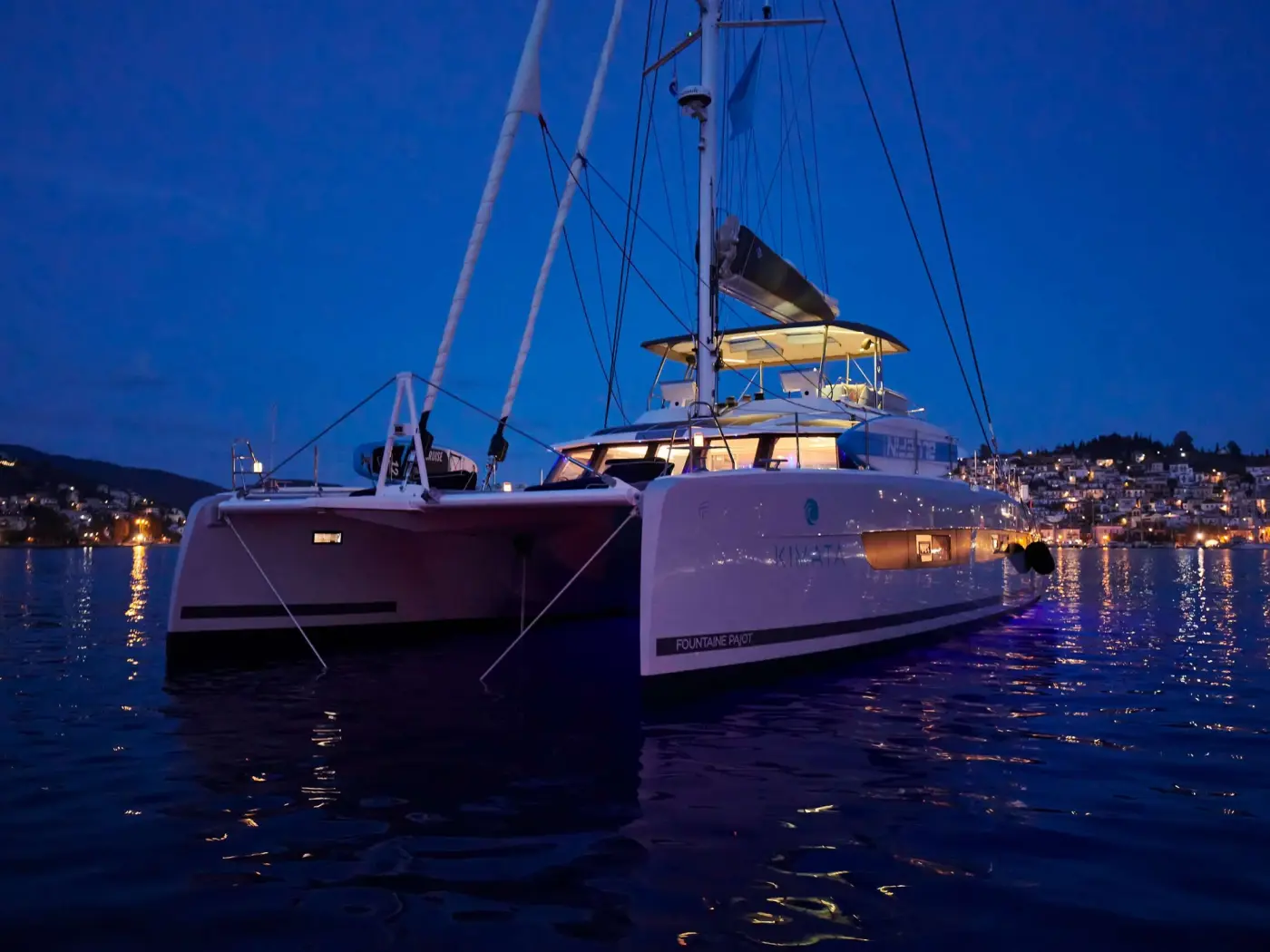
A crewed sailing catamaran for eight starts from EUR 17,000 a week base, about EUR 22,000 all in. That is a 15.6 metre boat such as EFFIE STAR, with a captain and a cook, five cabins and the table set on the aft deck. A 20 metre catamaran with a chef, such as KIMATA, runs EUR 31,500 to 42,500 base, about EUR 41,000 to 62,000 all in for eight guests and a crew of three. A 24 metre Sunreef such as ABOVE & BEYOND runs EUR 56,000 to 77,000 base, about EUR 73,000 to 113,000 all in, with a crew of five or six. Motor yachts start from EUR 17,500 base at 19.5 metres and run to EUR 235,000 at 50 metres.
All in means three lines added together. The base is the yacht and her crew. The APA, the advance provisioning allowance, is 25 to 35 percent of the base on a catamaran and 30 to 40 percent on a motor yacht, and it pays for fuel, food, drink, berths and port fees at cost, against receipts, with the balance returned. The Greek charter VAT is 5.2 to 12 percent depending on the yacht's certification. A gratuity of 10 to 15 percent of the base is decided by you on the last day and is never inside the all-in figure.
I will not do the arithmetic by the head for you, because the yacht is not sold that way and the comparison misleads in both directions. What I can say is that a party of eight on a catamaran at EUR 22,000 all in has paid for the boat, the crew, the fuel, the food and the harbours, and there is nothing to sign at a bar. If the base rate has to stay under EUR 50,000, the yacht charter in Greece under EUR 50,000 page sets out that band, and the all-inclusive yacht charter page explains what one fixed price does and does not cover.
Where does each one take you?
The big ships call at Piraeus, Mykonos and Santorini, sometimes Rhodes or Crete, on the ship's clock. The islands between are seen from the rail. A yacht leaves from Athens, ninety minutes from touchdown to deck, and goes where the week decides. In the Saronic Gulf the distances are short and the water is calm: Aegina is 18 nautical miles from Alimos, Poros 25, Hydra 35, Spetses 50, which is why the five-night Saronic week is the one I recommend to first-timers. In the Cyclades the legs are longer and the reward is the light: Kea 35 miles, Kythnos 45, Syros 70, Mykonos 90, Paros 95, Santorini 130. The Ionian, from Lefkada or Corfu, is green, sheltered and the family favourite in July.
Weeks start on any day you choose, not on the Saturday the ships sail. The season runs from late April to late October. If you want to see exactly how the week begins at the marina and where it goes from there, I set it out hour by hour in a crewed yacht charter from Athens.
Who is on board, and who is cooking?
On a ship you share a crew of hundreds with thousands of guests. On a yacht the crew is yours: a captain, a chef or cook, a stewardess, a deckhand on the bigger boats, two to nine people in all depending on the yacht. A commercial charter yacht in Greece carries up to twelve guests, which is why these boats feel private rather than crowded. I explained who does what aboard in a separate piece.
The food is the part that surprises people who have only cruised. The chef shops in the port you woke in, cooks what the market had that morning, and asks at breakfast what you want for dinner. The galleys of these yachts win awards: KIMATA's crew took 3rd Place Diamond in the CYBA Designer Water competition at the East Med Multihull and Yacht Charter Show in 2024. The cooking is included in the base; the provisions come from the APA; there is no bar bill. What you eat on a crewed yacht in Greece is the long version, and what is included on a crewed catamaran is the inventory.
How do the days differ?
A cruise day: wake at sea, dock at eight, queue for the tender, the town with the ship's guests, back aboard by five, sail at dinner. A yacht day: wake in a bay, swim before breakfast, the captain proposes two anchorages and a village, lunch at anchor under the awning, the tender to a taverna at dusk, the night where the water is flat. I wrote the hour by hour version for a first-time party, and it is the most honest description of the pace I can give.
The toys matter more than people expect. Most of the catamarans on the list carry a tender, paddleboards, snorkelling gear and a kayak; many carry a Seabob or water skis. On a ship the sea is scenery. On a yacht it is the swimming pool, and the children are in it before the coffee is poured.
What about the sea, the wind and seasickness?
A ship is steadier, and I will not pretend otherwise. A 20 metre catamaran is flat at anchor and comfortable under way; a monohull heels under sail, which some people love and some do not. The Meltemi blows across the Cyclades in July and the first three weeks of August, 15 to 25 knots and occasionally more, and a good captain routes around it or I move the week to the Saronic or the Ionian, where it barely reaches. June and September are the calm months, with warm water and rate cards 15 to 25 percent below peak. The seasickness, kids and weather piece covers every first-timer worry, and the weather page shows the season month by month.
When is the cruise the right answer?
Four cases, and I say them plainly because a client who should have cruised is not a client I want aboard for a week. You want several countries in one trip. A ship crosses the Adriatic or the Aegean overnight; a yacht stays in Greek waters, which is the point of it. You are a party of two and the budget is firm. A cabin for two costs less than the whole yacht; a couple charters when the yacht itself is the holiday, and there are 22 metre motor yachts for six on the list for exactly that, but it is a different decision. You want a theatre, a casino, a spa deck and a thousand people around you. A yacht has none of that; it has a chef, a tender and silence. Mobility. A ship has lifts and wide corridors; a catamaran has steps, a tender and a swim platform, and I would rather say that now than on the quay.
There is a fifth case, and it is the simplest: some people do not like boats. If a night at anchor sounds like a night in a hotel that moves, the ship is honest and the yacht is not, and I will tell you so on the phone.
How do you book a private week, and how far ahead?
Five of the six weeks I closed this season were signed nine to fourteen months before boarding. The four and five cabin catamarans for July and August 2027 are being contracted through this autumn and winter; June and September are easier and run below peak on the same rate card. The process is short. You write with the month, the number of people and the ages of any children. Within twenty-four hours you have two or three yachts with their rate cards and the all-in week worked for each. The contract is the MYBA Charter Agreement, the industry standard; half is paid on signature and the balance forty-five days before boarding. How far in advance to book has the calendar, and how to choose a crewed yacht charter broker has the five questions to ask anyone you write to, including me.
If the catamaran is the format, start on the catamaran charter in Greece page, where every crewed catamaran on the list sits by size with her rate card. If the group wants speed and a flybridge, the motor yacht charter in Greece page is the list, from 19.5 metres to 50.
Write to me with the month and the number of people, and I will answer myself, usually the same day. WhatsApp +1 786 798 8798, george@georgeyachts.com, or the contact page. George P. Biniaris, Founder and Managing Broker, George Yachts Brokerage House, Athens.


