
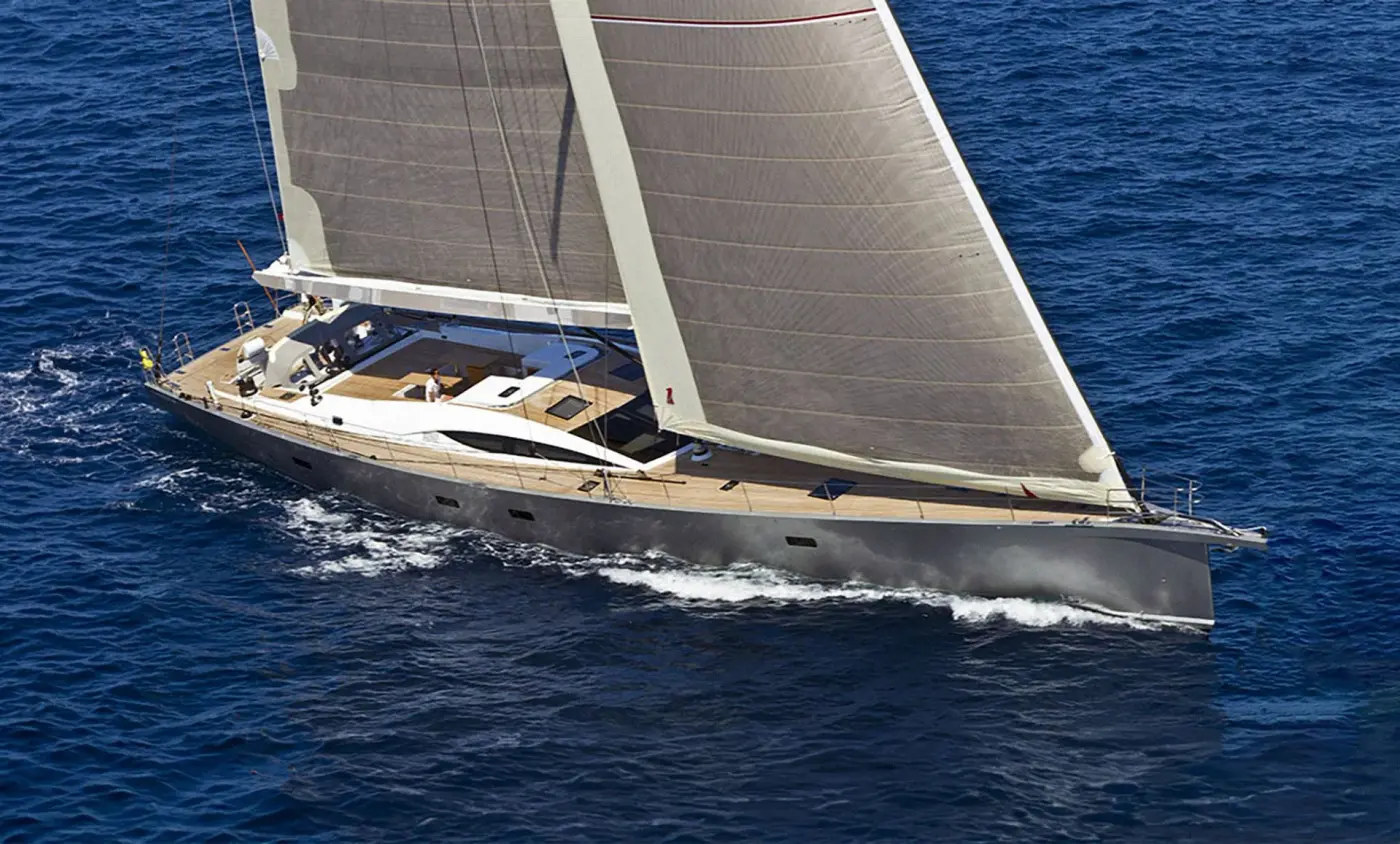
Every winter the same question arrives with the first serious enquiries for July and August. We want the Cyclades, they write, but a friend told us about the wind. Will the Meltemi spoil our week? It is the right question, and the usual answer, it depends, helps nobody. So this autumn I counted. I took ten summers of hourly wind data, 2016 to 2025, for the waters this house works, and I asked it what my clients ask me. I am a broker, not a meteorologist. I hold a sailing skipper's licence from the Olympiacos SFP Sailing Academy and a powerboat licence valid to 25 metres, and I work every week of the season with the captains who sail these waters, so I know which questions matter. What follows is the wind with numbers in it: when it blows, how hard, where it does not reach, and what a crewed yacht charter in Greece does on the days it does.
What is the Meltemi wind?
The Meltemi wind is the dry northerly that blows across the Aegean Sea in summer. The ancient Greeks called these winds the Etesians, from etos, the year, because they return every year. Meltemi is the name Greeks and Turks use today. It arrives under a clear sky, which is what surprises visitors most: no cloud and no rain announce it. The air is dry, the horizon is sharp, and the sea turns a dark, ruffled blue. It is also remarkably faithful to one direction. On the open water between Mykonos, Delos and Tinos, 92 percent of July afternoon hours in my ten summers came from between north-west and north-east.
What causes the Meltemi?
Two pressure systems that sit still. In summer a ridge of high pressure builds over the Balkans, while the heated plateau of Anatolia, in Turkey, holds a low. Air runs from the high to the low, and the Aegean lies between them like a corridor. The reference study of these winds, by Tyrlis and Lelieveld in the Journal of the Atmospheric Sciences in 2013, ties their rhythm to the South Asian monsoon far to the east, and notes that they strengthen by day over the central and southern Aegean as the Anatolian low deepens in the heat. That is why this is a summer wind, and why its hardest weeks are the hottest ones.
When is the Meltemi season in Greece?
The textbooks give mid May to mid September, with the strongest winds in July and August. My count agrees on the peak and adds a detail worth money. I measured the share of days on which the wind reached 22 knots, the bottom of Beaufort force 6, the point at which an open-water passage stops being a pleasure on a smaller yacht. Between Mykonos and Tinos that was 13 percent of days in May, 14 in June, 34 in July, 32 in August and 30 in September. Read the first two numbers again. June is the quiet month in these islands: more than half of all June days there, 54 percent, never reached even 17 knots.
September deserves an honest sentence, because I am on record calling it the best month in Greece, and I still do. The average afternoon wind falls, from 17.4 knots in August to 15.8, and the calm days grow from 25 percent of the month to 38. But the windy days do not leave with the crowds. Three September days in ten still reached 22 knots, some of them the first autumn northerlies rather than the summer wind proper. September is calmer on average and less predictable from one day to the next. Greece by yacht in September is still the month I would choose for myself. I would simply choose the yacht with the wind in mind, and the month by month guide sets the rest of the season beside it.
How strong is the Meltemi?
On a typical day, Beaufort 4 to 6, a fresh to strong breeze. For readers who think in knots: force 4 is 11 to 16, force 5 is 17 to 21, force 6 is 22 to 27, force 7 is 28 to 33, and force 8, a gale, begins at 34. On the open water off Mykonos the average July afternoon across the ten summers was 17.1 knots, the lower edge of force 5. One July day in three reached force 6. A sustained force 7 was rare in the open-water data, about one July day in a hundred. Gusts are another matter. The daily peak gust averaged 26 knots, and on roughly one July day in nine it touched gale force.
Two cautions keep these numbers honest. First, each is an average over a square of sea about 25 kilometres across, hour by hour. Where the wind is squeezed between islands it runs harder than any average: the Kafireas strait between Evia and Andros, the channel between Tinos and Mykonos, the strait between Paros and Naxos that windsurfers travel for. Second, wind is only half of what you feel on board. The other half is the sea it raises, a short, steep chop that grows with every mile of open water to the north of you.
| Area | July afternoon average | July days reaching 22 knots | August afternoon average | August days reaching 22 knots |
|---|---|---|---|---|
| Andros and Tinos | 17.0 knots | 35% | 17.8 knots | 38% |
| Mykonos, Delos and Tinos | 17.1 knots | 34% | 17.4 knots | 32% |
| Paros and Naxos | 15.7 knots | 26% | 15.6 knots | 19% |
| Santorini | 14.6 knots | 22% | 14.1 knots | 10% |
| Kea and Kythnos | 14.1 knots | 20% | 14.8 knots | 28% |
| Milos and Kimolos | 12.7 knots | 15% | 12.6 knots | 14% |
| Saronic Gulf, off Aegina | 8.0 knots | 0% | 8.4 knots | 0% |
| Hydra | 7.6 knots | 0% | 7.8 knots | 0% |
| Ionian, Lefkada to Ithaca | 11.1 knots | 2% | 10.4 knots | 1% |
| Ionian, Corfu to Paxos | 10.8 knots | 4% | 9.9 knots | 2% |
Afternoon wind, 1 to 5 pm local time, and the share of days with at least one hour at 22 knots or more, 2016 to 2025. Source: ERA5 reanalysis, Copernicus Climate Change Service, open-water grid cells. Analysis by George Yachts.
Does the Meltemi blow all day, or only in the afternoon?
Here the data corrected something that yacht brokers, this one included, repeat too easily: that the wind builds late in the morning and dies at sunset. Close to land there is truth in it. In open water it barely sleeps. Off Mykonos the July average was 15.5 knots between midnight and five in the morning, 16.6 between six and nine, and 17.1 in the afternoon. The published research agrees on the shape, a maximum around the middle of the day and a minimum around midnight. Over the sea the difference is a knot or two, not a calm.
So why do good captains still leave early? Because the passage is only part of the day. Leave at seven and the yacht is anchored in a lee by late morning, before the bay fills, with the afternoon free for swimming in flat water while the wind does what it likes outside. And because near the islands the afternoon does add something my open-sea numbers cannot see. The studies put the daily cycle down to circulations driven by local heating, and a grid cell 25 kilometres wide is blind to a gust falling off a hillside.
The Ionian is the opposite case, and the contrast is the most useful thing on this page. Its summer wind is a true afternoon sea breeze, the maistro, from the north-west. Between Lefkada and Ithaca the July average was 5 knots at nine in the morning and 12 at five in the afternoon, easing again through the evening. Glassy mornings, a sailing breeze after lunch, a quiet night. That is the daily clock of the Ionian, and it is why I send families with small children there in August.
How long does a Meltemi last?
Shorter than its reputation, most of the time. I counted every run of consecutive days that reached 22 knots off Mykonos across ten Julys and Augusts. There were 76 such spells. More than half, 57 percent, lasted one or two days. Fewer than one in five ran to five days or more, and the longest was nine. The wind comes in pulses with easier days between them, and those easier days are exactly what a captain uses.
What nobody can promise you is the summer itself. In 2017 the same waters had 31 days of force 6 in July and August, half the season. In 2018 they had nine, and in 2023 ten. The same islands, the same weeks, three times the wind.
What are the odds for your own week?
This is the number I wanted for my own desk. Take every possible seven-day week in July and August over the ten summers, 560 of them, and count the days in each that reached 22 knots.
- Mykonos, Delos and Tinos: 18 percent of weeks had no such day at all, 36 percent had one or two, 32 percent had three or four, and 14 percent had five or more.
- Paros and Naxos: 30 percent of weeks had none, 44 percent had one or two, and 26 percent had three or more.
- Santorini: 43 percent had none, 40 percent had one or two, and 17 percent had three or more.
- Milos and Kimolos: 48 percent had none, 36 percent had one or two, and 16 percent had three or more.
- The Saronic Gulf, off Aegina: every one of the 560 weeks had none.
- The Ionian, between Lefkada and Ithaca: 92 percent of weeks had none, and the rest had one or two.
So the typical high-summer week around Mykonos has two or three days on which the captain changes the plan, and four or five on which the plan stands. About one week in seven has five or more windy days. About one in five has none. In June the picture changes character: 54 percent of weeks there had no force 6 day at all, and only 9 percent had three or more.
Which Greek islands are the windiest, and which are less windy?
The wind is strongest in the north and the centre of the Cyclades and weakens to the south and the south-west. Andros, Tinos and Mykonos take it first and hardest. Paros and Naxos sit a step below. Kea and Kythnos, the first islands out of Athens, sit about level with them. Santorini is gentler than its reputation, above all in August, when one day in ten reached 22 knots in my data. Milos and Kimolos were the calmest corner I measured in the group, at 12.7 knots on a July afternoon, with half of all days never reaching 17. I have written about the Cyclades islands, one by one, and about the quieter ones beyond Mykonos and Santorini.
Outside the Cyclades the picture changes completely. In the Saronic Gulf, on the doorstep of Athens, the afternoon average was 8 knots, and not one July or August day in ten years reached 22 at the point off Aegina. Off Hydra it was the same. In the Ionian the afternoon breeze averaged 10 to 11 knots, and force 6 appeared on one to four days in a hundred. If your question is which Greek islands are less windy in summer, the answer is these two groups: the Saronic islands, Aegina, Poros, Hydra and Spetses, and the Ionian islands, from Corfu and Paxos down to Lefkada, Ithaca and Kefalonia. I have set out whether the Saronic Gulf is good for a yacht charter, the Ionian islands and the choice between the Cyclades and the Ionian on their own pages.
I have not measured the Dodecanese, the Sporades or Crete, although the same wind reaches them, because this house works four grounds only: Athens, the Saronic, the Cyclades and the Ionian.
Is Mykonos windy? And Santorini, Paros and Milos?
Mykonos is the windiest of the famous islands, and it has always known it. Most of the windmills above its harbour were built from the sixteenth century, in Venetian times, to grind grain with exactly this wind. In July, one day in three reaches force 6 on the water around it, and seven days in ten reach at least force 5. But three days in ten stay below that, and the bays on the southern side of the island lie in the lee, which is why the yachts gather at Ornos and Kalafati.
Santorini is lighter. In my data 22 percent of July days and 10 percent of August days reached force 6, and nearly half of all August days, 48 percent, never passed 17 knots. Paros and Naxos fall between the two, with the strait between them the lively exception. Milos is the quiet one. If you are staying ashore rather than afloat, the same map serves you: on a north-wind day, choose a beach that faces south. And if the plan is Mykonos to Santorini by yacht, the direction you travel matters more than the distance.
Do ferries stop for the Meltemi, and does a yacht?
Ferries run through most windy days. When the forecast reaches about Beaufort 8, the port authorities stop departures, usually for a day at a time, and review the ban each morning. Anyone crossing between islands on a tight schedule in August should leave a day of slack before the flight home.
A crewed yacht lives under the same sky and answers to the same port authority. The difference is that she has no timetable to defend. If Tuesday is the windy day, Tuesday becomes the day in the lee, with the long lunch and the paddleboards, and the passage moves to Wednesday morning. This is the plainest difference between a private yacht and a Greek islands cruise: nobody aboard is trying to deliver you to a port by four o'clock.
What does a crewed yacht do on a windy day?
Three things, and they are the reason I am relaxed about a wind that worries people in November.
The captain plans the week around the pulses, reading the forecast every evening and putting the long legs on the easier days. From Athens the outward leg to the islands runs with the wind behind the beam, and the leg home runs into it. That is why the return is usually planned through Kythnos and Kea, where my numbers are lower than at Mykonos, and why the last day is kept short: Kythnos to the marina at Alimos is 45 nautical miles, a morning. How a week from Athens begins follows the same logic.
The night's anchorage is chosen for the wind, not for the postcard. On a north wind the south-facing bays are flat: Ornos and Kalafati on Mykonos, Finikas on Syros, the Despotiko channel behind Antiparos, Manganari on Ios, Vathy on Sifnos, Adamas on Milos. I keep the lee anchorages and the passage rules, island by island, on a page of their own.
And you hear the truth at breakfast. A good crew does not sell you a rough passage as an adventure. If the answer is not today, you hear it over coffee with an alternative attached, and by the afternoon you will have forgotten there was ever another plan. You may have built this week in your mind for a year. The crew's work is to give you that week, not a schedule.
Which yacht handles the Meltemi best?
Size first, then type. Length and weight are what carry a yacht through a short sea, so my rule for the Cyclades in July and August is a catamaran of 20 metres or more, or a motor yacht of 26 metres or more. Below that, the same money buys a happier week in the Saronic or the Ionian. This is the one place where I will talk a client out of the boat they came for.
On a motor yacht, ask about stabilizers. A stabilized yacht stays level at anchor when the swell wraps around a headland, which is when an unstabilized one sets the glasses sliding. Ten motor yachts in this fleet list them on their specification. Three examples, each stabilized both under way and at anchor: the 24 metre FREEDOM at EUR 28,000 to 35,000 a week, the 31 metre SUMMER FUN at EUR 45,000 to 65,000, and the 34 metre PROJECT STEEL at EUR 55,000 to 67,000.
Two hulls do not heel, and a catamaran of 20 metres has the beam and the weight to sit quietly in a lee. On the Greek Charter Index the sailing catamarans of 20 to 22 metres, Kimata and Serenissima among them, run EUR 31,500 to 43,500 a week. Every figure here is the weekly base rate for the whole yacht and her crew, and what a week costs all in is set out separately.
For sailors, the wind is not the problem. It is the reason to come. Huayra, the 31 metre carbon sailing yacht in the photograph above, lists up to 17 knots under sail on her card. A week running south through the islands with a force 5 behind her is, for my money, the best sailing in the Mediterranean, and I will not pretend to be neutral about it. Sailing in Greece says why at more length.
Should you avoid the Cyclades in July and August?
Some parties should, and I tell them so.
- If anyone aboard is frightened of motion or prone to seasickness, do not make their first week an August week around Mykonos. Take the Saronic, or the Ionian, or take the Cyclades in June. I have answered the first-timer's worries, seasickness included, one by one.
- If you travel with very young children, the same. Chartering with young children has the detail.
- If the budget points to a yacht under 20 metres, spend it where that yacht is at her best.
- If the trip exists for one fixed list, Mykonos on Tuesday, Santorini on Thursday, a table booked every night, know the odds: in almost half of the July and August weeks I counted, three or more days reached force 6 around Mykonos.
Everyone else should come. The same wind is what makes the islands bearable in high summer. It clears the haze, takes the edge off the heat on deck, and leaves the south-facing bays flat and bright. The islands look the way they do in the photographs because of it, not in spite of it.
How do you check the forecast before you travel?
Nobody can tell you in November whether your week in July will be windy. What a forecast can do is tell you a few days out, and tell your captain every evening. The Hellenic National Meteorological Service publishes the official marine bulletins in Beaufort, and the common wind apps show the same weather models on a map. Look at the wind in knots at the island you are going to, look at the direction, and remember that a north wind means the south coast is the calm one. Our own Greek sailing weather guide sets out wind, sea temperature and crowds month by month. Then leave the rest to the person whose job it is.
How were these numbers made?
The data are ERA5, the global weather reanalysis produced by the European Centre for Medium-Range Weather Forecasts for the Copernicus Climate Change Service, retrieved through the Open-Meteo archive. I took the hourly wind at 10 metres above the sea for ten open-water grid cells, each about 25 kilometres across, for May to October of 2016 through 2025, in local time. Afternoon means 1 to 5 pm. A day reaching 22 knots is a day on which at least one hourly average touched 22 knots, the lower edge of Beaufort 6. A reanalysis smooths the extremes. It cannot see a gust off a cliff or the jet in a narrow channel, so read every figure here as the open sea on an ordinary pass, not the worst corner on the worst afternoon. If you quote the numbers, a link to this page is all I ask.
Write to me with the month, the islands you have in mind and the number of people, and I will tell you honestly what the wind is likely to do to that plan and which yacht I would put under it. I answer myself, usually the same day. WhatsApp +1 786 798 8798, george@georgeyachts.com, or the contact page. George P. Biniaris, Founder and Managing Broker, George Yachts Brokerage House, Athens.


