
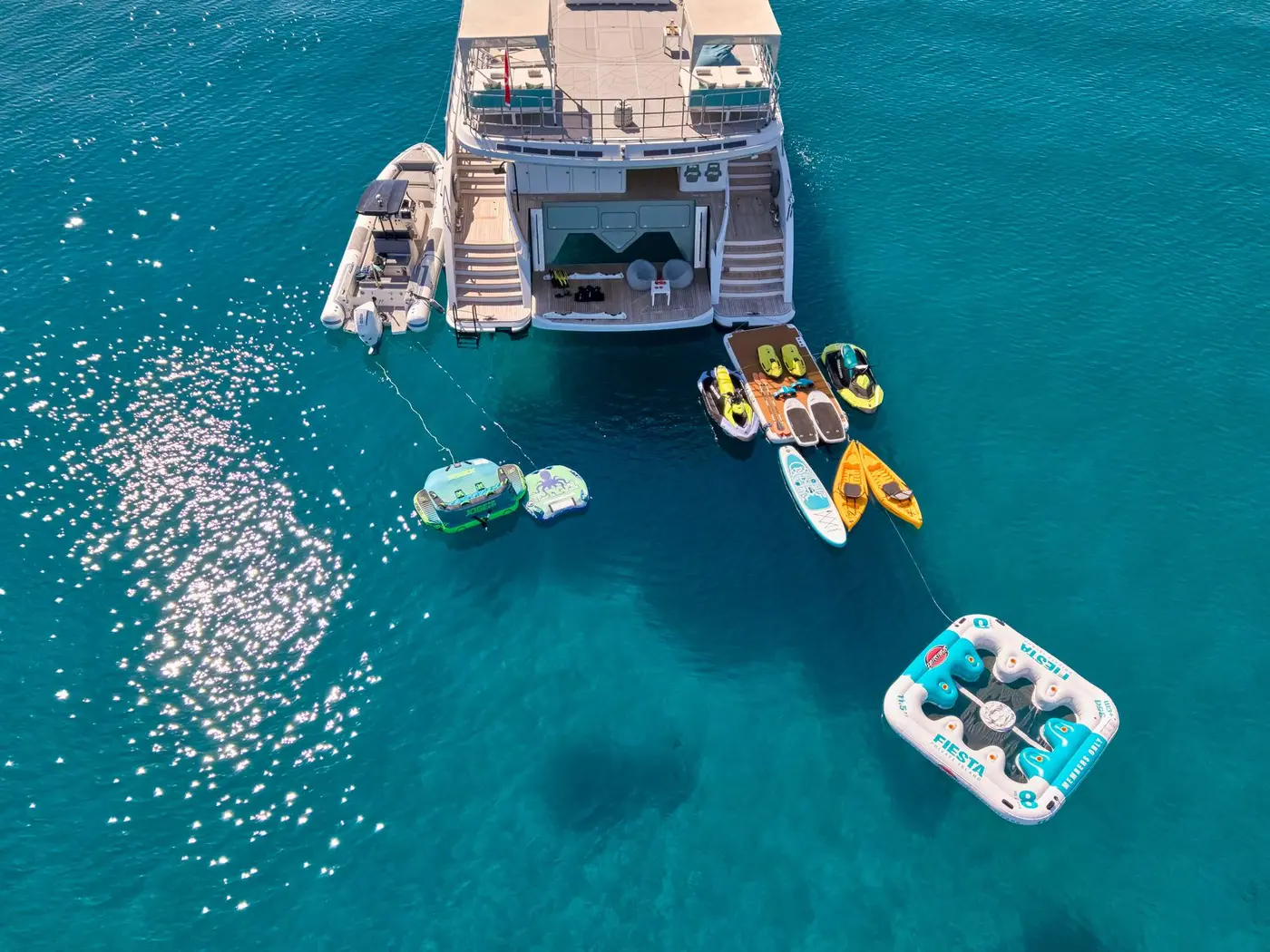
The second question in almost every enquiry for May, June or October is the same one. Will the water be warm enough to swim? It is the right thing to ask before you commit a family holiday to a yacht, because on a yacht the sea is the swimming pool. The honest answer depends on the month and, more than most people expect, on which part of Greece you choose. So after counting ten summers of the Meltemi, I counted the water. NOAA has kept a satellite record of sea surface temperature for every day since 1981. I took twelve patches of sea that this house works, from Corfu to Santorini, and asked the record what my clients ask me. Ten years, 2016 to 2025, make the averages below. The full record, 45 summers, shows how fast those averages are moving. I am a broker, not an oceanographer. What I can add is what the numbers mean when you are standing on a swim platform deciding whether to jump.
What is the sea temperature in Greece, month by month?
In round numbers, across the waters where most yacht charters in Greece take place: about 17°C (62 to 63°F) in April, 19°C (66°F) in May, 22 to 23°C (71 to 74°F) in June, 24 to 26°C (75 to 79°F) in July, 24 to 27°C (76 to 81°F) in August, 24 to 26°C (75 to 79°F) in September, 22 to 23.5°C (71 to 74°F) in October and 19 to 21°C (67 to 70°F) in November. The coldest water of the year comes in February and March, at 15 to 17°C (59 to 62°F). The table gives the six charter months for each area.
| Area | May | June | July | August | September | October |
|---|---|---|---|---|---|---|
| Andros and Tinos | 18.7°C (66°F) | 21.9°C (71°F) | 24.0°C (75°F) | 24.6°C (76°F) | 24.0°C (75°F) | 21.8°C (71°F) |
| Mykonos and Delos | 18.9°C (66°F) | 21.9°C (71°F) | 23.8°C (75°F) | 24.4°C (76°F) | 23.8°C (75°F) | 21.7°C (71°F) |
| Paros and Naxos | 19.1°C (66°F) | 22.0°C (72°F) | 23.7°C (75°F) | 24.4°C (76°F) | 23.9°C (75°F) | 21.8°C (71°F) |
| Santorini | 19.4°C (67°F) | 22.5°C (73°F) | 24.3°C (76°F) | 25.1°C (77°F) | 24.6°C (76°F) | 22.5°C (73°F) |
| Milos and Kimolos | 19.2°C (67°F) | 22.8°C (73°F) | 24.9°C (77°F) | 25.4°C (78°F) | 24.6°C (76°F) | 22.7°C (73°F) |
| Kythnos and Kea | 19.0°C (66°F) | 22.4°C (72°F) | 24.5°C (76°F) | 25.2°C (77°F) | 24.7°C (76°F) | 22.7°C (73°F) |
| Athens Riviera | 19.1°C (66°F) | 23.0°C (73°F) | 26.1°C (79°F) | 26.6°C (80°F) | 25.7°C (78°F) | 23.5°C (74°F) |
| Aegina and Poros | 19.1°C (66°F) | 23.1°C (74°F) | 26.1°C (79°F) | 26.6°C (80°F) | 25.7°C (78°F) | 23.5°C (74°F) |
| Hydra and Spetses | 19.2°C (67°F) | 23.2°C (74°F) | 25.9°C (79°F) | 26.3°C (79°F) | 25.5°C (78°F) | 23.4°C (74°F) |
| Lefkada to Ithaca | 19.2°C (67°F) | 23.1°C (74°F) | 25.7°C (78°F) | 27.0°C (81°F) | 25.9°C (79°F) | 23.5°C (74°F) |
| Kefalonia and Zakynthos | 19.0°C (66°F) | 22.9°C (73°F) | 25.7°C (78°F) | 26.9°C (80°F) | 25.9°C (79°F) | 23.5°C (74°F) |
| Corfu to Paxos | 19.2°C (67°F) | 23.3°C (74°F) | 25.6°C (78°F) | 26.8°C (80°F) | 25.4°C (78°F) | 23.0°C (73°F) |
Monthly mean sea surface temperature, 2016 to 2025, for twelve open-water areas. Source: NOAA Optimum Interpolation Sea Surface Temperature (OISST) version 2.1, quarter-degree grid. Analysis by George Yachts.
Three things stand out. The whole country starts level: in May every area sits within half a degree of 19°C. By July the map has split, with the waters near Athens and the Ionian above 25.5°C while Mykonos, Paros and Naxos are still under 24. And autumn is generous. The sea in October is as warm as the sea in June, and near Athens it is half a degree warmer.
When is the sea warm enough to swim in Greece?
That depends on you, so here are some fixed points to judge by. Competition swimming pools are kept between 25 and 28°C under World Aquatics rules. In the same satellite record, the Atlantic off Montauk, at the tip of Long Island, averages 22°C (72°F) in August, its warmest month, and Santa Monica Bay peaks at 21°C (70°F). If you swim happily at home in either place, you will swim happily in Greece from early June to the end of October.
My own scale, after years of watching guests go in off the stern: at 19 or 20°C the adults who love the sea swim and the children need persuading. From 22°C nobody on board hesitates. From 24°C people stop getting out.
- The water reaches 20°C to stay in the last ten days of May, in every area I measured.
- It reaches 22°C around 8 June in the Saronic Gulf and the Ionian and stays there until the first days of November, about 150 days. Around Mykonos the same mark arrives around 19 June and lasts until about 12 October, 116 days.
- It reaches 24°C around 23 June near Athens and in the Ionian and holds until about 9 October. Around Mykonos that warmth runs from the middle of July to the middle of September, 60 days.
So the swimming season, in the sense that a child would recognise, is about five months long in the Saronic and the Ionian and about four in the central Cyclades.
Which part of Greece has the warmest sea?
In August, the Ionian. Between Lefkada and Ithaca the August average was 27.0°C (81°F), with Kefalonia and Zakynthos at 26.9 and Corfu at 26.8. In July the lead belongs to the waters near Athens: 26.1°C off Aegina and along the Athens Riviera. In June, September and October the two seas run level, within half a degree of each other. Both are sheltered and out of the main summer wind, so they heat quickly and hold what they gain. In ten years of daily values, not one August day off Aegina fell below 25°C.
The Cyclades are the cool end of the country in summer. In August the water around Mykonos, Paros and Naxos averaged 24.4°C (76°F), more than two and a half degrees below the Ionian. That is still warmer than the Atlantic off Long Island ever averages in a month. But it is a real difference, and you feel it on the first swim.
Why is the sea around Mykonos cooler than the sea near Athens?
Because of the wind. The Meltemi, the dry northerly of the Aegean summer, blows hardest across exactly these islands. It stirs the warm surface into the cooler water beneath it, and satellite studies of the Aegean show it drawing colder water up along the eastern side of the sea, from where it spreads south and west. The wind that makes a July passage lively also keeps the swimming fresh.
You can read it in the table. The windy heart of the Cyclades, from Tinos and Mykonos down to Paros and Naxos, has the coolest July and August water. Milos, the calmest corner of the Cyclades in my wind count, has the warmest. And the two counts agree year by year. 2018 was the calmest of my ten summers, with nine windy days in July and August, and it gave the warmest July water around Mykonos, 25.4°C. 2017 was the windiest, with 31, and it gave the coolest August, 23.6°C. When the wind sets in, the change is quick: in the first week of July 2017 the water off Mykonos lost more than three degrees in five days.
Can you swim in Greece in May?
Yes, if you like your swimming brisk. May averages 19°C (66°F) in every area, from 18.7 off Andros to 19.4 off Santorini, and the month climbs steeply: about 18°C on the first of May, 19 in the middle, and between 20 and 21 on the last day. Across the ten years, about one May day in four reached 20°C. Years differ more than areas do. The coolest May of the ten around Mykonos averaged 18.0°C and the warmest 19.9.
What I tell families is this. May is a wonderful month to be on a yacht in Greece. The islands are green, the harbours are empty and the sun is already strong. But it is a month for walking, long lunches and short swims, not for children who want to live in the water from breakfast to sunset. For that, wait for the second half of June, or come in September. The month-by-month guide sets the water beside everything else that changes through the season.
Is the sea warm in Greece in June?
June is the month the water turns. It averages 22 to 23°C (71 to 74°F), and no other month moves as fast: off Aegina the sea is about 21°C on the first of June and above 25 on the first of July. The areas separate in June too. By the middle of the month the Saronic Gulf and the Ionian are at 23°C while Mykonos is still just under 22.
Late June is one of the best-kept weeks in Greece. The water has arrived, the days are the longest of the year, and in the Cyclades it is the quiet month for wind: more than half of all June days around Mykonos never reached 17 knots in my wind count.
What month is the sea warmest in Greece?
August, in every area. The peak of the year falls in the first half of the month, and on its warmest day the sea averages about 26°C around Mykonos and 28°C in the Saronic Gulf and the Ionian.
September is the surprise. The air cools, the crowds leave, and the sea barely notices. In every area I measured, the September average is within half a degree of the July average, and in seven of the twelve it is equal or higher. Between Lefkada and Ithaca, September water averages 25.9°C against 25.7 in July. This is one of the reasons I keep sending people to Greece by yacht in September, and it is the heart of the August or September question.
Can you swim in Greece in October?
Yes, and comfortably in the first half of the month. October averages 21.7 to 22.7°C (71 to 73°F) in the Cyclades and 23 to 23.5°C (73 to 74°F) in the Saronic Gulf and the Ionian. The month cools as it goes. Off Aegina the sea is about 24.7°C on the first of October, 23.6 in the middle and 22.4 on the last day. Off Mykonos the same three dates read 23.0, 21.8 and 20.4.
Put another way, the sea off Aegina at the end of October is as warm as the Atlantic off Montauk at the height of August. What changes in October is not the water. It is the day: shorter light, a cooler deck when you climb out, and the first unsettled weather of autumn. I suggest October to couples, to walkers, and to anyone who dislikes heat, and I suggest they take the Saronic or the Ionian, where the water is almost two degrees warmer.
What about April and November?
April is the one month I do not sell for swimming. The sea is about 17°C (62 to 63°F) everywhere, barely above its winter low, and the yachts are still coming out of their winter refits.
November is the opposite case, and it surprises people. The sea gives its heat back slowly, so November water is still 19 to 21°C (67 to 70°F). Near Athens and in the Ionian that is two degrees warmer than in May. But most crewed yachts in Greece end their season with October, so it is a fact for those who live here more than for visitors.
What is the water temperature in Mykonos and Santorini?
Around Mykonos and Delos the sea averages 18.9°C (66°F) in May, 21.9°C (71°F) in June, 23.8°C (75°F) in July, 24.4°C (76°F) in August, 23.8°C (75°F) in September and 21.7°C (71°F) in October.
Santorini is half a degree to a degree warmer in every month: 19.4°C (67°F) in May, 22.5°C (73°F) in June, 24.3°C (76°F) in July, 25.1°C (77°F) in August, 24.6°C (76°F) in September and 22.5°C (73°F) in October. It lies further south and a little out of the strongest wind. The warm, rust-coloured springs inside the caldera are a curiosity for an afternoon, not a measure of the sea. The Cyclades, island by island explains how the islands differ in everything else.
What is the water temperature near Athens, in Aegina, Poros and Hydra?
The waters within a few hours of Athens are the warmest in the Aegean and the calmest. Off Aegina and Poros the sea averages 19.1°C (66°F) in May, 23.1°C (74°F) in June, 26.1°C (79°F) in July, 26.6°C (80°F) in August, 25.7°C (78°F) in September and 23.5°C (74°F) in October. The Athens Riviera reads the same to a tenth of a degree, and Hydra and Spetses run two or three tenths cooler in high summer.
This is the practical case for the Saronic that most visitors never hear. It is forty minutes from the airport, the wind in my count never reached 22 knots there in July or August, and the water is two degrees warmer than around Mykonos. For a first charter with young swimmers it is very hard to beat, and I have set out the whole argument in is the Saronic Gulf good for a yacht charter.
What is the water temperature in Corfu, Lefkada and Kefalonia?
The Ionian has the warmest August water in Greece. Between Lefkada and Ithaca the sea averages 19.2°C (67°F) in May, 23.1°C (74°F) in June, 25.7°C (78°F) in July, 27.0°C (81°F) in August, 25.9°C (79°F) in September and 23.5°C (74°F) in October. Kefalonia and Zakynthos are within a tenth or two of those figures all season. Corfu and Paxos, the northern end, match them until August and cool a little sooner in autumn: 25.4°C in September and 23.0°C in October.
The Ionian is also where the sea has been changing fastest, as the record below shows. The Ionian islands, explained covers which island suits which kind of week.
How does the Greek sea compare with the water at home?
Nine in ten of my clients are American, so I ran the same satellite record for the waters they know, and for the Mediterranean coasts they weigh Greece against.
| Place | June | August | October |
|---|---|---|---|
| Mykonos, Cyclades | 21.9°C (71°F) | 24.4°C (76°F) | 21.7°C (71°F) |
| Aegina and Poros, Saronic Gulf | 23.1°C (74°F) | 26.6°C (80°F) | 23.5°C (74°F) |
| Lefkada to Ithaca, Ionian | 23.1°C (74°F) | 27.0°C (81°F) | 23.5°C (74°F) |
| Montauk, New York | 16.6°C (62°F) | 22.2°C (72°F) | 17.7°C (64°F) |
| Newport, Rhode Island | 16.4°C (62°F) | 21.4°C (71°F) | 17.3°C (63°F) |
| Nantucket, Massachusetts | 15.0°C (59°F) | 20.5°C (69°F) | 16.1°C (61°F) |
| Santa Monica Bay, California | 18.2°C (65°F) | 20.9°C (70°F) | 19.5°C (67°F) |
| Miami, Florida | 28.8°C (84°F) | 30.1°C (86°F) | 28.9°C (84°F) |
| Côte d'Azur, France | 22.2°C (72°F) | 25.8°C (78°F) | 20.4°C (69°F) |
| Amalfi Coast and Capri, Italy | 23.2°C (74°F) | 27.1°C (81°F) | 22.5°C (73°F) |
| Dubrovnik, Croatia | 23.1°C (74°F) | 26.7°C (80°F) | 21.5°C (71°F) |
| Mallorca, Spain | 23.1°C (74°F) | 27.2°C (81°F) | 23.4°C (74°F) |
Monthly mean sea surface temperature, 2016 to 2025, open water off each place. Source: NOAA OISST version 2.1. Analysis by George Yachts.
Two readings. For an American, the Greek sea in June is already as warm as the Atlantic off Rhode Island and Massachusetts gets in August, and in October it is still warmer than Santa Monica Bay at its summer peak. Only Florida is in another league. If you are coming to Greece from the United States, the water will feel warm to you in any month from June onward.
Against its Mediterranean neighbours, Greece is two seas. In August the Saronic Gulf and the Ionian are level with Amalfi, Dubrovnik and Mallorca and warmer than the Côte d'Azur, while the Cyclades are the coolest Mediterranean water in the table. In October Greece keeps its heat better than France, Italy or Croatia: 23.5°C off Aegina against 20.4 on the Côte d'Azur, 21.5 off Dubrovnik and 22.5 off Amalfi.
Is the sea in Greece getting warmer?
Yes, and the record shows by how much. I compared the same twelve areas across two decades of it, 1982 to 1991 and 2016 to 2025. From June to September the sea is now 1.2 to 1.4°C warmer in the Aegean areas and about 1.7°C warmer in the Ionian. Between Lefkada and Ithaca the August average was 25.2°C in the first decade and 27.0°C in the last. Around Mykonos, August went from 22.9 to 24.4°C.
The season has stretched as well. October around Mykonos is a degree and a half warmer than it was, 21.7°C against 20.2. May has moved least, by under one degree.
The summer that has just ended belongs in this paragraph. June to September 2026 was the warmest summer of the 45 on record in the Ionian areas I measured, level with 2024 between Lefkada and Ithaca and ahead of it off Corfu and Kefalonia. Off Aegina and along the Athens Riviera it was the second warmest, behind 2024. The Cyclades stayed close to their ten-year normal. The highest monthly figure in the whole series is still August 2024 between Lefkada and Ithaca: 28.8°C (84°F), averaged over the month.
For someone planning a week, the reading is simple. May, June and October are better months for swimming than their reputation, because that reputation was formed a generation ago. What a warmer sea means for the life in it is a serious subject, and it is one for the scientists who study it, not for a yacht broker.
How much does the water change from one year to the next?
More than the brochures admit, and more in the windy islands than in the sheltered ones. Around Mykonos the July average ranged from 22.3°C in the coolest of the ten years to 25.4 in the warmest, a spread of three degrees. Off Aegina the same July spread was 25.0 to 27.3. The single days range wider still: in August around Mykonos the daily figure ran from 22.9 to 27.3°C across the ten years.
So read every number here as the middle of a range. Your week will sit a degree or so either side of it, and in the Cyclades the wind of the week before decides which side.
What does this mean for choosing your week?
- If the children plan to live in the water, take the Saronic Gulf or the Ionian between late June and mid September. It is the warmest and the calmest sea in the country at the same time. Chartering with young children has the rest of that playbook, and the family charter page shows the yachts.
- If you want the Cyclades in July or August, come. Water at 24°C under a hot sun is refreshing, not cold, and a good captain anchors in shallow south-facing bays, which run warmer than the open-sea figures above.
- If your dates are May, the areas are equal, so choose on other grounds and pack for short swims. What to pack covers it.
- If your dates are October, the Saronic and the Ionian are almost two degrees warmer than Mykonos, and that is the difference between a quick dip and a long swim.
- Ask about the stern before you ask about the cabins. A platform that lowers to the water, an easy ladder and a hot shower on deck decide how much swimming a week holds, in any month.
How were these numbers made?
The data are NOAA's Optimum Interpolation Sea Surface Temperature, version 2.1: a daily analysis on a quarter-degree grid that blends satellite measurements with readings from ships and buoys, and runs from September 1981 to the present. I retrieved it from the NOAA Physical Sciences Laboratory. Each area is one grid cell of open water beside the islands named, about 28 kilometres from north to south and 22 from east to west. The monthly figures are averages of 2016 to 2025. The long comparison sets them against 1982 to 1991. The dates and the day counts come from the daily values for April to November, and a date such as 8 June means the average first day of a run of five days at or above the mark.
Three cautions keep this honest. It is the temperature of the top of the open sea, averaged over a day and over a large square. A shallow sandy bay on a still afternoon is warmer than the figure, and a deep anchorage after two days of north wind can be cooler. The grid cannot see a single cove. And an average is not a forecast.
Write to me with the month, who is coming and how much of the day they mean to spend in the water, and I will tell you honestly which sea I would put under that plan and which yacht. I answer myself, usually the same day. WhatsApp +1 786 798 8798, george@georgeyachts.com, or the contact page. George P. Biniaris, Founder and Managing Broker, George Yachts Brokerage House, Athens.


