
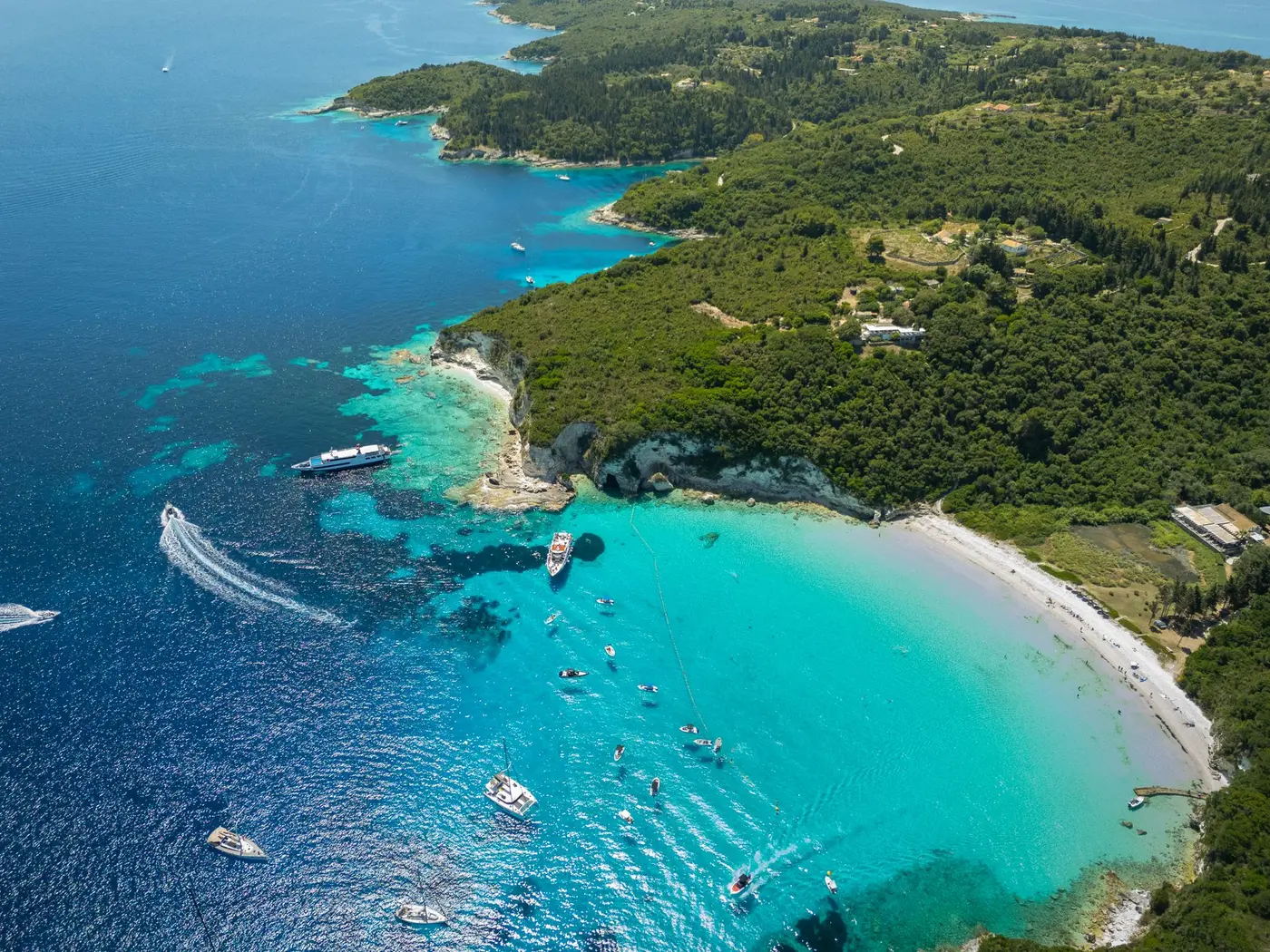
Two days after I wrote up the Cyclades island by island, the replies began arriving with the other question: and the Ionian? The families who ask it are usually the ones who have heard two things, that the water on the west side of Greece is green and calm, and that the islands are the ones you drive to from Corfu or Lefkada rather than the ones you fly to from Athens. Both are true, and neither tells you which island is which. So here is the Ionian the way I explain it on a call: what the group is, how the islands differ, the nautical miles between them from the house table, where a yacht sleeps, where it only visits, and how a week threads the lot. Everything below is drawn from the anchorage guides and island pages we keep on this site, so a captain would recognise every number.
What are the Ionian islands, and how are they different from the Cyclades?
The Ionian islands lie down the west coast of Greece, between the mainland and the open sea towards Italy, from Corfu in the north to Zakynthos in the south. The name is the sea's, not a shape's: the Cyclades are a circle around Delos, the Ionian are a string along a coast. The difference a charterer feels is more basic than geography. The Ionian is green where the Cyclades are dry: forested hills, olive terraces, pine down to the waterline, and villages that lean Italian, a Venetian inheritance in the harbours of Corfu and Fiskardo. The water is glass-flat compared with the Aegean, because the Ionian sits in a different weather system: there is no Meltemi here, only a thermal breeze in the afternoon. That single fact decides who I send where. The Cyclades demand a captain who knows the Meltemi and a party that enjoys a sea with character. The Ionian is the broker consensus for a first crewed week, for families with young children, and for anyone who wants the swim, the table and the village without the wind as a third guest. I have set out the two seas side by side in Cyclades or Ionian; this piece is the Ionian on its own terms.
Which islands are the Ionian, from north to south?
The islands a yacht actually uses, in the order the coast presents them. Corfu, the Venetian capital of the north, with the airport that opens the region. Paxos, twenty-five square kilometres of olive groves south of Corfu, the quiet one with the big reputation. Antipaxos, the tiny island five miles south of Paxos with the two beaches everyone photographs. Then a gap of open water down the mainland coast to Lefkada, the only Greek island joined to the mainland by a bridge, and the centre of every Ionian week. Off Lefkada's east coast sits Meganisi, with its narrow coves and the sea cave, and beyond it the two small islands of Kalamos and Kastos, where the week goes quiet. South again, Ithaca, Odysseus's home, and its larger neighbour Kefalonia, the island of Fiskardo, Assos and Myrtos. At the far end, Zakynthos, with Navagio beach and the Blue Caves on its wild west coast. Ten islands a yacht can plan around, and the mainland coast between them, with Sivota as the quiet stop.
How far apart are the Ionian islands by yacht?
These are the passages from the house distance table, in nautical miles as a yacht actually sails them, not straight lines on a map. Corfu to Paxos, 35. Paxos to Lefkada, 50. Lefkada to Ithaca, 20. Ithaca to Kefalonia at Fiskardo, 10. Lefkada to Kefalonia, 25. Kefalonia to Zakynthos, 35. The two long ones, for a party that wants the whole coast: Corfu to Lefkada, 80, and Corfu to Ithaca, 95. Antipaxos is 5 nautical miles south of Paxos, a morning's swim rather than a passage. Read those numbers and the shape of the region appears: a northern group around Corfu and Paxos, a central group around Lefkada, Meganisi, Ithaca and Kefalonia where the hops are ten to twenty-five miles, and a long leg of fifty miles between the two. Most weeks live in one group. Two weeks, or a party that does not mind a long day, take both. The classic seven-day loop from Lefkada runs 180 to 220 nautical miles in all, in sheltered water, and I have it day by day on the seven-day Ionian itinerary.
What is the wind like in the Ionian?
Different in kind, not just in strength. The Ionian has a thermal wind, a breeze that builds in the afternoon as the land warms and dies away in the evening; the Meltemi of the Cyclades, which blows from the north for days at a time in July and August, does not reach here. In practice the captain plans the day around the breeze rather than the week around a forecast: passages in the morning, the anchorage chosen by lunch, the afternoon at anchor while the thermal blows itself out. There are two places worth knowing about. Vassiliki on the south coast of Lefkada has the most reliable mid-afternoon thermal in Greek waters, which is why the windsurfers and kite-surfers keep it, and why a party that wants a watersports afternoon is routed there. And the west coast of Zakynthos takes the north-westerly afternoon thermals full on, which is why its famous sites are morning visits. The season runs longer than the Aegean's, from late May to the middle of October. June is the green peak, with the hillsides still verdant from the spring rains and the sea around 22 degrees; July and August are full but never as crowded as Mykonos or Santorini, a half-step quieter at every turn; September and the first half of October are the months I quietly recommend, warm water, gentle wind, the villages back to themselves. The whole weather picture for Greek waters is on its own page.
Corfu: what is it like, and where does a yacht anchor?
Corfu is the case for a calmer week made in one island. The capital is Venetian, the hills are tree-covered, the cuisine leans Italian, and the whole island sits in water that does not know what a Meltemi is. Direct flights land at Corfu airport from London, Vienna, Frankfurt, Amsterdam, Manchester and Dublin at high frequency from April to October, and the boat is fifteen minutes away by taxi, which is the shortest distance between an airport and a first swim anywhere in Greece. The Corfu anchorage guide documents six anchorages; the four I use most are Kassiopi in the north-east, six to twelve metres over sand with good holding, Agni Bay on the same coast, five to ten metres over sand, Sidari and the Canal d'Amour on the north coast, five to ten metres over sand, and Paleokastritsa on the west, eight to eighteen metres over sand with rock patches. Sand in three to twelve metres with a village taverna ashore is the reason I route children under ten here rather than into the Cyclades. Corfu has no Meltemi problem, so routing is driven by the day's plan rather than the wind, and the captain's flexibility is the highest in Greece: a change of island is a sentence at breakfast, not a risk. One yacht of the list lives here.
ARIVA is a Fountaine Pajot Power 67 with five cabins for ten guests and four crew, a captain, a chef, a stewardess and a deckhand, at EUR 34,000 to 48,000 a week per yacht before VAT and APA on her own listing. She draws 1.15 metres, which in the three-to-eight-metre anchorages of Paxos and Antipaxos is the difference between anchoring where the swimming is and anchoring outside it. Her page carries her plan, her rate card and her season on the ARIVA listing, and the island's own charter page is yacht charter Corfu.
Paxos and Antipaxos: why does everyone talk about the water?
Because the water is the point. Paxos is small, twenty-five square kilometres of olive trees with three villages on the water, and it has four anchorages that suit a catamaran better than any other hull. Gaios, the main harbour on the east coast, is six to eight metres over mud and weed with good holding and the only proper marina, used for provisioning; Lakka on the north coast is three to four metres over sand, weedier and deeper to the south, and it is the first swim of most Ionian weeks, with twelve metres of visibility from the bow at midday; Loggos, between them, is three to four metres over sand and weed and the Ionian's best village for dinner; Mongonisi in the south-east is three to six metres over mud. The Paxos anchorage guide has each one with its shelter. Antipaxos, five miles south, adds the two beaches: Voutoumi on the north-east, five to ten metres over sand, and Vrika on the north, four to eight over sand, both adequate from the north-west and exposed under a southerly, both settled-weather anchorages for the day rather than the night. The island has a handful of permanent residents, vineyards that make a local wine, and a couple of seasonal tavernas. The honest note: Paxos is pretty and sheltered and very crowded with charter fleets in July and August, and Antipaxos in high season has the tripper boats from Corfu by late morning. The answer to both is the same, arrive early, swim, and be somewhere else by lunch. Paxos has no airport; the standard pattern is to fly to Corfu and come south by yacht, three to four hours. The island's charter page is yacht charter Paxos, and the Antipaxos guide has the two beaches in detail.
Lefkada and Meganisi: why is this the centre of every Ionian week?
Because everything is close, and because of one bay. Lefkada is joined to the mainland by a bridge, which sounds like a downside until you realise it means Lefkada Marina, a proper deep-water marina, is reachable by road from Athens in about four hours or in thirty minutes by taxi from Preveza airport. It is the Ionian gateway, and it skips the delivery leg from Athens entirely for a yacht that lives here. The Lefkada anchorage guide documents four anchorages on the east coast, and one of them is the answer to any forecast: Vlicho Bay, south of Nidri, five to seven metres over mud with excellent holding and protection from every direction, the safest anchorage in the Ionian and the one every captain keeps in reserve. Sivota on the south-east is five to ten metres over mud with good holding; Rouda Bay at Mikros Gialos is five to ten over sand and weed; Nidri itself is mud and weed and the base with fuel and services. On the west coast, reached by road rather than by yacht, are the beach under the cliffs, Porto Katsiki, which the party sees from the tender on a calm morning or from a car on a windy one.
Meganisi lies across the channel from Nidri, and it is where the week first feels like the Ionian. Its four anchorages are narrow, deep coves that take a line ashore, five to eight metres over sand or mud: Port Atheni on the north-east, five to six metres over sand; Abelike beside it, five to six metres in the east cove over mud and weed, good holding once through the weed; Vathi, the main harbour on the north, up to eight metres in the marina over mud; and Spartochori at Spilia, stern-to, because the seabed rises sharply. There is no fuel on the island, so the yacht fills at Lefkada or Nidri before crossing. And there is the cave. Papanikolis, twelve nautical miles from Nidri, is the second largest sea cave in Greece, 120 metres long and 60 wide, entered only by tender or small boat. In the Second World War the Greek submarine Papanikolis used it as a hidden base after raids on the Italian fleet in the Adriatic: the crew would kill the engines, drift inside in silence, and wait. The cave still has that silence. Go in at low speed with a torch; at the far end there is a small white-sand beach that exists only for those who come by sea. The Meganisi guide has the coves, and the island's charter page is yacht charter Lefkada.
Kalamos and Kastos: where does the week go quiet?
South of Meganisi, two small islands that most itineraries skip and that the best ones keep for the middle of the week. Kalamos has Port Kalamos on its east side, two and a half to four metres over mud and weed with good holding and room for about thirty yachts, sheltered in everything but an easterly or south-easterly; the taverna owner acts as the informal harbourmaster. Port Leone, on the south coast, is the bay of the village abandoned after the 1953 earthquake, six to seven metres in the south cove with a line ashore, and it is the quietest night in the Ionian. Episkopi on the north coast has two and a half metres at the quay. Kastos, its smaller neighbour, is a low island of very old olive trees, figs and prickly pear, with a village, a windmill, the nineteenth-century church of Agios Ioannis Prodromos and a sea cave, the Fokotrypa, with a sandy beach inside it. The port takes the night if you arrive early and the wind is not in the east; Prasonisi, the islet anchorage by the port, is four to five metres over sand for the late arrival and the prevailing north-westerly; Sarakiniko on the north-west, six to seven metres over sand inside the islet, is only for settled weather or when a strong easterly makes the harbour untenable. Both islands are for a catamaran or a motor yacht under thirty metres; the coves are too small for anything larger. The guides are Kalamos and Kastos.
Ithaca: what does Odysseus's island offer a yacht?
Privacy, mainly. Ithaca has no airport, which keeps the numbers down; you arrive by yacht from Lefkada or Kefalonia, twenty miles from the one and ten from the other, or by ferry from Sami on Kefalonia in twenty minutes. It is quieter even than Kefalonia next door and it is the island the private clients ask for by name. Vathy, the main harbour on the east coast, is three and a half to four metres at the quay or at the anchorage off the town, with good holding and relative shelter in the prevailing west and north-west, with an afternoon chop; that depth decides the hull, a catamaran or a motor yacht under thirty metres lies to the quay, a larger yacht anchors off. Frikes on the north-east is ten to twelve metres over sand and weed with good holding; the Aetos coves on the east coast, around ten metres over sand and weed with excellent holding, are for the quiet swim and the night away from the quay. June and September are the sweet spots. The Ithaca anchorage guide and the Ithaca charter page carry the rest.
Kefalonia: Fiskardo, Assos, and the honest word about anchoring
Kefalonia is the Ionian island the cinematographers chose, and the reason is visible from the water: mountains that plunge straight into the sea, and the mountains stay green longer than anything in the Aegean. Fiskardo, at the north-east tip, is the prettiest harbour in the group and the most crowded, eight to fifteen metres over sand and weed with all-round shelter and holding that is good but patchy, so the captain arrives early and is not surprised by a second anchoring attempt; the quay takes yachts med-moored up to 45 metres. Assos, the village on the west coast, is the photograph. Sami Bay on the east is ten to twenty metres with good holding, sheltered from north to west, and it is the anchorage for the caves. Argostoli, the capital, is eight to fifteen metres over mud with very good holding, a small but working marina, and the place the chef provisions. Agia Efimia on the east coast is mud, weed and rock, not everywhere good, with afternoon gusts, so plenty of scope. Myrtos, the white-pebble beach on the west, is the most photographed beach on the island and a morning by tender in calm weather. Ashore, the Robola and Mavrodaphne wines are not exported well, so order them at the table. Kefalonia airport has summer connections from London, Manchester and Athens, which makes it the second way into the central group after Lefkada. The Kefalonia anchorage guide and yacht charter Kefalonia hold the detail.
Zakynthos: are Navagio and the Blue Caves worth the passage?
Yes, in the morning, and this is the island where honesty about shelter matters most. Zakynthos is the far end of the Ionian week, thirty-five miles south of Kefalonia, and its headline sites, Navagio with its shipwreck under the white cliffs and the Blue Caves at the northern tip, are fair-weather day stops on a west coast that takes the north-westerly afternoon thermal full on. They have no overnight shelter and heavy tripper-boat traffic by mid-morning. The yacht visits early, the party swims while the light is on the cliffs, and the yacht leaves as soon as the wind picks up; it is not an anchorage to sleep in. Porto Vromi on the west coast is ten to fifteen metres over foul ground, sand, weed, rock and old chains, so a tripline on the anchor; Agios Nikolaos at Skinari in the north-east has good holding but a seabed that rises quickly, so plenty of chain; the port of Zakynthos town has a reef to mind east of the green light and a south-western part that is often too shallow. That is the whole honest picture, and it is why I put Zakynthos at the end of a week that has already had its quiet nights further north, or on a two-week plan. One yacht of the list is based here.
MANU, a 21-metre motor yacht with four cabins and two crew based in Zakynthos, is one of the smallest crewed motor weeks we place, at EUR 18,500 to 21,000 a week per yacht before VAT and APA on her listing; the Zakynthos anchorage guide and yacht charter Zakynthos carry the rest.
Where do you fly in, and where does the yacht start?
Three doors, one for each group. For the northern Ionian, Corfu: direct flights from six northern European cities from April to October, fifteen minutes to the boat, and a first day's cruising to Kassiopi or south towards Paxos. For the central Ionian, Lefkada: fly to Preveza and be at Lefkada Marina thirty minutes later, or drive about four hours from Athens, and the yacht is in Vlicho or Meganisi by the first evening. Kefalonia's airport is the third door, a summer one, for a party that wants to start in Fiskardo. From the United States, all three mean a connection in Athens or in a European hub; the Ionian is one more flight than Athens, and the calm water at the end of it is what the flight buys. Most of the yachts on our list live in Athens and are delivered to the Ionian for the week; the delivery is a line on the proposal, quoted for the named yacht, and I set out how the quote is built on how a Greek charter works. The comparison of the three departure points is on Athens, Mykonos or Lefkada.
How does a week thread the islands?
The classic seven nights start and end at Lefkada and run Meganisi, Ithaca, Kefalonia at Fiskardo and Assos, then the long leg north to Paxos, and back by Meganisi to Lefkada: 180 to 220 nautical miles in sheltered water with a gentle afternoon thermal and no Meltemi, the route on the seven-day Ionian itinerary. A northern week, from Corfu, is shorter on miles and longer on swimming: Corfu's east coast, Paxos for two nights, Antipaxos in the morning, Sivota on the mainland for the quiet quay, and back, the plan on Corfu in seven days. A central week that never crosses open water is the one I build for families with small children: Lefkada in seven days, Meganisi, Kalamos, Kastos, Ithaca, Fiskardo, and home, with no passage over twenty-five miles. And two weeks in the Ionian is the whole string, Corfu to Zakynthos, which is the only way to see both ends without a long day in the middle. Any day of the week can be the first; we are not bound to Saturdays.
Which yacht suits the Ionian?
The depths choose it. The anchorages that make the Ionian what it is, Lakka at three to four metres, Loggos at three to four, Vathy on Ithaca at three and a half to four, Port Kalamos at two and a half to four, the coves of Meganisi at five to eight with a line ashore, are the water a catamaran was built for: it draws little, it barely rolls, and it lies where a deep-keeled yacht anchors outside. A motor yacht under thirty metres fits the same water at speed, and a fast motor yacht turns the fifty-mile leg between the two groups into a morning. A yacht over thirty metres is happier in the Cyclades or on the deep anchorages of Corfu and Kefalonia, and I say so before I quote one for a Lefkada week. On the Greek Charter Index 2026 the hulls that fit best sit in these bands, net base per yacht per week: a 16 to 19 metre sailing catamaran for eight at EUR 18,900 to 48,000, a 20 to 22 metre at EUR 31,500 to 43,500, a power catamaran from EUR 21,000, and a 26 to 31 metre motor yacht at EUR 35,900 to 75,000. The crewed catamaran page, the power catamaran page and sailing in the Ionian each hold the boats of their kind; for a motor week from Corfu, motor yacht charter Corfu.
When is the Ionian the wrong choice?
Three honest cases. If the party wants the white villages, the volcanic drama and the marquee names, Mykonos and Santorini, the Ionian will feel like a different country, because it is: green, Venetian, quieter. That party belongs in the Cyclades. If the party is chartering a yacht over thirty metres for the yacht's own sake, the coves of Meganisi and the quays of Ithaca will not take her, and her captain will spend the week anchoring off; Corfu, Kefalonia and the Cyclades suit her better. And if the dates are the middle of August and the party hates company, Paxos, Antipaxos and Fiskardo will be full of charter fleets and tripper boats by eleven in the morning; the answer is either the quiet islands, Kalamos, Kastos, the coves of Meganisi, or a September week, when the Ionian is at its best and the fleets have gone. Everything else, first-timers, young children, three generations at one table, a party that wants to swim more than sail, the Ionian answers better than any sea in Greece, and I have written the three-generation week in the Ionian on its own page.
What does an Ionian week cost?
One price, per yacht, per week, fully crewed, with the party sharing it however it likes. The base is the yacht's own rate card, which lands in the Index bands above; then APA for fuel, food, drink and port fees, which the captain accounts for openly, Greek VAT at the yacht's certified rate, between 5.2 and 12 per cent and never one flat number, and a gratuity of 10 to 15 per cent of the base at your discretion. The all-in multipliers this house publishes are 1.35 to 1.6 times the base on a catamaran and 1.45 to 1.7 on a motor yacht. Worked on the two Ionian-based boats: ARIVA at EUR 34,000 base lands around EUR 46,000 to 54,500 all in for ten guests; MANU at EUR 18,500 base around EUR 27,000 to 31,500 for eight. A shoulder-season crewed catamaran week in the Ionian for four to six guests is the one honest way under EUR 30,000 all in. The four lines are set out in full on the cost breakdown, the Corfu numbers on what a charter from Corfu costs, and the band where most private weeks are booked, EUR 35,000 to 80,000 base, on private yacht charter Greece. APA and Greek charter VAT have their own glossary entries.
How do I start?
With four facts: your dates, or the month if the dates are open; the number of guests and their ages; whether the party wants to sail or to be there fast; and whether anyone aboard should never meet a swell. From those I can tell you which of the three doors to fly to, which group of islands the week lives in, and which three or four yachts on the list fit the depths and the party, with the base fee, the certified VAT rate and the APA on each. For 2027 the calendars are open, and the Ionian weeks in late June, July and August go first, most of them booked the autumn before. September is still wide. Write to me with the four facts and you will have the real options within a day, from the full list of crewed yachts or the private fleet, and the honest answer if the Ionian is not the sea for your party.


