
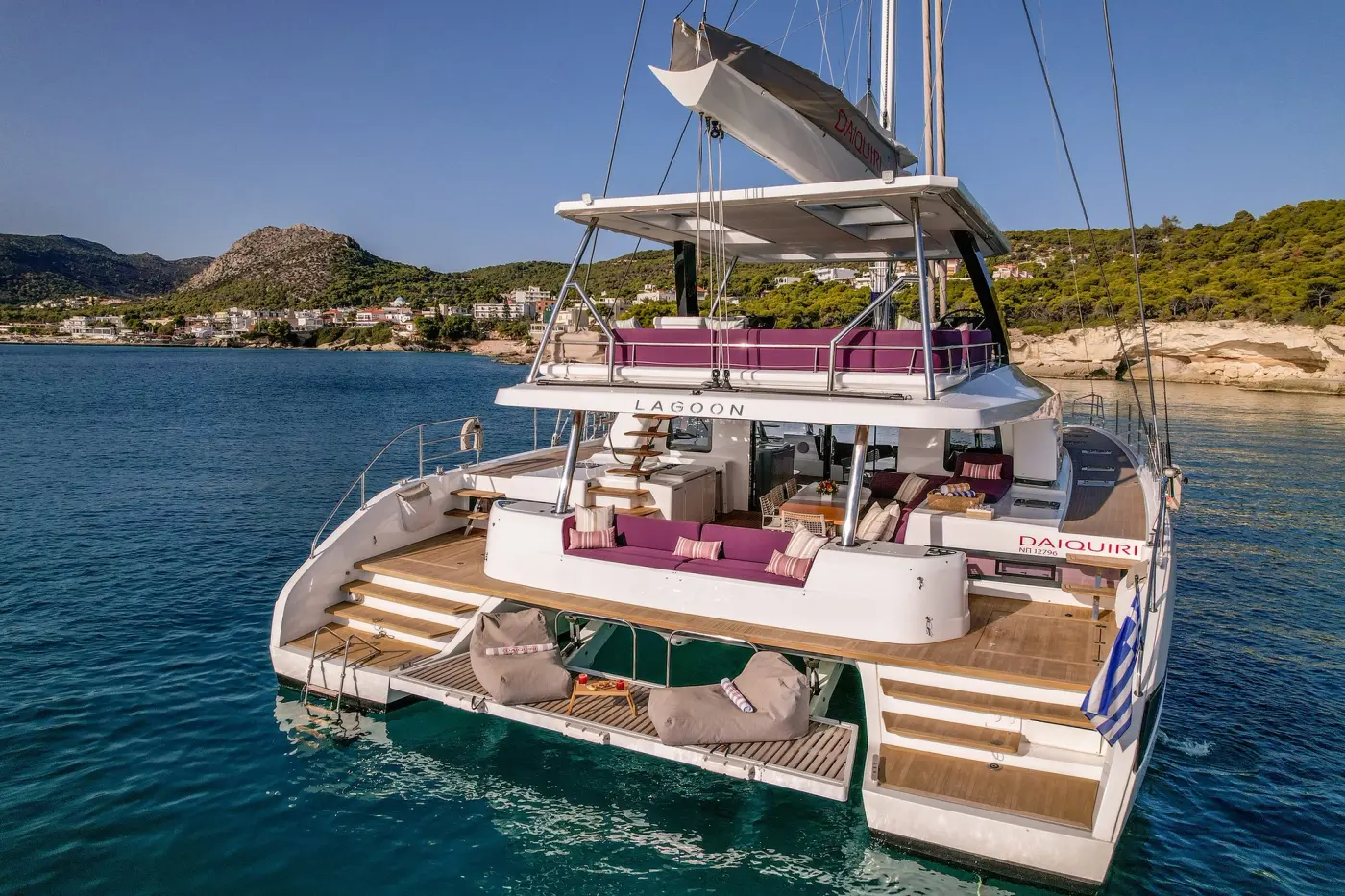
Most of the people who write to me land in Athens, and sooner or later most of them ask the same thing. Which islands are close? Some have two free days at the end of a business trip. Some are planning a week and do not want to spend it under way. Some have simply looked at a map of Greece, counted more than two hundred inhabited islands and wondered where to start. I work on this coast. The yachts this house arranges leave from the marinas of the Athens shore, and on a clear morning the first of these islands is in plain sight from the dock. So I have set them out the way I set out ten summers of wind and ten years of sea temperature: numbers first. How far each island is in sea miles, how long the ferry takes, how long a yacht takes, how hard the wind blows on a July afternoon and how warm the water is in August. Then what each island is like when you step ashore, which no table can tell you.
Which Greek islands are closest to Athens?
Seven islands lie within 50 nautical miles of the Athens marinas. Five are in the Saronic Gulf, the sheltered water south-west of the city: Aegina, Agistri, Poros, Hydra and Spetses. Two are the first of the Cyclades, east of Cape Sounion: Kea and Kythnos. A nautical mile is 1.15 land miles, or 1.85 kilometres, so the nearest of the seven is about 20 land miles from the dock and the farthest under 60.
| Island | Sea miles from Athens | Fast ferry | Motor yacht at 20 knots | Sailing catamaran at 9 knots |
|---|---|---|---|---|
| Aegina | 18 | 40 minutes from Piraeus | About 55 minutes | 2 hours |
| Agistri | 21 | 55 minutes from Piraeus | About 1 hour | 2 hours 20 minutes |
| Poros | 30 | About 1 hour from Piraeus | 1 hour 30 minutes | 3 hours 20 minutes |
| Hydra | 35 | 1 hour 10 to 2 hours from Piraeus | 1 hour 45 minutes | Just under 4 hours |
| Kea | 35 | About 1 hour from Lavrio | 1 hour 45 minutes | Just under 4 hours |
| Kythnos | 45 | 1 hour 40 to 2 hours from Lavrio | 2 hours 15 minutes | 5 hours |
| Spetses | 50 | 2 to 3 hours from Piraeus | 2 hours 30 minutes | 5 hours 30 minutes |
Sea distances in nautical miles from Alimos marina, Athens, rounded, along the track a yacht takes. Ferry times are typical summer crossings and vary by operator, stops and season. Yacht times are the distance divided by the cruising speed. Compiled by George Yachts, November 2026.
Two notes on reading it. Ferries to the Saronic islands leave from Piraeus, the port of Athens. Ferries to Kea and Kythnos leave from Lavrio, on the far side of Attica, about an hour by road from the centre of the city. That is why Kea, exactly as near as Hydra on the chart, feels farther to anyone travelling by car and ferry. A yacht does not make that drive. She rounds Cape Sounion under the Temple of Poseidon, and Kea is the first island on the bow.
What is the closest island to Athens?
Strictly, Salamina. It lies so close to the western suburbs that the car ferry from Perama takes about a quarter of an hour, and Athenians think of it as part of the city more than as an island to visit.
Of the islands people travel to, the closest is Aegina: 18 nautical miles from the Athens marinas, 40 minutes from Piraeus by fast ferry and about an hour and a quarter on the conventional one. Agistri sits just behind it, three miles farther on.
How long does it take to reach each island, by ferry and by yacht?
By fast ferry, between 40 minutes and three hours. By yacht, between one hour and five and a half, depending on the yacht far more than on the island.
That difference is worth a moment, because it decides which yacht belongs on which water. A motor yacht cruising at 20 knots is at Hydra in an hour and three quarters and can be at Kythnos for a late lunch. She is wasted on the 12 miles between Poros and Hydra. A sailing catamaran at 9 knots turns those same 12 miles into a morning under sail with a swim at the end of it, which is the whole point of these islands. The distances choose the boat, not the brochure.
They also shape the first evening. A crewed week from Athens boards at five in the afternoon. With 18 miles to run, in summer the anchor can be down off Aegina before the sun sets on the first day, and nobody has spent a holiday day travelling. How a week from Athens begins covers the marinas, the boarding hour and the first night in detail.
Which islands near Athens have the calmest sea?
The Saronic islands, and by a wide margin. I counted the wind hour by hour across ten summers, 2016 to 2025, for the middle of the Saronic Gulf, for the water around Hydra and Spetses, and for the sea around Kea and Kythnos.
| Waters | July afternoon wind | July and August days with an hour of 22 knots | August sea | Sea at 22°C or warmer |
|---|---|---|---|---|
| Aegina, Agistri and Poros | 8.0 knots | None in ten summers | 26.6°C (80°F) | 8 June to 4 November |
| Hydra and Spetses | 7.6 knots | None in ten summers | 26.3°C (79°F) | 7 June to 2 November |
| Kea and Kythnos | 14.1 knots | About one day in four | 25.2°C (77°F) | 14 June to 25 October |
| Mykonos, for comparison | 17.1 knots | About one day in three | 24.4°C (76°F) | 19 June to 12 October |
Wind: ERA5 reanalysis, hourly wind at 10 metres over open water, 2016 to 2025. Sea: NOAA Optimum Interpolation Sea Surface Temperature version 2.1, 2016 to 2025. Analysis by George Yachts.
Twenty-two knots is where Force 6 begins, the strength at which most guests stop enjoying a passage. In the middle of the Saronic, across 620 July and August days, the record does not show a single hour of it. A July afternoon there averages 8 knots, a gentle breeze, and 85 mornings in 100 stay under 11.
Kea and Kythnos are different water. They sit east of Cape Sounion, in the path of the Meltemi, the northerly that rules the Aegean summer. A July afternoon averages 14 knots, and across July and August about one day in four brings an hour of 22. The count swings from year to year, from 8 such days in the calmest of the ten summers to 26 in the windiest. That is still gentler than Mykonos, and a good captain simply picks the morning for the crossing.
What I take from this as a broker is that Athens is a forgiving place to start. On the first morning the captain can turn the bow either way. If the Aegean is blowing, the week begins in the Saronic and nobody on board ever knows there was a decision.
Where is the sea warmest near Athens?
In the Saronic, which in July is the warmest of the twelve Greek waters I measured. Off Aegina the sea averages 26.6°C (80°F) in August. It passes 22°C around 8 June and stays above it until the first days of November, about 150 days. Around Hydra and Spetses the figures are within half a degree of that.
Kea and Kythnos run about a degree and a half cooler in August, at 25.2°C (77°F), because the same wind that fills the sails stirs the surface. Their season at 22°C or more runs from the middle of June to late October, 134 days.
Autumn is the part people do not expect. October water off Aegina averages 23.5°C, which is warmer than the Atlantic off Long Island in August.
Which island near Athens is best for a day trip?
Aegina or Hydra, for different reasons.
Aegina, because it is the nearest and it fills a day without effort: a temple on a hill, a working harbour front, and lunch on the water at Perdika. Hydra, because no other harbour in Greece looks like it, and at 1 hour 10 to 2 hours each way it is just within reach. Agistri is the choice if the only plan is to swim. Poros is possible in a day. Spetses, Kea and Kythnos are too far to enjoy on a return ticket and deserve a night.
There is also the one-day cruise. Boats leave the Athens coast every morning in season and call at Hydra, Poros and Aegina in one long day, with a short stop at each. It is a fair way to see three harbours if a day is all you have.
I should be plain about one thing. This house does not arrange day trips. We arrange crewed yachts by the week. For a single day the ferry is the right tool, and I would sooner tell you so than sell you something else.
Aegina, 18 miles: the nearest
Aegina is where Athens goes for lunch. It was briefly the first capital of modern Greece, and the town still has the neoclassical front to show for it. On a pine ridge above the east coast stands the Temple of Aphaia, built around 500 BC and one of the best preserved in the country. The island grows the pistachios it is known for, and you will be offered them everywhere.
By yacht the stop is usually Perdika, a fishing village on the south-west corner with tavernas along the quay, or the islet of Moni opposite, where the water is clear over sand and the pines come down to the shore. The anchorages of Aegina are set out one by one.
Agistri, 21 miles: pine trees and clear water
Agistri is small, green and quiet, an island of pine woods and a few villages, a few miles west of Aegina. People come for the water, which is some of the clearest in the gulf, and for very little else, which is its charm. A ferry passenger sees the two harbours. A yacht goes round to the coves of the west and south coasts and stays for the afternoon. See where a yacht anchors at Agistri.
Poros, 30 miles: the channel
Poros is two islands joined by a bridge, and its town faces the Peloponnese across a channel a few hundred metres wide. Arriving by sea is the event: the yacht turns in from the gulf, the channel narrows, and the white town climbs to its clock tower directly above the quay. The bays to the west of the town are wooded, sheltered and calm at night. The Poros anchorages are among the easiest in Greece, which makes Poros a favourite second night for families.
Hydra, 35 miles: the island with no cars
Hydra has no cars and no motorbikes. Everything that moves on the island is carried by mule, by hand or by water taxi, and the silence that follows from that is the first thing visitors notice. The harbour is a horseshoe of grey stone mansions built by the sea captains and merchants of the eighteenth and nineteenth centuries. Leonard Cohen bought a house here in 1960, and painters and writers have been coming ever since.
The harbour is small and fills early in summer, so the captain plans the arrival. Many yachts lie instead in the bays just along the coast and send guests in by tender. Mooring and anchoring at Hydra explains the options. One piece of advice from experience: stay the night. By early evening the day boats have gone, and the harbour belongs to the people sleeping there.
Between Hydra and the mainland lies Dokos, almost uninhabited, with a deep bay that is one of the quietest overnight stops near Athens. Only a boat gets you there. The Dokos anchorage has its own page.
Spetses, 50 miles: carriages and sea captains
Spetses is the farthest of the Saronic five and the most elegant. Private cars are restricted in the town, so people move by horse-drawn carriage, bicycle and scooter. The island sent its ships to the Greek War of Independence, along with the most famous woman of that war, Laskarina Bouboulina, whose house is now a museum. The Old Harbour still has working boatyards where wooden caiques are built by hand, and every September the island restages a sea battle of 1822 with fireworks.
It is two to three hours by fast ferry, which keeps the crowds lighter than at Hydra. On a yacht it is the natural turning point of a Saronic week. The Spetses anchorages include the pine-backed bays of the south and west coasts.
Kea, 35 miles: the first of the Cyclades
Kea is the Cycladic island that Athenians keep for themselves. It is an hour from Lavrio by ferry and little known to visitors from abroad, partly because its ferries leave from Lavrio and not from Piraeus. The hill capital, Ioulida, has no cars in its lanes, and a short walk beyond it a stone lion, carved around 600 BC, smiles out of the hillside. Old stone footpaths cross the island to bays that have no road.
For a yacht leaving Athens for the Cyclades, Kea is the first night: the sheltered inlet of Vourkari, with a row of fish restaurants on the quay. The Kea anchorages cover the rest.
Kythnos, 45 miles: the beach with sea on both sides
Kythnos is low, bare and unhurried, the next island south of Kea. It has the picture that sells the western Cyclades: Kolona, a strip of sand that joins an islet to the shore, with a bay on either side of it. There is no village and no proper road, so most of the people on that sand arrived by boat. At Loutra, on the east coast, hot springs run into the sea beside the harbour.
A yacht anchors in the bay at Kolona, and with a little luck has it nearly alone after the afternoon boats leave. The Kythnos anchorages show the alternatives when the wind is up.
Can you see several islands near Athens in one trip?
Yes, and they are arranged for it. By ferry, Aegina and Agistri pair naturally, and Poros, Hydra and Spetses sit on one line from Piraeus, so two or three islands in four or five days is easy.
By yacht the five Saronic islands make a full, unhurried week, in legs of 12 to 25 miles between them, with room for Dokos and for an evening at the ancient theatre of Epidaurus, a short drive from its anchorage. I have written about this ground twice: whether the Saronic is right for a yacht charter, with the costs and the yachts, and the Saronic programme that starts where you land, day by day.
A week can also face east. Kea on the first night, Kythnos on the second, and the rest of the western Cyclades beyond them.
Is it better to see the islands near Athens by ferry or by yacht?
They are different trips, and I would not pretend otherwise.
The ferry is fast, frequent and inexpensive. It runs from town to town on a timetable, and it shows you the harbours. For one island and a hotel, it is all you need.
A yacht shows you what lies between the harbours. The islet off Perdika, the wooded bays of Poros, Dokos, Kolona before the day boats arrive. She leaves when your family is ready and stays as long as the swim is good. And she lets you be in Hydra at night and gone before the first ferry lands. The price of that is real: a crewed yacht in Greece starts from EUR 17,000 for the week, for the yacht and her crew, before provisions, fuel and tax. The full cost breakdown shows every line.
When is the best time to visit the islands near Athens?
June and September. In both months the sea is warm, 23°C by the middle of June and 25.7°C through September off Aegina, the wind is light and the harbours have room.
July and August are hot, busy and perfectly good, with one piece of local knowledge. Athens empties onto these islands every weekend. Hydra, Aegina and Kea are different places on a Saturday in July than on a Tuesday, so if you can choose your days, go midweek. October is the quiet secret: through the first half of the month the sea is still at 23.5°C or more, and you will share Hydra with the people who live there. The month-by-month guide sets out the whole season.
How would I choose?
- One free day: Aegina by fast ferry, with lunch at Perdika.
- Two days: Hydra, and sleep there.
- A family week in the calmest, warmest water in Greece: the five Saronic islands on a sailing catamaran.
- A week with more sea in it: Kea and Kythnos first, and the Cyclades opening beyond them.
- Dates in May or October: the Saronic, where the water is warmest at both ends of the season.
Where do these numbers come from?
The distances are sea miles from Alimos marina to each island, rounded, measured along the track a yacht takes and not in a straight line over land. The ferry times are the typical summer crossings published by the ferry companies, checked in November 2026. They change with the operator, the number of stops and the season, so confirm the timetable before you travel. Yacht times are simple arithmetic and assume flat water, which in the Saronic is a fair assumption.
The wind figures come from ERA5, the reanalysis of the European Centre for Medium-Range Weather Forecasts, hour by hour for May to October, 2016 to 2025. The sea temperatures come from the NOAA satellite record for the same ten years. Both describe open water near the islands named, not a particular cove. I am a broker, not a meteorologist. What I can add is what the numbers mean for a week on the water.
If that week is the one you are planning, the Athens yacht charter page shows the yachts that leave from here. Or write to me with your dates, who is coming and how much sea you want in the week, and I will tell you honestly which of these islands I would put in it and which yacht. I answer myself, usually the same day. WhatsApp +1 786 798 8798, george@georgeyachts.com, or the contact page. George P. Biniaris, Founder and Managing Broker, George Yachts Brokerage House, Athens.


