
There is a question I am asked more than any other, and it is almost never asked plainly. It arrives dressed as something else. We are thinking about next summer, is it too early to talk? Or, more often, with a note of apology in it: I know this is probably ridiculous, but we are already looking at 2027.
It is not ridiculous. It is the single most useful thing a charterer can do, and the people who do it are rarely the anxious planners you might imagine. They are the ones who have chartered before, learned what a good week feels like, and discovered that the yacht they fell in love with was not available the second time they asked for her.
So let me answer the question properly, with numbers rather than instinct. Some of those numbers come from my own desk, and I will be precise about what they do and do not prove.
How far in advance should you book a Greek yacht charter?
For a peak summer week in Greece, book nine to fourteen months ahead. That means late 2026 for summer 2027. For June or late September, six to nine months is usually enough. For May or October, three to four months will still give you a real choice. And if you need five or six cabins in any month at all, treat the long end of every one of those ranges as your deadline rather than your comfort zone, because the yachts that sleep ten or twelve are the scarcest thing in this market.
Those are the working rules I give clients. They are not the rules you will read elsewhere, which tend to compress everything into a cheerful six months. Six months is fine if your dates are flexible, your group is four to six people, and you do not much mind which yacht you end up on. If any one of those three is untrue for you, six months is late.
The reason is not scarcity in the abstract. Greece has a large charter fleet and it grows every year. The scarcity is specific: a particular yacht, in a particular week, with a crew you would happily spend seven days with. There is exactly one of those, and she can only be sold once.
What are people actually doing right now for 2027?
They are already booking. In the ten weeks between 30 May and 5 August 2026, thirty nine charter requests came across my desk. Thirty four of them named dates. Ten of those thirty four, close to three in ten, were not for the summer happening around us. They were for 2027.
What interests me more is how far ahead those ten were looking. The shortest lead time among them was 317 days. The longest was 451. The middle of the group sat at 394 days, a little over thirteen months. Not one of the ten arrived with less than ten months of runway. There was no gradual curve and no tail of people testing the water eight months out. The 2027 enquiries came as a distinct cohort, and every one of them came early.
Let me be exact about what that does and does not show, because I would rather be useful than impressive. This is one boutique house across ten summer weeks, not an industry survey, and thirty four is a small number. A window sitting inside the 2026 season will naturally catch short notice enquiries for 2026 and only long lead ones for 2027, so I will draw no conclusion whatsoever from comparing the two years against each other. That comparison would describe when I was looking, not how people behave.
What the numbers do show is narrower and, I think, more useful. The 2027 market is not a future event. It is happening now, and the people in it are not casually browsing. They are more than a year out and they are asking for named weeks. If you plan to start looking in the spring, it is worth understanding who you will be standing behind when you do.
The months they asked for were exactly the ones you would expect. Three requests for September, two each for June, July and August, one for late May. Group sizes ran from a couple travelling alone to a party of twenty two. The scarcity conversation, as always, was loudest at the top of that range.
Why does the Greek charter calendar move in autumn, not in spring?
Because that is when the owners move. A charter season has a quiet season of its own, and it runs from roughly October to January. That is when owners review how their year went, set next season's rate card, decide how many weeks they want to keep for their own families, and open the calendar to brokers.
The order in which those weeks are offered is neither secret nor sinister. It is simply human. The first call goes to the guests who chartered that yacht last year and left the crew glowing. The second goes to the brokers who have kept a genuine relationship with the owner or the central agency all year, and who arrive with a named client and a real brief rather than a speculative enquiry. Only after that does a week reach the open market.
This is why the calendar feels strange from outside. In April, a charterer searches, finds that all three yachts they liked are unavailable for the second week of August, and concludes that Greece is overbooked. Greece is not overbooked. Those three weeks were spoken for in November, by people who had said in October what they wanted.
It is also why I spend my autumn the way I do. Between October and January I am not selling. I am watching the curated list, ninety one crewed yachts I know first hand, as their 2027 rate cards land and their weeks open, and matching them against briefs I already hold. A brief in my hands in October is worth more to my client than a signed enquiry in April, and it costs them nothing to give me.
Which 2027 weeks will actually run out, and which never do?
Late July and the whole of August will go first, as they do every year, and the reason is structural rather than fashionable. European school holidays land there, the sea is at its warmest, and every family with children is pointed at the same fortnight. If your dates are set by a school calendar, you are competing with everyone else whose dates are set by a school calendar. Those are the weeks to secure a year out, and I would rather tell you so in August 2026 than apologise for it in March 2027.
Early September is the month I argue for hardest, and it fills faster now that the argument has spread. The sea holds the summer's heat, the Meltemi loses its temper, and the crowds vanish within days of the month turning. It used to be the connoisseur's secret. It is now the month adult groups and couples quietly compete for.
June is the value nobody talks about: long daylight, warm air, water that has not quite caught up, and rates a genuine step below peak. There is usually still room in June well into the spring.
And then there are the weeks that essentially never run out. Late May, early June, the second half of October. If your dates are truly flexible and your priority is the water rather than the calendar, you can book those three or four months ahead and still choose from a real shortlist. I say this plainly because the alternative is pretending every week in Greece is a scramble, and it is not. The month by month guide walks the whole year honestly.
Does the answer change if you need five or six cabins?
It changes completely, and this is what most first time charterers discover too late. Cabin count is the hardest constraint in the market, and supply falls off a cliff at the top.
Look at my own fleet, which is a fair sample of the good Greek boats. Of ninety one crewed yachts, forty have four cabins. Forty two have five. Three have three. And six yachts, out of ninety one, have six, one of them a 64 metre ship.
Read that last figure again, because it is the whole point. If you are twelve people who each want a cabin, you are not choosing between dozens of yachts. You are choosing between a handful, and every other party of twelve in Europe is choosing between the same handful, in the same fortnight in August. That is why a six cabin request twelve months out is a comfortable conversation, and the same request four months out is usually a disappointing one.
Four and five cabin yachts are a different world. With forty and forty two boats respectively, a party of eight or ten has genuine depth of choice, at rates running from around seventeen thousand euros a week at the accessible end of the sailing catamarans up through the low forties for the newest and most spacious. Even there, though, the particular boats people fall in love with are booked first, and love is not a fungible commodity.
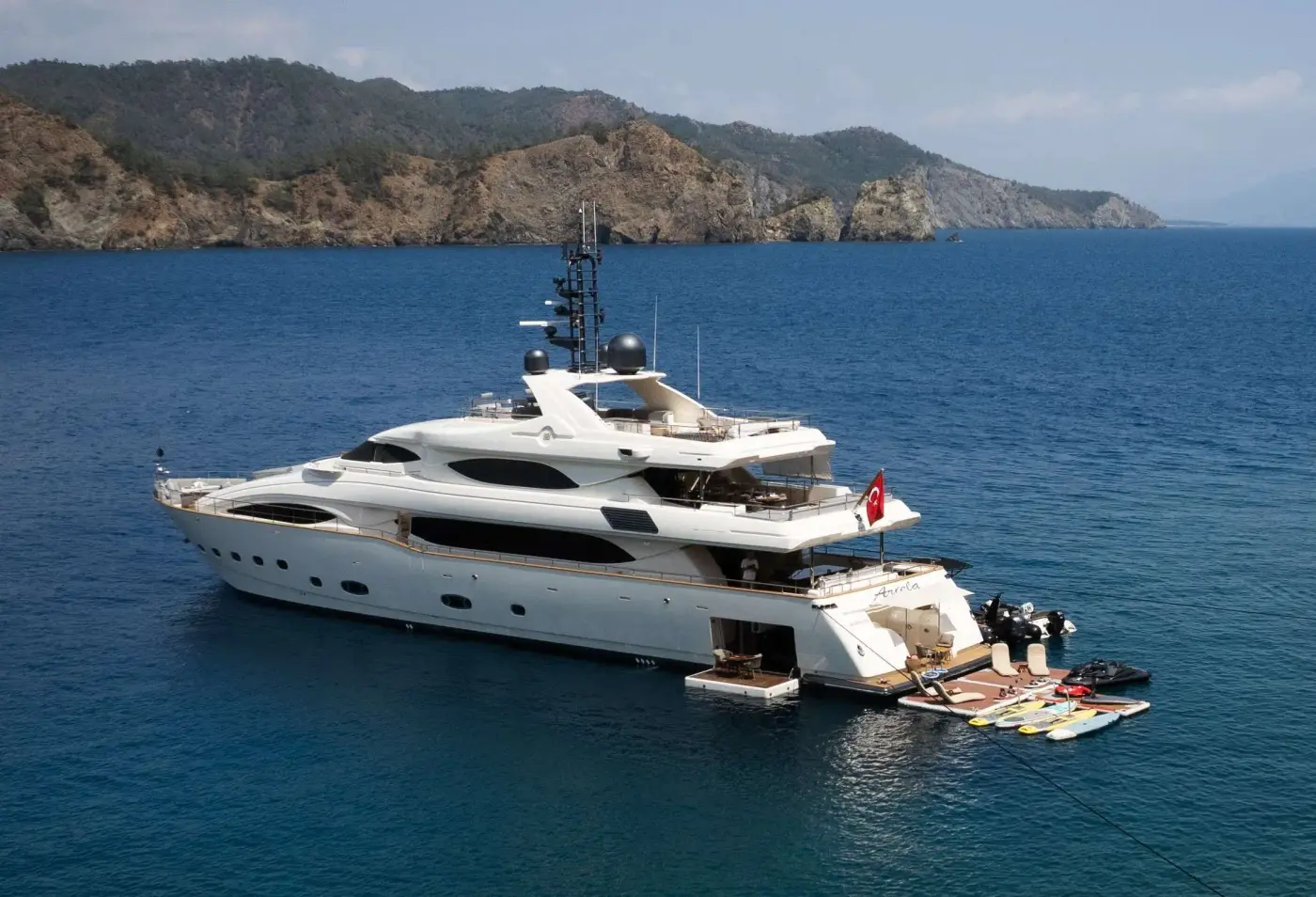
Kintaro is one of those six: a 38 metre Cantieri di Pisa carrying twelve guests in six cabins with a crew of seven, at eighty five to one hundred and ten thousand euros a week plus expenses, VAT and APA. There is no version of this market in which a yacht like her has August 2027 sitting quietly available next spring. If she is the shape of what your group needs, the useful month to say so is this one.
Does the type of yacht change how early you should book?
It does, and the reason is again supply rather than fashion. My ninety one yachts break down into thirty sailing catamarans, fifteen power catamarans and forty six motor yachts, with six crewed sailing monohulls quoted separately. Those are four quite different markets sitting inside one fleet, and they do not fill at the same speed.
Sailing catamarans are the deepest pool and therefore the most forgiving. If you want four cabins, stability at anchor and a crew of two or three, you have real choice later into the year than anyone else does. That is exactly why they suit first time charterers and families, and why I recommend them so often.
Motor yachts behave differently. Seventeen boats is a healthy number, but motor yacht clients tend to want particular things, speed to cover islands, a flybridge, a specific length, and the boats that combine them are few. A motor yacht week in August is a year ahead conversation more often than a catamaran week is.
Power catamarans are the newest and fastest growing category in Greece and, at twelve boats, still the thinnest. They offer the catamaran's space and stability with a motor yacht's pace, which is a combination a lot of people want once they understand it exists. Demand is outrunning supply in this category more visibly than in any other, so if a power catamaran is what you have in mind, be early by instinct.
One last practical point, because it is asked constantly. You cannot informally reserve a week. Formally holding dates requires a signed contract and a deposit, and no serious owner will block a peak week on the strength of a conversation. What a broker can genuinely do for you is be first in the queue when the calendar opens, which is precisely why the autumn brief matters so much and why it costs you nothing to give one.
What does booking a year in advance actually cost you?
Money, committed early. This is the honest counterweight and I will not soften it. A Greek crewed charter runs on the MYBA agreement, and MYBA is normally paid in two instalments: typically fifty percent of the charter fee shortly after signing to hold the dates, and the balance plus VAT and APA roughly thirty days before you board. Sign in November for the following August and you have parted with half the charter fee nine months before you smell the sea.
You should also understand the cancellation position before you decide rather than after. Under the standard agreement you may give notice at any time before the charter starts, and the owner keeps the instalments that have fallen due by that point. Pull out early and that is the first fifty percent. There is a fairness valve, in that the owner carries a duty to try to re-let the week and to account to you if they succeed, but never sign expecting the valve to save you. Book the week you intend to take.
Rates, meanwhile, are not the reason to book early, and I want to be very clear about this because the phrase early bird gets used carelessly in my industry. Serious owners rarely discount weeks that will sell anyway, and a yacht that will fill August at her rate card has no commercial reason to reward you for asking sooner. What you buy with time is not a lower price. It is first choice: the yacht you actually want, in the week your family can actually travel, with a crew whose references you have had time to check. Occasionally an owner does open a season with a genuine early rate, and when that happens I say so and pass it on. I do not build the case for planning ahead on top of it.
The last real cost is optionality. Life happens across thirteen months. Jobs change, teenagers acquire opinions, a grandparent becomes fragile. If your circumstances are genuinely unsettled, a long lead time turns a holiday into an obligation, and that deserves honest weighing against the yacht you might otherwise miss.
When is booking a year ahead the wrong move?
When your dates are truly open. If you can take any week between the middle of May and the middle of June, or anything after the first week of October, the market will still be offering you good boats three months out and you gain very little by committing early. Flexibility is a form of leverage. If you hold it, use it rather than trade it away.
When you have never chartered before and are not yet sure the format suits you. I would rather sell you a day charter or a short late season week first, and have you come back for the full August fortnight in 2028 knowing exactly what you are buying, than take a thirteen month commitment from someone who is not certain they enjoy being on a boat. A first charter is a real question and it deserves an honest answer.
When your group has not actually confirmed. The most expensive mistake I see is a booking made for eight when only five have said yes. Cabins are the thing you are paying for, and downsizing later is not a phone call, it is a new contract on a different yacht at whatever is left. Count the heads first, then talk to me.
And when the budget is not settled. A charter fee is the beginning of the number, not the end of it. VAT on a weekly crewed charter in Greece runs between roughly five and twelve percent depending on the yacht's certification rather than one flat figure, thirteen percent is the statutory ceiling rather than the normal rate, short and bareboat charters sit at twenty four percent, and on top of the fee sit the APA, the cruising tax, and a crew gratuity that customarily runs ten to fifteen percent of the charter fee entirely at your discretion. If those pieces are not yet real to you, settle them before you commit.
What should you do between now and summer 2027?
If your week is in July or August 2027, or in the first ten days of September, the work happens this autumn. Tell me the month, the group and the mood before the end of October, and let the calendar come to you as it opens. No deposit and no obligation attach to that conversation. It exists so that when the right yacht releases her week, you are the call I make rather than the client I still have to find.
If your week is in June or late September 2027, you have until roughly the turn of the year in comfort, and into February at a push. The best boats thin out through the spring, so earlier is better, but you are not in a race.
If your week is in May or October 2027, or you are genuinely flexible, spring is soon enough. Spend the time instead on the questions that actually shape the week: which sea you want, how much moving you want to do, and whether yours is a sailing catamaran group or a motor yacht group. Those decisions matter far more to your seven days than the date you signed.
And whatever your month, do the dull things now, because they cost nothing and they remove every excuse for delay later. Count the heads honestly, including the ones who will decide in January. Agree the shape of the budget with whoever is paying. Check the passports. Read what the process actually involves so that no step surprises you. Then write to me, and let the autumn do its work.
The short version
Peak summer 2027 is decided in the autumn of 2026, not in the spring of 2027. Six cabins are decided earliest of all, because there are six such yachts on a list of ninety one. Booking early buys first choice rather than a discount, and it costs you half the charter fee held for the better part of a year. If your dates are flexible you may reasonably ignore all of this. If they are not, this is the month.
One last thing the extra months buy you, and it is the one guests thank me for afterwards: time to look properly at the crew. A captain, a chef and a stewardess shape your week far more than the hull does, and each role does something quite specific. Booking early means you choose the people, not just the boat.
Write to me with the month, the group and the mood of the week you have in mind, and I will tell you honestly whether you are early, on time, or already late. I read every enquiry myself, and I answer it personally.
P.S. Since this was written the desk has started publishing its own request log: what one broker is being asked for 2027, month by month, with the lead times, the months and the budgets counted rather than argued.


