
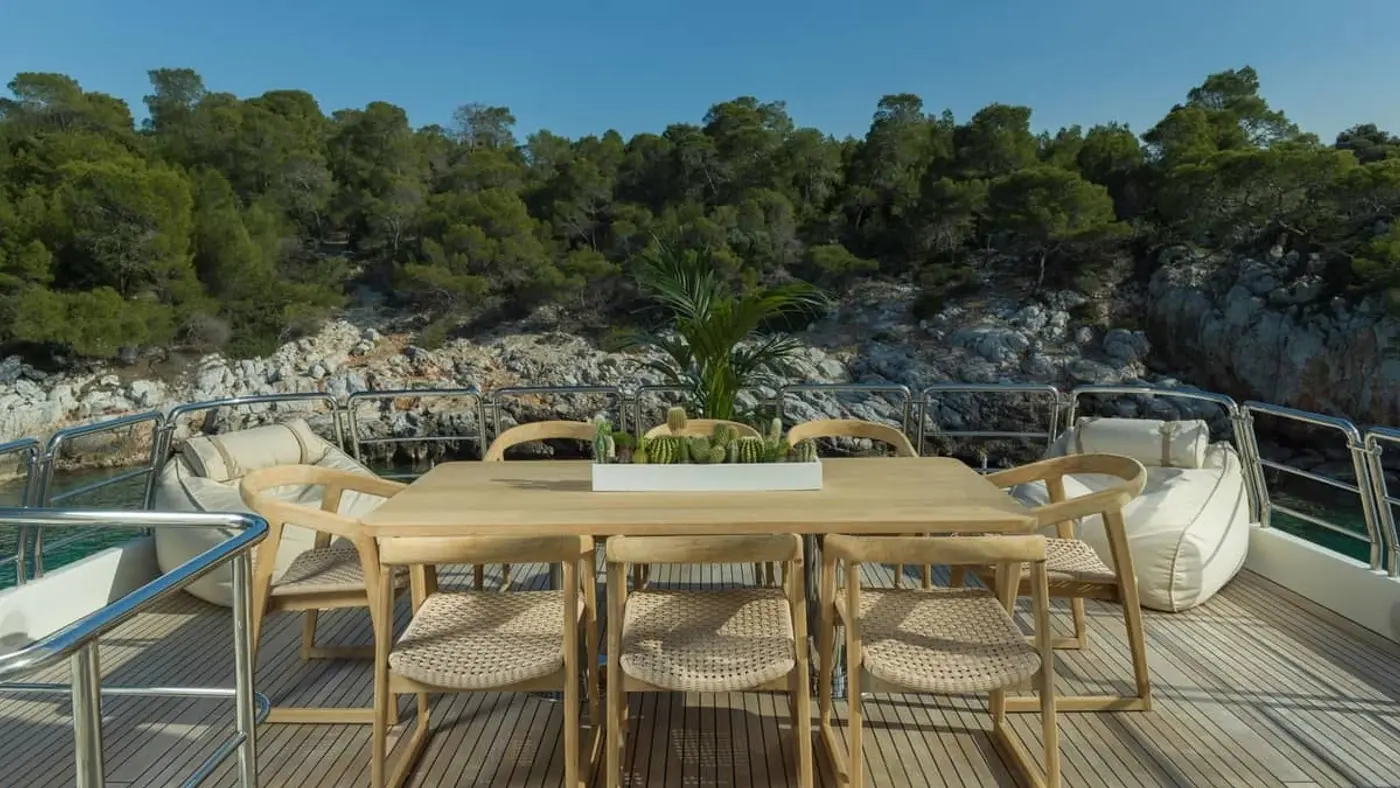
Take a family like this. A couple in their sixties wants to bring everyone: two grown children, their partners, four grandchildren between five and sixteen. They have done the villa. They have done the cruise ship. They want one week where nobody drives, nobody books a table for ten, and the whole family is in the same place at breakfast. They have heard the Ionian is the calm side of Greece, and they want to know whether a yacht can hold three generations without anyone being miserable.
It can, and the Ionian is where I would send them first. But the week works or fails on decisions made months before boarding: which hull, how the cabins are arranged, where the grandparents sleep, how far the yacht moves each day, and who has somewhere quiet to go at four in the afternoon. This is how I plan it, with the yachts, the distances and the money stated plainly.
What is a multi-generational yacht charter, and why does the Ionian suit it?
It is one private yacht, hired by the week with her professional crew, for a family that spans three generations: usually eight to twelve people, from a grandchild in armbands to a grandfather with a new knee. The yacht is priced per yacht per week, never by the head, so the arithmetic does not change whether ten of you come or eight. What changes is how carefully the boat has to be chosen.
The Ionian suits it for reasons that are physical rather than romantic. The islands lie off the west coast of Greece: Corfu, Paxos and Antipaxos in the north, Lefkada, Meganisi, Ithaca and Kefalonia in the middle, Zakynthos in the south. Summer brings an afternoon thermal breeze instead of the Meltemi that governs the Aegean, the water is clearer, and the distances between anchorages are short. On the Ionian page I call it the family charter region, and on the Greek Charter Index Corfu and Lefkada appear among the most requested islands for exactly that reason: sheltered from the Meltemi, growing among families.
For a group that includes a seventy-five-year-old and a six-year-old, short and calm is not a preference. It is the design brief.
How many people can one yacht carry, and what happens above twelve?
Twelve guests is the ceiling on almost every charter yacht in the world, whatever her size. It comes from passenger-vessel law, not from the number of beds, and I explain it in full under the twelve-passenger rule. A 50 metre yacht and a 24 metre catamaran stop at the same number.
On the list I work from today, 91 yachts, the berths fall like this: 42 yachts sleep ten, five sleep eleven and ten sleep twelve. So a family of ten has a wide choice, a family of twelve has ten yachts to choose from, and a family of thirteen has a different problem. Above twelve the honest answer is two yachts sailing in company, which I describe under multi-yacht charters for large groups. It costs more than one larger yacht would, and it is still the only lawful way to do it.
One practical note. Give me the ages of the children in the first message. They shape the cabin plan more than anything else you will tell me.
Catamaran or motor yacht: which hull works for three generations?
Both work. They solve different problems.
A crewed catamaran gives you flat decks with no heel under sail, a saloon and cockpit on one level, and two hulls that put sleeping children a long way from the adults still at the table. A shallow draft lets her anchor close to a sandy beach, which matters when the smallest swimmers are five. Catamarans hold particularly well in the Ionian because the wind does not fight you, and I place more of them here than in the Cyclades. The full picture is on crewed catamaran charter in Greece, and the motor-driven version, faster between islands and just as stable at anchor, on power catamaran charter.
A motor yacht above 30 metres gives you something a catamaran cannot: separate zones. A sundeck for the teenagers, a shaded aft deck for the grandparents, a saloon nobody has to cross to reach a cabin, and more crew to run two kinds of service at once. For multi-generational groups of eight to twelve I usually point toward a 30 to 40 metre motor yacht for that reason, and the rates by size are on weekly motor yacht charter.
The format I steer three generations away from is the sailing monohull. She heels, the companionway is steep, and the cockpit is one shared space. A wonderful week for six sailors. A long one for a grandmother.
Where do the grandparents sleep?
This is the question that decides the yacht, and it is the one most families ask last.
Guest cabins on most motor yachts sit on the lower deck, down a flight of stairs. For many grandparents that is fine. For some it is the difference between a holiday and an ordeal, repeated six times a day. So I look first for a master cabin on the main deck, the same level as the saloon and the aft deck, with no stairs between bed and breakfast.
Three yachts on my list document exactly that. M/Y IDYLLE, a 36.8 metre Benetti refitted in 2024, carries what her own page calls the layout families ask for most: a master cabin on the main deck, ten guests, a crew of seven, from EUR 59,900 a week. M/Y BROOKLYN, 37 metres, has a full-beam master on the main deck and two twin cabins, one of which converts to a double, from EUR 60,000. M/Y NAIA, a 38.5 metre Sanlorenzo, puts the master on the main deck with a fold-down balcony, from EUR 135,000.
On a catamaran the geometry is kinder by nature: every cabin is a few steps below a single-level living space. It is not step-free, and I will not pretend it is, but it is the shortest staircase in yachting.
If someone in the family uses a wheelchair or cannot manage steps at all, tell me at the first message. No yacht on my list documents a passenger lift, boarding is by passerelle or by tender, and I would rather design around the truth than discover it in Lefkada.
How many cabins does a family of ten or twelve really need?
Five cabins for ten is the standard answer, and 42 yachts on the list have five cabins. The better question is which five. Three couples and four children do not want five identical doubles. They want doubles for the adults and twins for the children, so nobody's teenage sons share a bed.
The yacht records tell you this if you read them closely. P/CAT Crazy Horse, a 23.8 metre Lagoon 78 with five crew, is laid out as one king, two queens and two twins. S/CAT World's End, a 19 metre Galathea 65 from EUR 20,500, is one king, three queens and one twin. Those twin cabins are the children's rooms, and they are why the same family fits one yacht comfortably and another awkwardly.
Six cabins is rarer. Six yachts on the list have them, and one of those is a 64 metre ship for 49 guests, which is a different kind of week. The five that matter here are M/Y SUMMER FUN, P/CAT ChristAl MiO 80, M/Y CAN'T REMEMBER, M/Y KINTARO and M/Y KOKOMO NIGHTS. KINTARO's page puts the case better than I can: most 38 metre yachts offer five cabins and reach twelve guests by counting a convertible, while six doors mean a family and the grandparents without anyone sharing. CAN'T REMEMBER goes further. One of her six staterooms is a playroom with bunk beds, a rarity in Greek charter, and her record notes a medical assistance programme that keeps a doctor reachable around the clock. With three generations aboard, that line is worth more than another jet ski.
Where does an Ionian family week start?
From Lefkada or from Corfu. Both have airports close by, and both keep the first day short.
Lefkada is the middle of the Ionian and the base I use most for families. Preveza airport is about thirty minutes from Lefkada Marina by taxi, and from the marina everything is a morning away: Ithaca 20 nautical miles, Kefalonia 25, Paxos 50. The options are set out under family charters from Lefkada and catamaran charter in Lefkada.
Corfu is the northern door. Paxos is 35 nautical miles south, and the week turns around Paxos, Antipaxos and the mainland coast before coming home. See family charters from Corfu and catamarans from Corfu.
Here is the part most guides leave out. The crewed fleet in Greece lives mostly in Athens. A yacht's rate attaches to the vessel, not the cruising ground, and an Athens-based yacht reaches the Ionian through the Corinth Canal, with the delivery quoted per yacht on its own line rather than hidden in the week. That is normal, and I will always show you the line. But two yachts on my list already live in the Ionian. P/CAT ARIVA, a 2023 Fountaine Pajot Power 67 with five cabins for ten and four crew, is based in Corfu: in her own words, the Ionian option, no Meltemi, short passages, green islands instead of bare rock, with a draft of 1.15 metres that lets her into the shallow bays. M/Y MANU, an Azimut 68 with four cabins for eight, is based at Zakynthos. A family of ten who choose ARIVA start the week clean, with no positioning from Athens at all.
If you are flying from the United States, the route is a transatlantic flight to Athens or a European hub and a short connection to Corfu or Preveza. I cover the flights, the passports and the first night in the American's guide to chartering in Greece.
What does a realistic Ionian week look like for three generations?
Short legs, long lunches, and one fixed rule: never more than three hours under way in a day, and most days far less.
From Lefkada, the loop I draw most often runs to Meganisi first, the nearest island. Her north-east coast is a run of coves, Port Atheni and Abelike among them, where a yacht anchors with a line ashore and the children are in the water before the crew have finished. Meganisi also has the Papanikolis cave, the second largest sea cave in Greece, 120 metres long, entered by tender at low speed with a torch. Teenagers remember it for years. The details of every bay are in my Meganisi anchorage guide.
Then Ithaca, 20 nautical miles from Lefkada, two and a half hours at a catamaran's eight knots. Frikes still has a waterline of fishing boats. From Ithaca to Kefalonia is 10 nautical miles, a passage shorter than lunch, and Fiskardo is the harbour where the grandparents will want to walk the quay in the evening. Anchorages for both are in the guides to Ithaca and Kefalonia.
On the way home, Atokos: an uninhabited island between Ithaca and Lefkada, part of the Natura 2000 network, with One House Bay, white pebbles, four to six metres over sand, and a single stone chapel. It is the swim the whole family does together. The last night belongs in the south-east of Lefkada itself, at Sivota or in Vlicho Bay, which my Lefkada anchorage guide describes as one of the safest anchorages in the Ionian, mud bottom, protection from every direction. A quiet night before flights matters when the youngest is five.
From Corfu the shape is similar and the names change. Paxos in a morning, with Lakka on the north coast, sand in six to eight metres and twelve metres of visibility from the bow at midday, and Gaios behind its island for the evening walk. Antipaxos for Voutoumi: anchor only, no quay, white pebble and sand in three to six metres, a bay for settled weather and an early arrival, because it is a very popular day-boat beach. Both are covered in the Paxos and Antipaxos guides.
Neither loop tries to see everything. With three generations, the week that works has two or three anchorages where the yacht stays long enough for everyone to find their own corner.
How do you keep a six-year-old, a sixteen-year-old and a seventy-five-year-old happy on the same deck?
You stop trying to keep them together all day. The secret of a multi-generational week is parallel afternoons and a shared table.
Parallel afternoons need equipment and crew. S/CAT Serenissima, the Alegria 67 I describe on the Ionian page as the family catamaran for Meganisi and Ithaca, carries SeaBobs, paddleboards, water skis and two folding bicycles, and her captain guides guests into sea caves and onto beaches you cannot reach by road. While he has the teenagers, the grandparents have the flybridge and the shade. On a motor yacht the separation is built in. M/Y OAK, a 35 metre Benetti with eleven berths and eight crew, is written up on her own page as a yacht for multi-generational family weeks: a crew that can run children's meals and an adult dinner service in the same evening, and a cruising speed that lets grandparents sleep through the passage.
Stillness matters more than speed. A yacht that rolls at anchor sends the oldest and the youngest ashore. Catamarans barely roll at all. Among the motor yachts, eight on my list document stabilisers that work at anchor as well as under way. Five of them have the five or six cabins a large family needs: M/Y SUMMER FUN, whose own record names large American families and multi-generational celebrations as her guests, M/Y PROJECT STEEL, M/Y NAIA, M/Y PAREAKI II and M/Y LA PELLEGRINA 1. PAREAKI II's page describes the point exactly: grandparents can retreat to quiet while the younger crowd is still laughing on deck.
And then the table. One long dinner, every night, cooked by someone who was told in advance that the six-year-old eats pasta, the grandfather avoids salt and the daughter-in-law is vegetarian. The preference sheet you fill in before the charter is where a family week is really won. If the youngest are under ten, I wrote a separate piece on chartering with young children, with the safety equipment each yacht actually documents.
What does the week cost, all-in?
The yacht is priced per yacht per week. On the Greek Charter Index, the classes that carry ten to twelve guests run as follows, net base per week: sailing catamarans of 20 to 22 metres EUR 31,500 to 43,500, of 23 to 24 metres EUR 54,900 to 90,000; power catamarans of 20 to 22 metres EUR 33,000 to 69,000; motor yachts of 26 to 31 metres EUR 35,900 to 75,000, of 32 to 34 metres EUR 49,000 to 125,000, and of 35 to 40 metres EUR 59,900 to 150,000. Smaller five-cabin catamarans begin at EUR 17,000.
The base is the start. On top come the APA, the allowance that pays for fuel, food, drinks and dockage and is returned if unspent, which runs 20 to 30 percent of the base on catamarans and 30 to 40 percent on motor yachts; Greek VAT at the yacht's certified rate, 5.2, 6.5, 7.8 or 12 percent, with 13 percent the statutory ceiling; and a crew gratuity of 10 to 15 percent of the base. Taken together, a catamaran week lands at roughly 1.35 to 1.6 times the base and a motor yacht at 1.45 to 1.7 times.
Applied to the low end of each rate card, that gives a family something to plan with. Serenissima, from EUR 31,500, is about EUR 42,500 to 50,500 all-in. ARIVA, from EUR 34,000, about EUR 46,000 to 54,500, before any delivery because there is none. SUMMER FUN, six cabins for twelve from EUR 45,000, about EUR 65,000 to 76,500. IDYLLE, with her main-deck master, from EUR 59,900, about EUR 87,000 to 102,000. CAN'T REMEMBER, from EUR 80,000, about EUR 116,000 to 136,000. OAK, from EUR 99,000, about EUR 143,500 to 168,500. High-season weeks sit at the top of each card, and an Athens-based yacht adds her delivery line. If you would rather see one fixed number, I explain how that is built under all-inclusive yacht charter.
Families sometimes ask me to divide the total by the head count to compare it with a resort. I understand the instinct, and I still quote the yacht, because that is what you are hiring: one vessel, one crew, one week, the same price whether nine come or eleven.
When should a family book for 2027?
Earlier than feels natural. Multi-generational weeks are tied to school holidays, which means July and August, and those are the weeks the Index shows booking six to twelve months ahead. The yachts a family of ten or twelve actually needs, five and six cabins, a main-deck master, stabilisers at anchor, are a small part of the list, and they go first.
My own desk shows the same thing. In the 2027 demand report, built from the requests I received between the end of May and the middle of September 2026, the typical 2027 request arrived 354 days before the charter. Owners settle the 2027 rate cards in the autumn of 2026. A family that wants the first fortnight of August on a specific yacht should be talking to me before Christmas, and I explain the reasoning in how far in advance to book. The mechanics are simple: a MYBA-standard contract, 50 percent on signing, the balance four weeks before boarding, as set out in how it works.
When is this not the right holiday?
There are families I steer away from this, and it is better said now than in August.
If anyone in the group cannot manage steps at all, a yacht is hard work, for the reasons I gave above. If the family is fourteen and cannot split, the twelve-guest limit makes it two yachts, and some families do not want that. If the grandchildren are in their twenties and want beach clubs and late nights, the Ionian will feel quiet, and the better week is the Cyclades, which I compare honestly in Cyclades or Ionian. If someone suffers badly from seasickness even at anchor, choose a catamaran or a stabilised motor yacht, or choose a villa. And if the real wish is for everyone to do their own thing for a week, a resort with a kids' club does that more cheaply. A yacht is for families who want to be together and need it to be easy.
How do I start?
With four facts: the dates, the number of guests with their ages, anything about mobility or diet that matters, and a figure you are comfortable with all-in. From that I come back with a short list, not a catalogue, each yacht with her cabin plan, her crew, her delivery line if she has one, and the week priced the way it will actually be invoiced. You can see how I work with families on family yacht charter in Greece and the wider crewed fleet on crewed yacht charter in Greece, or simply write to me.
What you are buying, in the end, is a last evening: one long table, the grandfather at one end, the smallest child asleep on a cushion at the other, and nobody in a hurry to be anywhere else. The yacht is only how you get there.


