
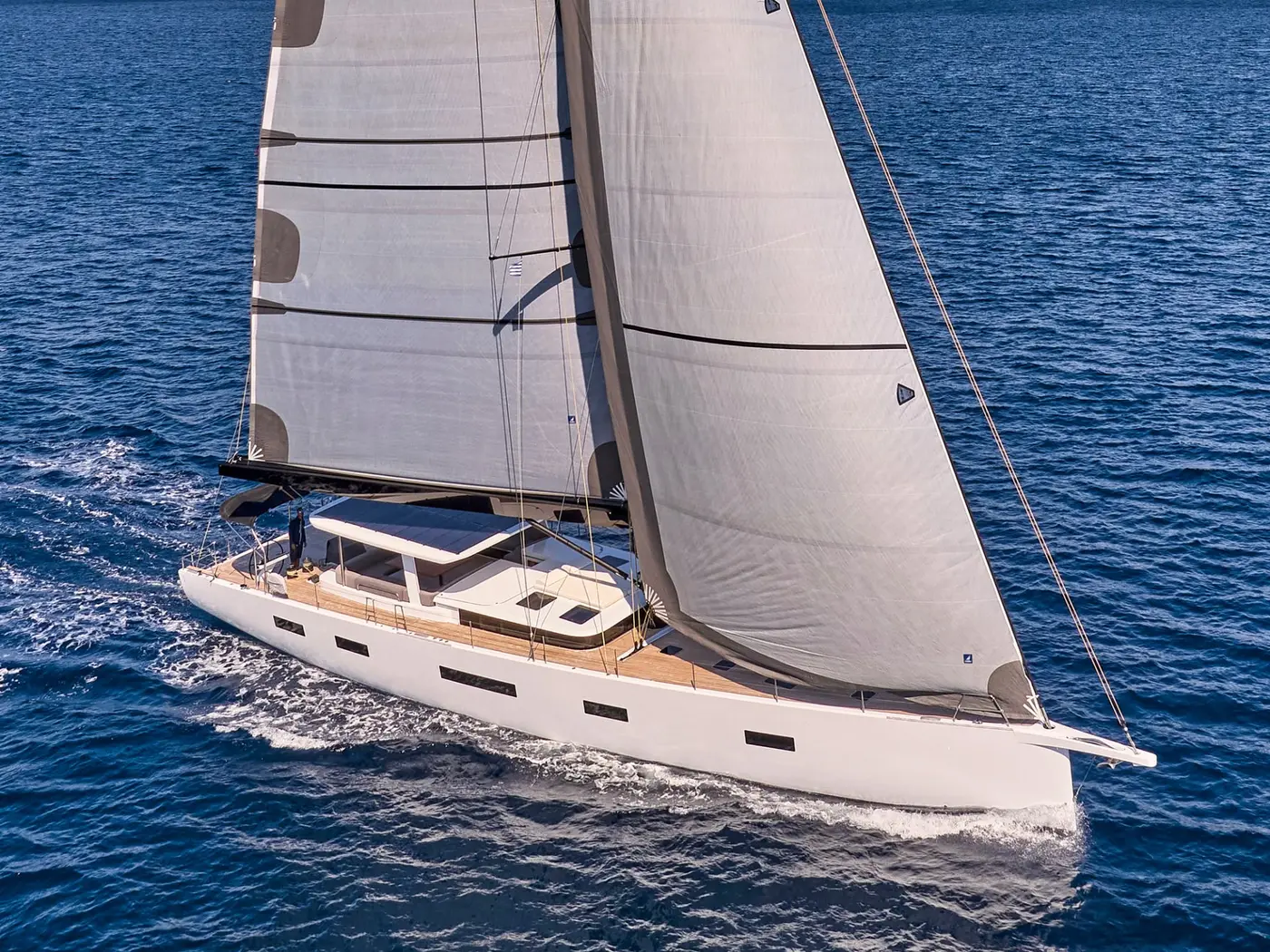
There is a reason the word for it never changed. Greeks have been sailing these waters for four thousand years, and when an American, a Brit or a family from Chicago asks me what a sailing holiday in Greece is actually like, I always give the same answer: it is the country working the way it was designed to work. Greece was built by the sea, for the sea, and a week under sail is the only way to read it in the original language.
This guide is the honest version, written from the broker's chair: what the week feels like, where to go first, what it costs with every line item included, and when sailing is the wrong choice and a motor yacht serves you better. Rates come from the Greek Charter Index and the weeks this house actually books, never from a brochure.
Why is Greece considered one of the best places in the world to sail?
Geography did most of the work. Greece has more than 6,000 islands and islets, of which around 227 are inhabited, scattered across three sailing grounds that behave like three different countries: the Cyclades, the Ionian and the Saronic Gulf. The distances are the secret. Most passages between islands run two to four hours, which means you sail every day without ever spending a day only sailing. You navigate by sight, from one white town on a hillside to the next, the way sailors here always have.
And the water is the kind photographs get accused of exaggerating. It does not need the help. Add roughly 300 days of sunshine a year and tavernas that still grill the day's catch twenty metres from your tender, and you understand why charterers who have sailed the Caribbean and the Balearics keep coming back to the Aegean.
What is sailing in Greece actually like, day to day?
The rhythm settles in by the second morning. You wake in a bay with coffee on deck and swim before breakfast in water you can see the bottom of. Mid-morning the crew raises sail and you make a passage of two or three hours, long enough to feel the boat lean into the wind, short enough that nobody is counting the minutes. Lunch happens at anchor in a cove the captain chose that morning, not one an algorithm chose last winter. Afternoons are for naps, paddleboards and the second swim. Evenings you are either stern-to on a village quay with the tavernas waiting, or alone in an anchorage watching the light do what Greek light does. I have written the hour-by-hour version of a crewed day if you want the full timetable.
Where should you sail in Greece for the first time?
My honest triage, the same one I give on the phone. First charter with family or anyone nervous about seasickness: the Ionian. It is green, protected and gentle, with afternoon breezes instead of open-sea wind, and Fiskardo and Gaios among the prettiest harbours in the country. Confident group that wants the marquee names and true sailing: the Cyclades, where the wind is real and Mykonos, Paros and Milos sit a morning's sail apart. Short on time or landing late in Athens: the Saronic, where the five-day charter starts where you land and Hydra is three hours from the airport.
For the harbour-by-harbour detail, our anchorage guides cover 48 islands, one page per island, written from seasons on these waters.
When is the best time to go sailing in Greece?
May, June and September, and I say that as a man who sells August. Early and late season give you warm water, empty anchorages and rates 25 to 40% below peak. July and August bring the Meltemi to the Aegean, a dry northern wind that runs 15 to 25 knots through the Cyclades; glorious sailing for people who want to sail, tiring for people who want to sunbathe. The Ionian barely feels it, which is why August families go west. The full comparison lives in the month-by-month guide and the case for the quiet months in the shoulder season piece.
How much does a week of sailing in Greece cost?
Real numbers, per yacht, per week, fully crewed, in euros. Crewed sailing catamarans start at €17,000 base for Summer Star, run through the heart of the fleet at €18,900 to €43,500, and reach €56,000 to €90,000 for the 80-foot flagships. Crewed sailing yachts, the monohulls, start around €24,000 base; a EUR 24,000 base week lands at roughly EUR 30,000 to 34,000 all in once APA and VAT are added, before the crew gratuity. Three honest examples from the live fleet: Libra at €18,900 to €26,900, Nadamas at €35,000 to €41,000, and Genny at €56,000 to €79,000.
What sits on top of base is the same for every yacht in Greece: APA, the provisioning allowance the captain accounts for openly, runs 20 to 40% of base depending on yacht type, with sailing boats at the low end because they burn wind, not fuel. VAT is invoiced at the yacht's certified rate, typically 6.5-12%, never one flat number. A crew gratuity of 10 to 15% of the base rate is customary and always at your discretion. Every line item is dissected in the complete cost breakdown.
Monohull or catamaran: which sailing boat suits Greece?
The two feel like different holidays on the same sea. A monohull like Nadamas heels under the wind and talks to you through the wheel; it is the romantic's choice, the one that smells of teak and tradition, and it slices upwind in a way no catamaran will. A sailing catamaran gives you a flat deck all week, four cabins of identical size instead of a hierarchy, a shallow draft that opens the bays deep keels must skip, and space that makes eight guests feel like five. Families and mixed groups overwhelmingly choose the cat; couples and sailors keep choosing the monohull, and both are right. I wrote a fuller answer in the choosing guide.
What about the food?
Half the reason to sail here, and I say that with a chef in the family tree. On a fully crewed boat the chef shops each morning in whichever harbour you woke in: tomatoes that taste of August, fish that was swimming at dawn, cheese from the island you are looking at while you eat it. Ashore, the quays of Greece remain one of the world's great restaurant rows, and your captain knows which taverna grills the octopus properly and which one merely photographs well. Nobody comes back from a Greek sailing week thinner, and nobody has ever complained about it.
Do you need to know how to sail to charter in Greece?
No, and this is the part first-timers consistently get wrong. On a crewed charter the captain and crew do all of the sailing, the navigation, the mooring and the cooking; your only obligations are appetite and curiosity. If you want to take the helm in open water, every captain I work with will hand it over with pleasure and stand beside you. There is also a middle tier, the skipper-led week, which I have compared honestly against the fully crewed week here.
When is sailing in Greece NOT the right choice?
Three honest cases. If your itinerary is a fixed list of far-apart marquee stops on a schedule, Mykonos Monday, Santorini Tuesday, a sailing yacht will frustrate you: sail moves at seven knots and answers to weather, and the motor yacht comparison exists precisely for you. If anyone aboard is genuinely wind-averse and the dates must be deep August, choose the Ionian or choose a crewed catamaran, whose two hulls flatten both the heel and the argument. And if your party is more than 12 guests, Greek law caps every charter yacht at 12 sleeping passengers regardless of size, so plan two boats sailing together, which is its own kind of wonderful.
How do you plan a sailing route in Greece?
Loosely, on purpose. You and I agree the shape of the week and the one or two fixed points that matter, an arrival, a dinner reservation, a flight home. The captain then reads the forecast each morning and chooses among the options, which is not a compromise, it is the whole craft. For planning appetite there is our distance and time calculator between any two Greek islands, and a worked 7-day Cyclades itinerary with the parts captains usually keep to themselves.
The sailing fleet is open for 2027 and the best weeks of May, June and September are always the first to go. Tell me who is coming and what the sea needs to do for them, and I will put three honest options in front of you within a day.
P.S. If you want the view from above before you choose between sail and power, I have since written yachting in Greece, explained by a broker: the three grounds with their distances, the season, and where each kind of crewed yacht starts on the rate cards.


