
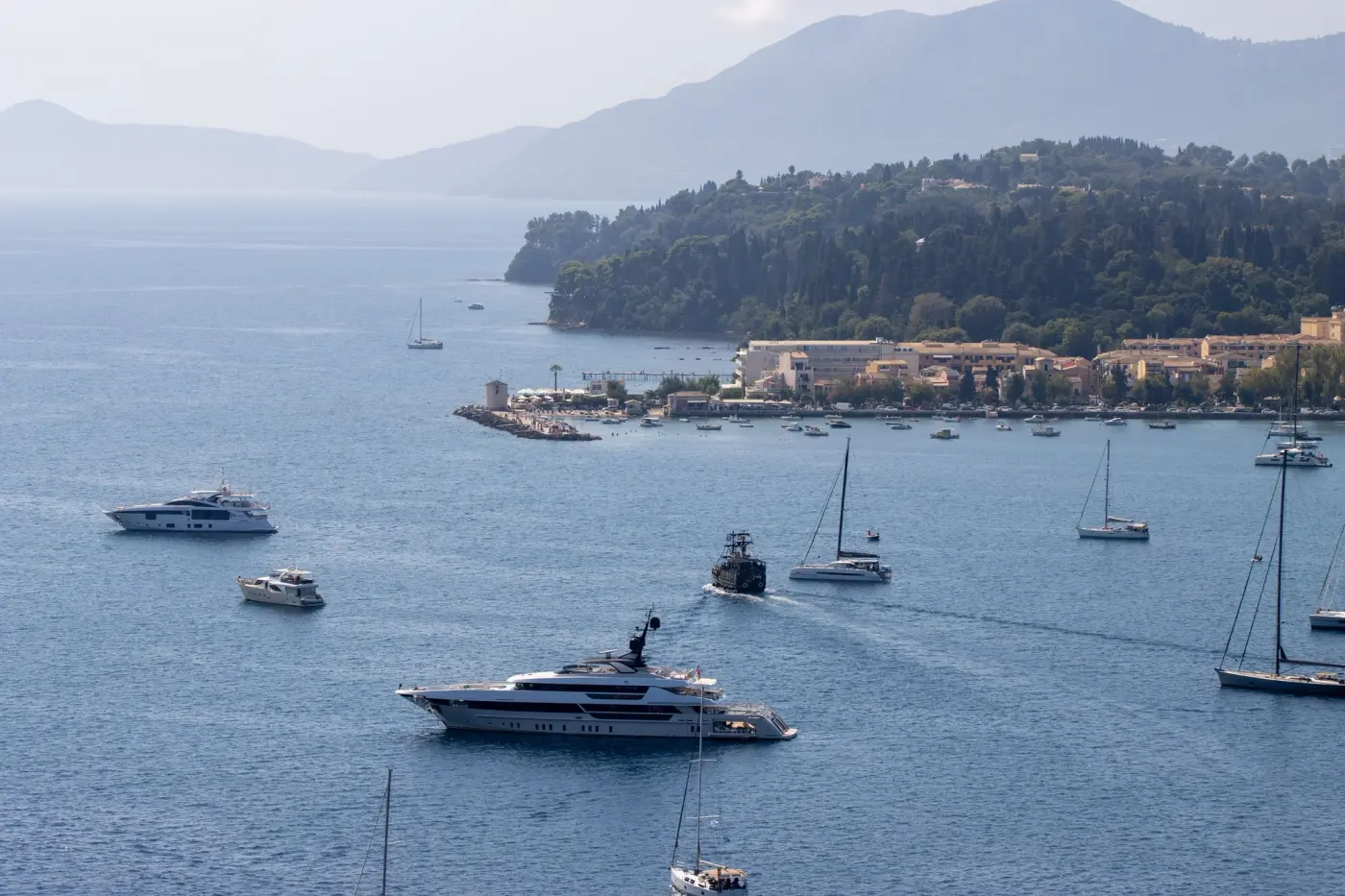
People write to me with the phrase "yachting in Greece" more often than with any yacht name, and I have learned to read it as a question rather than a plan. What they mean is: we want a week on the water among the islands, with someone else running the boat, and we do not yet know what that costs, where it happens, or who to ask. This page answers those three things in the order a careful family asks them, with the numbers I use at my own desk and nothing invented to fill a gap.
What does yachting in Greece actually mean for a family that charters?
For the families who write to me, yachting in Greece means one yacht, one week, one crew, and a route that changes with the wind and your mood. You do not rent a boat and drive it. You take a fully crewed yacht with a captain, a chef and a hostess or deckhand, you tell them how you like to live, and the week is run around you. The price is set per yacht and per week, never per head, and it is the same whether you fill every cabin or leave one empty. I have written a longer piece on what a crewed luxury yacht charter is, and another on the shape of a private yacht cruise in Greece; this page is the view from above, the one you need before either of those.
The Greek rule that shapes everything else is simple: a charter yacht carries at most twelve guests, by law, however large she is. That is why the market is built around families and two or three couples rather than parties of thirty, and why a 20 metre catamaran and a 45 metre motor yacht can both be the right boat for the same ten people. The twelve passenger rule is worth reading once, because it decides which boats are even on the table.
Which Greek waters does a crewed yacht actually cruise?
Three cruising grounds carry almost every week I arrange, and two of them begin in Athens. The Saronic Gulf is the water on the capital's doorstep: Aegina 18 nautical miles from the Alimos marina, Poros 25, Hydra 35, Spetses 50. It is sheltered, short-hop sailing, with the Peloponnese on one side and the islands on the other, and it is where I send a family with small children or a first week at sea. The Cyclades are the postcard, and the open water: Kea 35 miles from Athens, Kythnos 45, then Serifos, Sifnos, Milos, Paros and the rest, with Mykonos 90 miles out and best reached by a faster boat. I have written the islands up one by one in the Cyclades, explained. The Ionian, on the western side, is a different sea: green, calm, with afternoon breezes rather than the Meltemi, and its own departure ports in Corfu and Lefkada. Corfu to Paxos is 35 miles, Paxos to Lefkada 50, Lefkada to Ithaca 20, and the whole thing reads in the Ionian, explained.
I keep the boats I represent in these three grounds, and in Athens as the base, because they are where a crewed week works best, with short legs, real anchorages and a port within reach when the forecast says so. Every distance above is from the same table I use for routing, the sailing distance calculator.
When is the yachting season in Greece, and what does the Meltemi do to it?
The season runs from late April to late October, and the Meltemi, the dry northerly of the Aegean, is the single fact that organises it. In early June it is light, 10 to 18 knots. Through July it blows 18 to 25 knots on most afternoons, with a handful of days above 30. The first three weeks of August are its peak, 20 to 30 knots most afternoons. From late August into mid September it softens to 15 to 20 knots, and the weeks after that are calmer still. It builds from mid morning, peaks between two and seven in the afternoon, and drops by 8 to 10 knots after midnight, which is why a Cyclades captain moves early and anchors by lunch. All of that is on the Meltemi guide, with the month-by-month on the weather page.
What it means for you: June and September are the months I recommend to most families, with warm sea, light wind and islands that are not full. July and August are the Meltemi months, which a good captain reads as a routing problem rather than a reason to stay in port, and which push many of my clients towards the Ionian or the Saronic, where the northerly barely reaches. May and October are quieter and cheaper and perfectly good for a motor yacht or a well-run catamaran, with the honest caveat that the sea is cooler and an evening on deck wants a sweater.
What kinds of yacht can you charter in Greece, and where does each start?
The boats I represent fall into four families, and the floor of each is a real rate card, not a marketing number. A fully crewed sailing catamaran starts at EUR 17,000 a week at 15 metres for eight to ten guests, and runs to EUR 90,000 at 24 metres; the crewed catamaran page is the long version. A power catamaran, the same wide platform with engines instead of sails, starts at EUR 21,000 at 16 metres and also tops out at EUR 90,000; see power catamaran charter. A crewed motor yacht starts at EUR 17,500 at 20 metres and climbs to EUR 150,000 at 39 metres, with the two yachts above 50 metres at EUR 162,500 to 235,000; the weekly motor yacht page explains what the speed buys. A crewed sailing monohull, the purist's week, starts at EUR 24,000 at 24 metres, and lives on the sailing yacht charter page.
Those figures come from the ninety-six rate cards behind the Greek Charter Index, which I rebuild every autumn as the new season's cards open; ninety-one of those yachts have a page on this site, and sixty-six of them a walkthrough video filmed aboard. If you want the whole market on one page, that is the page.
What does a week of yachting in Greece cost, all in?
The number on the rate card is the base, per yacht and per week. Three things sit on top of it, and I set each out separately in every proposal before anything is signed. The Advance Provisioning Allowance is the running budget of the week: fuel, food, drink, berthing and port fees, settled against receipts at the end. On the boats I represent it runs 20 to 30 percent of the base on a sailing yacht, 25 to 35 on a catamaran, 30 to 40 on a motor yacht; the APA glossary entry explains how the captain accounts for it. Greek charter VAT is charged at the rate each yacht is certified for, from 5.2 to 12 percent, with a statutory ceiling of 13 percent; a short charter or a bareboat pays 24. The rate is the yacht's, not the broker's, which is why two boats in the same proposal can show two different percentages, and the Greek VAT entry has the current sheet. The crew gratuity is 10 to 15 percent of the base, at your discretion, handed to the captain on the last evening; the gratuity guide gives the worked examples.
Put together, the all-in week on a sailing yacht or catamaran lands at roughly 1.35 to 1.6 times the base, and on a motor yacht at 1.45 to 1.7 times, the fuel being the difference. So the EUR 17,000 catamaran is a week of around EUR 23,000 to 27,000 all in for eight people, and a EUR 45,000 motor yacht a week of around EUR 65,000 to 76,000 for ten. I have written the full anatomy of a EUR 50,000 week and of a week from Athens if you want the lines itemised. Nothing on any of these figures is charged per head.
What is included in the base, and what is not?
Included: the yacht, her crew, their wages and food, the insurance, the water toys on her list, the tender, bed linen and towels, and the use of everything aboard. Not included: the APA, the VAT and the gratuity above, your flights and transfers to the embarkation port, and anything you ask for beyond the boat's own list, which can usually be arranged and is always priced first. There is no resort fee, no service charge and no surprise on the last morning; the captain shows you the APA accounts and returns what was not spent.
How does a crewed charter week in Greece actually run?
You embark in the early afternoon, on any day of the week you choose; there is no Saturday-to-Saturday rule on the yachts I represent. The captain walks you through the boat and the week's intentions, the chef has your preference sheet and has already provisioned around it, and you are at anchor for your first swim before the sun is low. The days after that have a rhythm: a short morning leg while the wind is still asleep, an anchorage for lunch and the afternoon, a harbour or a quiet bay for the night. Twenty to forty miles is a full day in the Cyclades; in the Saronic and the Ionian the legs are shorter still. The itinerary is agreed with the captain a week before you fly, when the forecast is reliable, and he keeps the right to change it on the day, because the sea has the last word and his judgement is what keeps a family safe. How to charter a yacht in Greece, step by step walks the whole process from first email to disembarkation.
Is a yacht trip in Greece possible for less than a week?
My house is a weekly house, and the honest reason is the crew: a good crew is provisioned, briefed and paid for a week, and the short charters that exist on the market tend to be the boats that could not sell the week. The shortest I arrange is a five-night Saronic week, which still carries the full crew and the full table. Day trips and three-night runs exist elsewhere and pay 24 percent VAT rather than the certified weekly rate; they are a different product and I do not pretend to be good at them. If your dates give you five to seven nights, you are in the right place.
Who arranges a Greek yacht charter, and who should you contact?
A charter broker arranges it: I represent you, not the owner, and I am paid by the owner's side under the standard MYBA agreement, so my advice costs you nothing and my loyalty is to your week. I am George P. Biniaris, Founder and Managing Broker of George Yachts Brokerage House, a Wyoming LLC with the brokerage work done from Athens, where I am a licensed sailing skipper trained at the Olympiacos SFP Sailing Academy, with a powerboat licence valid to 25 metres. The house is listed as an IYBA Charter Active Member; the association keeps a public directory, and I would rather you checked it than took my word, which is why I wrote how to verify a yacht charter broker. What you get from me in writing, usually the same day, is the base fee, the yacht's own VAT rate, the APA and the gratuity range, laid out separately, with the yacht's page and video so you can see what you are buying. The credentials page has the rest, and the contact page is where a week begins.
How far ahead should you book a yacht in Greece for 2027?
For a peak summer week, nine to fourteen months ahead, which means the autumn and winter of 2026 for July and August 2027. June and late September need six to nine months; May and October still offer real choice at three to four. The five and six cabin yachts go first, because a family of ten has fewer boats to choose from than a party of six. The contract, a MYBA charter agreement, commits 50 percent of the charter fee on signing, with the balance, the VAT and the APA due forty-five days before embarkation. I keep the lead times by month in how far in advance to book, and Americans, who are most of my clients, will find the flights, the passports and the time zones in the American's guide.
When is yachting in Greece the wrong idea?
When you want to be in Mykonos, Santorini and Corfu in the same week; they are in two different seas, and a week that tries to touch all three is a delivery, not a holiday. When anyone in the party is badly seasick and you plan the Cyclades in August; take the Ionian, or a motor yacht in the Saronic, or September. When you want a hotel's anonymity; a crew of three lives with you, discreetly, and that is the point. And when the budget is below the floor: a crewed week in Greece starts at EUR 17,000 base and around EUR 23,000 all in, and below that the honest answer is a bareboat, which is another sport and one I do not sell.
Three boats that explain the market
Three yachts from my own list stand for the three tiers most families land on, each with her rate on her page. S/CAT Libra, a 2024 Bali Catspace 55, takes ten guests in five cabins with a crew of three at EUR 18,900 to 26,900 a week: the entry to the crewed market, and a very good one. M/Y ONE, a 27 metre Pershing 90 refitted in 2024, takes ten in four cabins with a crew of four at EUR 45,000 to 49,000 a week and makes Mykonos from Athens a morning rather than a day. S/CAT Genny, a 2021 Sunreef 80, takes ten in five cabins with a crew of six at EUR 56,000 to 79,000 a week, and is what the word "luxury" means on a catamaran. Between the first and the last sits the boat I send most often to a family of eight.
If you have read this far, you know more about yachting in Greece than most people who have already booked. The next step is a short message with your dates, your party and what a good week looks like to you, and I will answer with three boats and the real numbers. The crewed yacht charter page is the long form of everything above; the contact page is the short one.


