
The question arrives in my inbox in the same words every week, usually from an American family who has just read a rate card for the first time: what exactly is included in a crewed catamaran charter in Greece? The card says EUR 17,000 to 22,000 a week, plus expenses, VAT and APA, and the reader is not sure whether that buys a boat, a holiday, or a boat with a holiday still to be paid for.
Here is the full list, line by line, from the 44 crewed catamarans this house represents in Athens and Corfu and from the contract they are all chartered under. I am George P. Biniaris, Founder and Managing Broker of George Yachts Brokerage House, an IYBA Charter Active Member working to MYBA standard terms, and I have written the proposal for enough of these weeks to know which line surprises people. Nothing below is invented; where a figure is an estimate I say so.
What does the base charter fee of a catamaran actually cover?
The base fee, the number on the card, buys three things: the yacht herself with all her equipment, the crew's wages and the crew's own food, and the yacht's insurance. On the MYBA form agreement that governs every crewed week this house writes, that is the whole of it, and it is a lot.
The yacht means the catamaran as listed: the cabins, the saloon, the flybridge, the air conditioning, the generator, the water maker where the card states one, the tender and every water toy named on the listing. The crew means the captain, the chef and whoever else the card names, on duty from the moment you step aboard at 17:00 on day one until you step off at 09:00 on day eight, fed and paid by the owner, not by you. The insurance means the hull and third party cover that lets you sleep.
What the base fee does not buy is anything you consume: the diesel, the food on your plate, the wine, the night in a marina. That is the second account, and it is the one that confuses people, so it gets its own chapter below.
What equipment and water toys come with the catamaran?
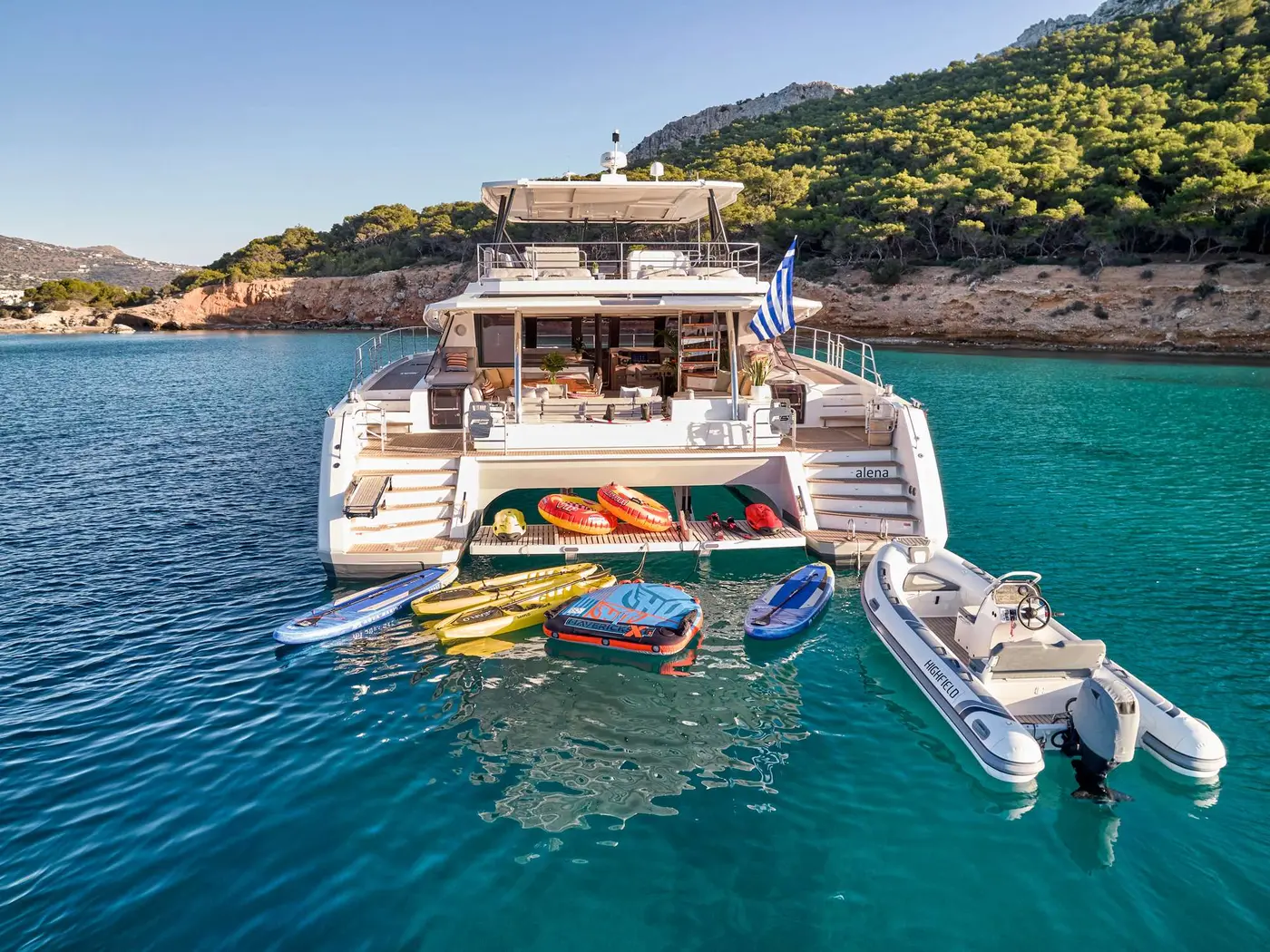
More than most first time charterers expect, and it is written on each card rather than promised in general. I counted across the 44 crewed catamarans on our list this week, and the numbers are these: 43 carry a tender with an outboard, 43 carry snorkelling gear, 42 carry stand up paddleboards, 36 water skis, 35 kayaks, 33 a wakeboard, 30 a Seabob, 19 a Jacuzzi on deck, 8 a jet ski and 5 an e-foil. Thirty state full air conditioning on the listing and 29 state Wi-Fi; most of the rest have both and simply did not write it down, which is exactly why I confirm every line with the owner before a yacht goes on your shortlist.
A concrete card, so the list is not abstract. ALENA, a 2023 Fountaine Pajot Power 67 at Alimos, lists a tender with outboard, Seabob underwater scooters, two paddleboards, two person kayaks, a wakeboard, water skis in adult and children's sizes, towable tubes, floating mats, eight sets of snorkelling gear and fishing equipment, plus a foredeck Jacuzzi, a 36 square metre aft cockpit with a plancha grill and a hydraulic swim platform. All of that is inside her EUR 34,000 to 48,000 base. Her sister ELLY adds a four by four metre inflatable sea pool with a net floor and a home cinema projector; ARIVA at Corfu carries a netted floating pool three metres across for small children.
Two honest notes. A Seabob is on 30 cards out of 44, so on the other 14 it is either absent or an extra charge: ask. And linen, towels, bathrobes and the hotel pack are standard on the crewed catamarans, but a yacht that lists them is making a promise and a yacht that does not is not.
Who is the crew, and is their pay and food included?
Yes, both, inside the base fee. The crew of a crewed catamaran in Greece is two to six people; across our 44 cards, 18 sail with three, 14 with four, 9 with five, two with two and one with six. Three is the shape I recommend most: a captain, a chef, and a stewardess or deckhand, so that the person cooking is not also the person handling lines. BABALU, a 2024 Lagoon 51 at EUR 17,000 to 22,000, carries a captain, a cook and a hostess in their own quarters, and at that size the third person changes the week more than anything on the specification sheet.
The chef is the line most Americans underestimate. On ALENA the chef took 1st Place Diamond in the chef competition at the EMMYS 2026, the Greek charter show; on KIMATA the chef trained at Le Monde in Athens. Three meals a day cooked aboard from your preference sheet are part of the service; the ingredients are part of the APA. The crew roles piece explains who does what hour by hour.
What does the APA pay for, and how much is it?
The APA, the Advance Provisioning Allowance, is your own money, held aboard for your own consumption during the week: fuel for the catamaran and for the tender and toys, all food and drink for your party, marina berths and port fees, water and electricity taken from shore, and anything else you ask the crew to buy. On a crewed catamaran it runs about 25 to 35 percent of the base fee, at the lower end of the industry's band because a catamaran at eight knots burns little diesel, so the account is mostly provisioning and berths. On a power catamaran that cruises at 15 or 16 knots the figure sits toward the top of that band.
The mechanics matter: the APA is paid before you board, the captain keeps a running account through the week, and at the end whatever you have not spent is refunded to you against receipts. Spend more, and you settle the difference aboard. A week at anchor with modest wine returns money; a week of marinas and Champagne does not. The full APA explainer has the arithmetic.
Is VAT included in a catamaran charter in Greece?
No, it is added, and the rate depends on the yacht, not on you. Greek charter VAT runs at 5.2, 6.5, 7.8 or 12 percent depending on each yacht's certification, with a statutory ceiling of 13 percent; short and bareboat charters carry 24 percent, which is one reason a crewed week is the better structure. Two real cards: ELLY at Flisvos is certified at 6.5 percent and ARIVA at Corfu at 12 percent, both stated on the listing. The VAT guide goes line by line, and every proposal this house sends shows the rate for each yacht as its own line.
What is not included at all?
Six things, and I would rather you read them here than discover them in June.
- The crew gratuity, customarily 10 to 15 percent of the base fee, at your discretion, given to the captain in cash at the end of the week for the crew to share. It is never inside an all in figure. The gratuity guide covers the custom.
- Flights and transfers. The airport to Alimos is about 25 minutes by road; the piece on a week from Athens covers the marinas and the boarding times.
- Shore excursions: a guide on Delos, a car on Milos, a table at a taverna ashore. The chef can take the evening off whenever you eat ashore, and the saving stays in your APA.
- Personal laundry ashore, spa treatments and anything the crew buys for you that is not provisioning.
- A relocation fee when you ask a catamaran to begin or end away from her home port. Most of our list is based at Alimos in Athens; a week starting in Mykonos on an Athens boat carries a delivery charge that is stated in the proposal before you decide.
- Premium labels. Standard wine, beer and spirits come out of the APA; a case of Champagne is also paid from the APA, just faster.
Is food included on a crewed catamaran in Greece?
The cooking is included and the ingredients are not, which sounds like a lawyer's answer until you see how it works. The chef cooks breakfast, lunch and dinner aboard from the preference sheet you fill in before the charter: allergies, the children's breakfast, the wine you drink at home, the one thing somebody will not eat. The shopping is done from the APA, so a family that eats simply pays less than a family that wants lobster twice. Full board aboard is the norm; evenings ashore are your choice and your bill. What to pack covers the rest of the preference sheet.
Can you charter a catamaran by the cabin?
Not through this house, and I would be careful of anyone who offers it on a crewed catamaran in Greek waters. The yachts on our list are chartered whole, one price per yacht per week for whoever boards, divided among your party however you choose. A 4 cabin catamaran is eight guests in four en suite doubles; a 5 cabin one is ten, and on the 51 foot Lagoons the fifth cabin shares a bathroom, which is why I give it to the children. Greek law also caps a charter yacht at 12 guests, the 12 passenger rule, so a party of fourteen is two catamarans sailing together, not one.
How many days do you need for a catamaran charter in Greece?
Seven nights is the standard week and the one the owners price; five nights in the Saronic Gulf is the shortest programme this house writes, and it is a complete holiday because Aegina is 18 nautical miles from Alimos, Hydra 35 and Spetses 50. Seven nights covers the Saronic with time to spare, or the western Cyclades from Lavrion with Kea, Kythnos, Serifos, Sifnos and Milos. Ten nights is the honest number for a Cyclades week on a sailing catamaran that wants Santorini in it, because Santorini is 130 nautical miles from Athens and a catamaran at eight knots turns that into two days each way. For a seven night week with Santorini, take a power catamaran or a motor yacht; the Cyclades piece and the catamaran comparison explain the trade.
What does it add up to? Three real cards, all in
All in means base plus APA plus VAT, before the gratuity. The brackets below use the catamaran APA band of 25 to 35 percent and the certified VAT range of 5.2 to 12 percent, so they are estimates built from published numbers rather than quotes; the exact figure for a given yacht and week is on the proposal.
- BABALU, Lagoon 51 launched 2024, four cabins for eight, a crew of three, Alimos: EUR 17,000 to 22,000 base, roughly EUR 22,000 to 32,000 all in. The floor of a crewed catamaran week in Greece.
- KIMATA, Fountaine Pajot Alegria 67 from 2021, four cabins for eight, a crew of three, 3rd Place Diamond at the EMMYS 2024: EUR 31,500 to 42,500 base, roughly EUR 41,000 to 62,000 all in.
- ALENA, Fountaine Pajot Power 67 from 2023 on solar and lithium, four cabins for eight, a crew of three, 15 knots: EUR 34,000 to 48,000 base, roughly EUR 44,000 to 71,000 all in. The power catamaran that makes the Cyclades a week rather than a passage.
The complete cost breakdown walks through every line for every yacht type, and the Charter Index has every card. If what you want is one fixed figure agreed at booking with the running costs folded in, that exists on a smaller list of yachts and is explained on the all inclusive page.
When is a crewed catamaran not the right choice?
Three cases. If your week is long on miles, Athens to Santorini and back in seven nights, a catamaran at eight knots will spend two of them under way; a power catamaran at 15 or a motor yacht at 20 to 25 knots changes the arithmetic, and I say so in the proposal. If your party is more than twelve, the law gives you two yachts, not a bigger one. And if what you want is the volume and crew of a 30 metre motor yacht, with six cabins and seven crew, the four couples price ladder shows where that money starts.
How to read the next rate card you see
Look for four lines before you look at the yacht's photographs: the base fee and whether it says plus expenses, the APA percentage, the VAT rate as certified for that hull, and the home port. Then look for the toys that matter to your family on the listing itself, not in the brochure's adjectives. A good house sends you that card with all four lines filled in and the all in figure beside it, usually within the day; the piece on comparing charter houses says what else to check. Send me the week, the party and whether you think in base or all in, and you will have three catamarans with every line above on one page.


